

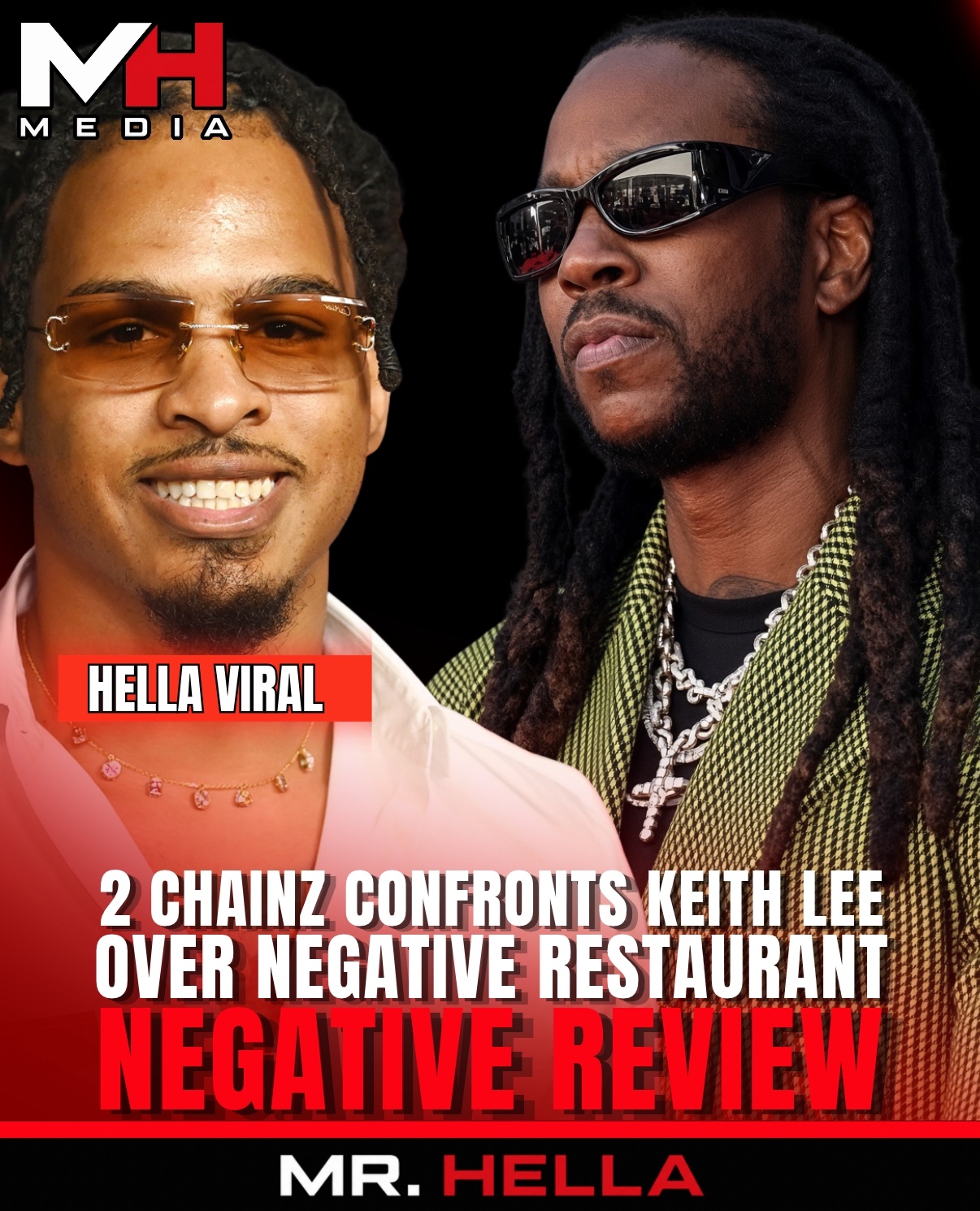
2 Chainz Confronts Keith Lee Over Negative Restaurant Review, Sparking Debate About Black-Owned Businesses
MR. HELLA MEDIA | LATEST | NOVEMBER 2, 2026
Rapper and entrepreneur 2 Chainz has addressed viral food critic Keith Lee over an unfavorable review of Esco Restaurant & Tapas, a business associated with the Atlanta hip-hop star. The two sat down for a conversation on Den of Kings, where their disagreement opened a larger discussion about celebrity treatment, restaurant criticism and the responsibilities that come with reviewing Black-owned establishments.
The exchange brought together two influential figures whose careers have developed in different corners of entertainment and business. While 2 Chainz has expanded his career beyond music through investments in restaurants and other ventures, Lee has built an enormous social media audience by sharing candid food reviews that can significantly influence a restaurant’s reputation.
At the center of their disagreement was a question that has followed Lee throughout his rise as a food critic: Should a reviewer consider the potential consequences for a business before publishing a negative opinion, particularly when the establishment is Black-owned?
For 2 Chainz, the conversation was personal because the criticism involved a restaurant connected to his business interests. For Lee, the issue concerned his responsibility to the people who rely on his reviews to decide where to spend their money.
2 Chainz Brings Up Keith Lee’s Negative Review of His Restaurant
During the discussion on Den of Kings, the roundtable series hosted by gospel artist Kirk Franklin, 2 Chainz addressed Lee’s previous review of Esco Restaurant & Tapas, the Atlanta restaurant concept he co-founded.
The rapper made it clear that he had seen the review and was aware of Lee’s criticism. However, he initially acknowledged that restaurant reviews are subjective and that Lee had the right to express his own experience.
“I saw you do my restaurant. I saw you do other people’s restaurants,” 2 Chainz said. “And I really can’t judge it because it’s your opinion.”
The conversation then expanded beyond the specific restaurant, with 2 Chainz emphasizing Atlanta’s importance as a center for Black entrepreneurship. He described the city as a place where Black business owners have built significant opportunities and suggested that those efforts deserve recognition.
His comments raised a difficult question about the relationship between supporting Black-owned businesses and holding those same businesses accountable for the quality of their food and customer service.
Lee, however, maintained that his reviews are intended to help customers make informed decisions, not to undermine the businesses he visits.
Keith Lee Explains Why He Reviews Restaurants Like an Everyday Customer
One of the most revealing parts of the discussion came when Lee explained why he often tries to experience restaurants without immediately revealing his identity.
According to Lee, celebrity recognition can dramatically change the service someone receives, making it difficult to determine how an ordinary customer would be treated.
He referenced the famous people participating in the conversation, including 2 Chainz, comedian Desi Banks, comedian Mojo Brookzz and Kirk Franklin, explaining that recognizable personalities frequently receive privileges unavailable to the general public.
Lee argued that the difference matters because the people watching his reviews are typically not celebrities. They are everyday customers who may travel across cities or states and spend their own money based on his recommendations.
To illustrate his point, Lee recalled sending his mother-in-law into several Atlanta restaurants before entering himself.
“I sent my mom-in-law into 10 different restaurants. She couldn’t eat nowhere,” Lee said, describing difficulties obtaining service.
According to his account, the situation changed once he arrived and restaurant employees recognized him.
“I go in, table ready right now,” he explained.
Lee used the example to argue that a restaurant’s service should not depend on whether the customer has millions of social media followers.
His account reflects his personal experience, rather than an independently verified assessment of all ten establishments.
2 Chainz Defends Special Treatment for Celebrities
Although 2 Chainz acknowledged Lee’s right to review restaurants, he disagreed with the suggestion that celebrity privileges were necessarily inappropriate.
The rapper argued that entertainers often receive special treatment because they have spent years building successful careers.
“I’m an entertainer and obviously we get perks that other people don’t get,” 2 Chainz said.
He pointed to his own experiences traveling, explaining that his celebrity status allows him to avoid certain inconveniences, including waiting in airport lines.
For 2 Chainz, those privileges represent some of the benefits of achieving success after years of work.
His argument was not that restaurants should deliberately mistreat ordinary customers. Rather, he appeared to view preferential treatment for recognizable public figures as an established part of celebrity life.
Lee approached the question from a different perspective.
He was not primarily concerned with whether 2 Chainz or another celebrity should receive VIP service. His concern was whether the special treatment would produce a misleading impression of what a restaurant normally offers.
That distinction became the central disagreement between the two men.
A restaurant might provide exceptional service to a celebrity while offering a very different experience to customers who arrive without a recognizable name or large online audience.
For Lee, that difference can determine whether a positive review accurately reflects the experience his followers are likely to receive.
Keith Lee Says His Recommendations Can Cost Followers Real Money
Lee also explained that his influence comes with a responsibility to the people who trust his opinions.
The former mixed martial arts fighter has built a substantial following through food reviews that often focus on small businesses and independently owned restaurants.
His videos typically feature detailed assessments of food, service and overall customer experience.
Positive reviews can bring enormous attention to businesses that previously struggled to attract customers, a phenomenon widely described as the “Keith Lee Effect.”
However, that influence also means his recommendations can affect how people spend their money.
Lee emphasized that some followers travel considerable distances to visit restaurants he recommends, making it especially important that his reviews reflect what ordinary customers can reasonably expect.
“I don’t ever want to put nobody in a situation that they get a different experience only because they not Keith Lee,” he said.
His position suggests that a review should be based on more than whether the restaurant prepares an excellent meal for a famous guest.
Customer service, accessibility, consistency and the treatment of people who are not celebrities are all part of the experience.
The discussion also raised questions about how restaurants handle the arrival of high-profile influencers, particularly when owners understand that a favorable review could produce significant publicity.
2 Chainz Questions Whether Keith Lee’s MMA Background Affects His Taste
The conversation eventually moved from restaurant service to Lee’s qualifications as a food reviewer.
2 Chainz questioned whether Lee’s background as a professional mixed martial arts fighter could influence his food preferences.
Athletes competing in weight-class sports often follow strict nutritional plans and manage their weight before competitions. The rapper suggested that those experiences might have shaped Lee’s relationship with food differently from the average restaurant customer.
Lee rejected the idea that his athletic background made him less qualified to evaluate meals.
Instead, he explained that training as a professional fighter helped him develop a deeper understanding of nutrition, ingredients and food preparation.
He described learning about food through his athletic career and becoming increasingly interested in cooking for his family.
Lee also discussed preparing meals for his wife during her pregnancy, explaining that cooking became an important part of his personal life.
His response challenged the assumption that a background in competitive sports necessarily limits someone’s appreciation of food.
The exchange also highlighted the subjective nature of restaurant criticism. Individual preferences, dietary restrictions and personal experiences can influence how someone evaluates a meal.
Lee’s argument was that those differences do not prevent him from sharing his opinion, particularly when restaurants invite him to review their establishments.
Keith Lee Pushes Back Against Restaurant Owners Who Invite Him and Then Disagree With His Reviews
One of Lee’s strongest responses concerned the expectations restaurant owners sometimes have when inviting him to visit.
The influencer explained that businesses frequently contact him hoping to receive exposure through his platform.
However, he argued that an invitation does not guarantee a favorable review.
Lee questioned why some restaurant owners seek his opinion but become upset when his assessment is less positive than they anticipated.
“You ask me to come get my opinion, but then you get upset because my opinion not what you wanted to hear,” he said.
His comments underscored the difference between a paid promotional endorsement and an independent review.
A business seeking honest feedback must accept the possibility that a reviewer will identify shortcomings, even when the restaurant’s owners have invested significant time and money into building the establishment.
The discussion also emphasized the importance of maintaining trust with an audience.
If viewers begin to believe that Lee provides favorable reviews simply because a restaurant is celebrity-owned or Black-owned, his recommendations could lose the credibility that made his platform influential.
At the same time, restaurant owners may feel that a negative review from a highly visible influencer can have consequences disproportionate to a single customer’s experience.
Neither concern automatically invalidates the other, which helps explain why the discussion has attracted so much attention.
Atlanta’s Restaurant Culture Has Faced Similar Criticism Before
The exchange also revisited an ongoing debate surrounding Atlanta’s restaurant scene.
In 2023, Lee attracted widespread attention during a visit to Atlanta when he documented difficulties with service and restaurant policies at several establishments.
His reviews generated discussions about reservations, takeout restrictions, customer treatment and the increasingly nightlife-oriented atmosphere at some popular dining locations.
Several of the establishments involved were Black-owned, leading to disagreements about whether Lee’s criticism was unfairly damaging businesses or exposing problems that ordinary customers had already experienced.
The controversy helped establish Atlanta as one of the most closely discussed stops on Lee’s nationwide food-review journey.
For some viewers, the reviews highlighted longstanding frustrations with restaurants that appeared to prioritize atmosphere, celebrity clientele and social media popularity over consistent customer service.
Others expressed concern about the influence a single content creator could have over the reputation of an independently owned business.
The conversation with 2 Chainz reflects many of those same concerns, particularly the tension between promoting Black entrepreneurship and demanding accountability from businesses serving the public.
Esco Restaurant & Tapas Is Part of 2 Chainz’s Business Portfolio
Beyond his recording career, 2 Chainz has established himself as an entrepreneur with interests in hospitality and entertainment.
The Atlanta rapper, whose real name is Tauheed Epps, co-founded the restaurant concept originally known as Escobar Restaurant & Tapas in 2016.
The business later adopted the Esco name and expanded its presence in the Atlanta restaurant market.
The concept combines dining with a lounge-style atmosphere, reflecting the popularity of establishments that offer food, music and nightlife experiences.
For 2 Chainz, the restaurant venture represents part of his broader effort to develop businesses outside the recording industry.
His career includes successful albums, hit singles, collaborations with major artists and television projects such as Most Expensivest, which explored luxury products and experiences.
His involvement in the restaurant industry also means that criticism of Esco carries a different significance than criticism directed at a business with which he has no personal connection.
The exchange with Lee offered an opportunity to address that criticism directly rather than through separate social media statements.
However, the conversation did not establish that Esco has made specific operational changes in response to Lee’s review.
Social Media Reacts to the Celebrity Treatment Debate
Clips from the conversation circulated widely across social media, generating criticism of 2 Chainz’s comments about celebrity privileges.
Some viewers argued that his position failed to address Lee’s central point: ordinary customers should receive dependable service even when they lack celebrity status.
Others emphasized that the two men were approaching the issue from different perspectives, with 2 Chainz discussing the benefits of fame and Lee explaining the standards he uses when recommending restaurants to the public.
The reaction reflects a broader disagreement about how celebrity-owned businesses should operate.
A recognizable owner may help attract customers, but diners ultimately judge a restaurant through the quality of the food, service and overall experience.
Likewise, a food reviewer with a large audience can provide valuable exposure while also drawing significant attention to negative experiences.
The discussion did not end in a physical confrontation or a reported personal feud. Despite their differences, 2 Chainz and Lee continued exchanging perspectives in a conversational setting.
The available reporting also does not establish that either man has announced plans for a follow-up review or a separate public response.
The Debate Raises an Important Question About Supporting Black-Owned Businesses
Perhaps the most significant aspect of the conversation is the question of how criticism should function within communities seeking to build and sustain successful businesses.
Black-owned restaurants can face challenges involving access to capital, operating expenses and competition in crowded hospitality markets.
Supporting those establishments can help strengthen local economies and create opportunities for entrepreneurs.
However, customers also have a legitimate interest in receiving quality food and respectful service, regardless of who owns the business.
Lee’s position is that honest feedback can coexist with a desire to see Black businesses succeed.
2 Chainz, meanwhile, emphasized the work that entrepreneurs have invested in building their establishments and the importance of recognizing Atlanta’s business community.
The disagreement illustrates how support and accountability can sometimes be interpreted differently, particularly when a review reaches millions of potential customers.
It also highlights the changing influence of social media personalities, whose opinions can now carry commercial consequences once associated primarily with established newspapers, television programs and professional restaurant critics.
2 Chainz and Keith Lee Leave the Conversation With Different Perspectives
The discussion on Den of Kings did not produce a clear agreement about celebrity treatment or the responsibilities of food reviewers.
2 Chainz acknowledged that Lee was entitled to his opinion while defending the privileges that often accompany success in entertainment.
Lee maintained that his responsibility is to provide an honest assessment of what ordinary customers can expect, even when the restaurant belongs to a celebrity or another prominent member of the Black business community.
Their exchange has resonated because it raises questions that extend beyond one restaurant in Atlanta.
Should celebrities receive preferential treatment? Should reviewers consider the financial consequences of negative criticism? And how can communities support independently owned businesses while still holding them to consistent standards?
For now, neither man has publicly announced a change in position following the discussion.
What began as 2 Chainz questioning a negative review of Esco Restaurant & Tapas ultimately became a much larger debate about celebrity privilege, honest criticism and whether every paying customer deserves the same level of service.

Comments