

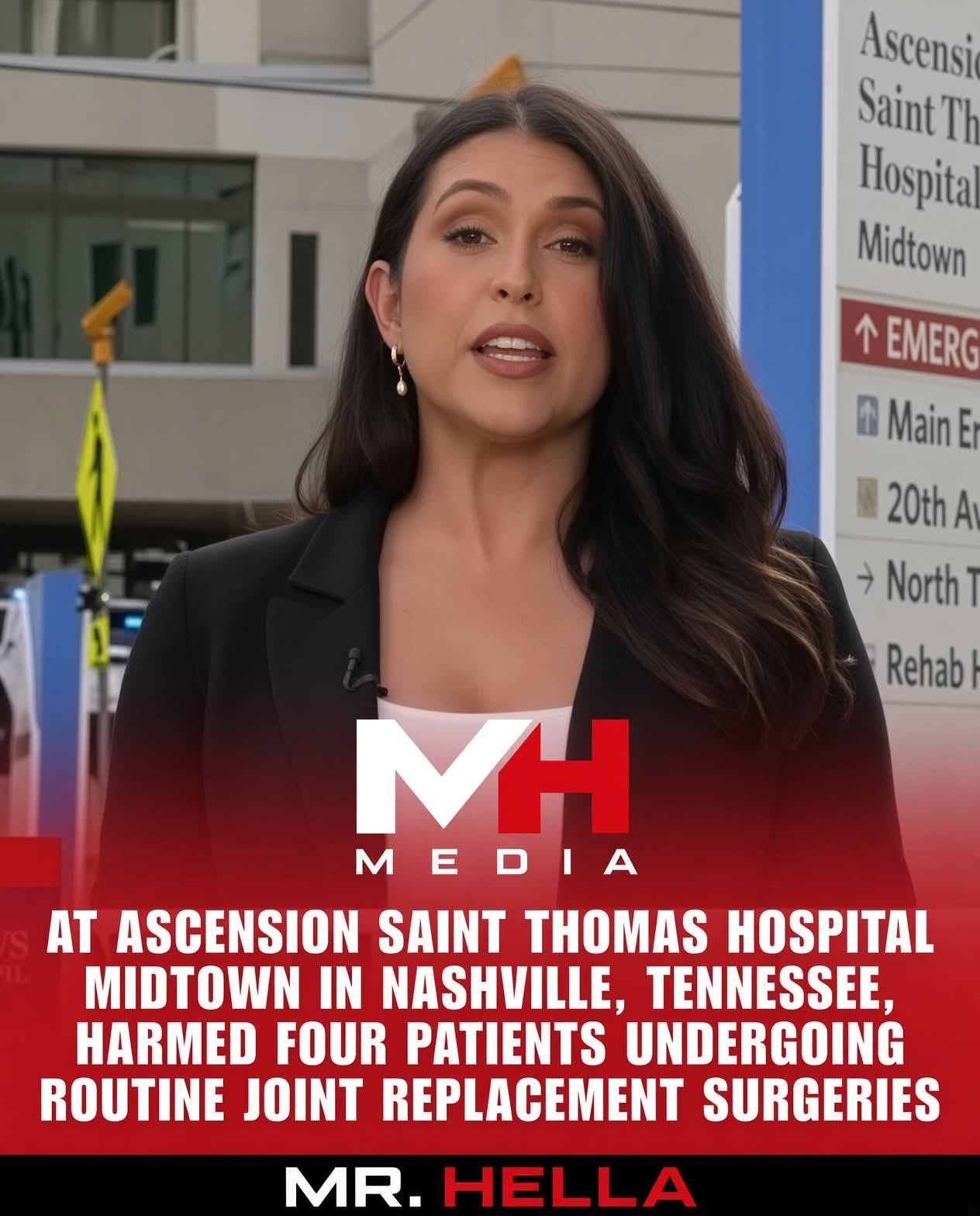
Four patients walked into a Nashville hospital expecting routine joint replacement procedures.
Instead, all four were given the wrong medication near their spines in an extraordinary pharmacy error that resulted in devastating medical complications—including paralysis, neurological damage, cardiac arrest and the need for intensive life-support treatment.
The incident occurred August 14, 2026, at Ascension Saint Thomas Hospital Midtown in Nashville, Tennessee.
The hospital has acknowledged that four joint replacement patients mistakenly received potassium phosphate instead of mepivacaine, the local anesthetic they were supposed to receive.
What initially emerged as reports from frightened family members has since developed into a major patient-safety investigation involving Tennessee regulators, federal authorities and the Tennessee Bureau of Investigation.
And subsequent regulatory findings indicate that the mistake wasn't simply a matter of one incorrect vial reaching one patient.
Multiple safety barriers failed before incorrectly prepared medication reached four people.
Four Patients Went in for Joint Replacement Procedures
August 14 was supposed to be relatively ordinary for the patients involved.
Seven patients were on the hospital's joint replacement surgical schedule that day, according to Ascension.
Four ultimately received the incorrect medication.
Joint replacements—including knee and hip replacements—are common orthopedic procedures, and these patients weren't entering the hospital expecting the type of medical emergency that ultimately unfolded.
The four affected patients were supposed to receive mepivacaine.
Instead, they received potassium phosphate.
Ascension has publicly confirmed the medication error and apologized to the patients and their families.
The Wrong Medication Had Been Prepared by the Pharmacy
The error originated in the hospital pharmacy.
According to the regulatory findings reported following the incident, syringes intended for the joint replacement patients had been prepared before the procedures and were labeled as though they contained mepivacaine.
They actually contained potassium phosphate.
That distinction was catastrophic.
Mepivacaine is a local anesthetic used to temporarily block nerve signals and prevent pain.
Potassium phosphate is an electrolyte medication used for entirely different medical purposes.
The patients therefore weren't simply given the wrong brand of anesthetic or an incorrect dose of a similar drug.
They received a fundamentally different medication through a route where the intended drug was supposed to provide regional anesthesia.
Glenda Dorton Went in for a Knee Replacement
Among the four patients was 72-year-old Glenda Dorton of Centerville, Tennessee.
Dorton was described by her family as active and an avid gardener.
She arrived at Ascension Saint Thomas Midtown for what was expected to be a routine knee replacement.
Her family expected the procedure to improve her mobility and quality of life.
Instead, Dorton's family says she emerged from the procedure unable to move or feel much of her body below her chest.
Her daughter-in-law, Kristina Dorton, later told reporters that the family was informed the wrong medication had come from the pharmacy.
The family has also stressed publicly that they do not blame the surgeon or anesthesiology team for preparing the incorrect medication.
According to the hospital itself, the error occurred in its pharmacy.
Dorton Was Left With T6-Level Paralysis
Dorton's family reported that doctors identified her neurological injury around the T6 level.
The T6 vertebral level is located in the thoracic portion of the spine, roughly around the mid-chest region.
For Dorton, the consequences were life-changing.
Her family reported that she could no longer move or feel below approximately the sternum.
A woman who had gone to the hospital expecting a new knee was suddenly confronting paralysis.
Medical teams attempted emergency interventions after the problem became apparent.
Dorton was eventually transferred for specialized spinal rehabilitation.
By late August, reporting indicated she had been transferred to a Chicago spinal-injury rehabilitation facility for an approximately six-week course of treatment.
Glenda Wasn't the Only Patient Seriously Harmed
As more information emerged, it became clear that the incident extended far beyond one patient.
All four people who received the incorrect medication suffered adverse reactions.
According to findings summarized from the Tennessee regulatory survey, all four required transfer to a higher level of care.
One patient experienced cardiac arrest during surgery.
As of the regulatory survey team's August 21 exit, one patient remained on extracorporeal membrane oxygenation, commonly known as ECMO.
ECMO is an advanced form of life support capable of temporarily performing critical functions normally handled by the heart and lungs.
Three patients were reported to have significant neurological impairment involving their lower extremities, including paralysis and loss of sensation extending from roughly the abdomen downward.
The hospital has generally declined to publicly disclose detailed individual medical information for all four patients, citing patient confidentiality.
Seven Patients Were Scheduled—Four Received the Wrong Medication
Ascension later clarified another important detail.
Seven patients were on the joint replacement surgical schedule that day.
Four received the incorrect medication.
The hospital says a comprehensive review determined that no additional patients were affected.
That means more than half of the patients on that day's joint replacement schedule received the incorrectly prepared medication before the problem was contained.
Ascension has emphasized that the event was isolated to those four patients and that its review found no evidence of the medication error affecting other service lines.
Regulators Examined How This Could Have Happened
The incident immediately raised a fundamental question:
How could an incorrect medication make its way from a hospital pharmacy into multiple patients without being stopped?
Modern hospitals employ layers of medication-safety procedures specifically because a single human mistake should ideally be caught before medication reaches a patient.
Those safeguards can include barcode scanning.
Computerized medication records.
Storage controls.
Pharmacist verification.
Medication labeling.
Independent checks.
Warnings for high-alert medications.
And verification before administration.
The investigation therefore wasn't limited to determining who initially selected the wrong medication.
Regulators examined why the broader system failed to catch the error.
The Syringes Were Mislabeled
One of the most troubling findings involved how the medication reached the surgical area.
According to the state survey findings reported by healthcare publications, the syringes had been prepared the previous day.
They were labeled as mepivacaine.
But they contained potassium phosphate.
That meant healthcare professionals downstream could encounter a syringe whose labeling told them they were handling the intended anesthetic when the contents were actually something entirely different.
That is precisely why medication-preparation safeguards are so important.
Once an incorrectly prepared medication is placed into a correctly labeled container, subsequent clinicians can unknowingly rely on inaccurate information created earlier in the medication chain.
The Incident Triggered an ‘Immediate Jeopardy’ Finding
Federal healthcare regulators use the term “immediate jeopardy” for situations involving serious threats to patient health and safety.
Following the medication incident, Ascension Saint Thomas Midtown faced immediate-jeopardy findings related to multiple Medicare participation requirements, according to reporting on the state survey.
That elevated the event beyond an internal hospital mistake.
It became a significant regulatory patient-safety matter requiring corrective action.
Ascension has said it takes the findings seriously and has continued cooperating with state and federal regulators.
The Tennessee Bureau of Investigation Became Involved
The incident also drew scrutiny from the Tennessee Bureau of Investigation.
The TBI confirmed that it opened an investigation after being notified about the patient-safety event.
That doesn't by itself establish criminal wrongdoing by any individual.
Medication errors can trigger several different forms of review simultaneously, including hospital investigations, licensing inquiries, regulatory enforcement, civil litigation and, in some circumstances, criminal investigation.
The TBI's involvement means authorities are independently examining the circumstances surrounding what happened.
Ascension has said hospital leadership self-reported the medication error to state regulators on August 14—the same day it occurred.
Ascension Publicly Apologized
One week after the incident, Ascension Saint Thomas issued a public statement acknowledging the medication error.
The health system extended what it described as its deepest apologies for the harm caused.
It confirmed that the four patients mistakenly received potassium phosphate rather than mepivacaine and said all four experienced adverse health reactions.
Ascension also said clinical teams continued supporting the affected patients and their families.
The hospital maintained that a comprehensive review found no additional affected patients.
The Hospital Changed Its Medication Procedures
Ascension has announced several specific safeguards implemented after the incident.
High-alert medications are now being stored in separate, distinctly marked locations.
The hospital implemented a mandatory hard-stop and escalation process when a spinal medication generates a scanning alert.
That means an alert shouldn't simply be bypassed without additional verification.
The hospital also introduced independent dual verification for spinal medications.
A second trained pharmacist must now perform final visual and physical checks as part of the workflow.
Ascension has additionally brought in independent outside experts to review and help guide its corrective plans.
Why Those Changes Matter
Each new safeguard addresses a different potential point of failure.
Separating medications reduces the possibility of someone accidentally selecting the wrong drug.
A hard-stop on barcode alerts makes it more difficult for a warning to be disregarded.
Independent verification creates another opportunity for a second professional to identify something the first person missed.
Together, the changes reflect a basic principle of patient safety:
A catastrophic medical error shouldn't require every individual in a system to perform perfectly.
The system itself should contain enough safeguards that one mistake is caught before it reaches the patient.
When multiple safeguards fail simultaneously, the consequences can be devastating.
The Hospital Says It Is Working With Federal and State Regulators
The investigation and corrective process did not end in August.
In a September 11 update, Ascension said it remained actively engaged with state and federal regulatory agencies.
The hospital said it was continuing to refine its corrective-action plans in coordination with regulators.
Ascension also said an independent expert had been brought in to review and guide those plans and assist with implementation.
The hospital said it was limiting additional public commentary while the regulatory process continued.
For Glenda Dorton, This Isn't Just a Regulatory Case
Behind the investigation reports, pharmacy procedures and regulatory terminology is a family whose life changed dramatically.
Glenda Dorton went to the hospital for a knee replacement.
Her family expected her to recover from orthopedic surgery.
Instead, she faced paralysis and specialized spinal rehabilitation.
Her story became the public face of an incident affecting four patients.
And it illustrates why medication errors are among the most serious patient-safety events a hospital can experience.
The difference between the correct drug and the incorrect drug can be a matter of one vial.
For a patient, the consequences can last for the rest of their life.
The Incident Raises Questions Far Beyond One Hospital
The Ascension Saint Thomas case has also renewed a broader healthcare discussion about how hospitals respond to medication errors.
One question is individual accountability.
Another is system accountability.
If one employee selects the wrong medication, investigators naturally need to understand why.
But patient-safety experts also examine why other safeguards didn't catch the mistake.
Was the medication stored appropriately?
Did the barcode system produce a warning?
Were warning systems easy to override?
Was an independent pharmacist check required?
Were medications visually similar?
Were staff under time pressure?
Did policies match actual practice?
Those questions matter because simply disciplining one employee doesn't necessarily prevent another employee from making the same mistake under the same conditions.
Medical Errors Are Rarely Just One Moment
Catastrophic medication errors can appear simple when summarized in a headline:
Wrong drug given.
But the actual medication process can involve multiple steps.
Ordering.
Storage.
Selection.
Preparation.
Scanning.
Labeling.
Verification.
Transport.
Administration.
Documentation.
Each stage can either prevent an error or allow it to move one step closer to the patient.
The significance of the Nashville incident lies partly in the fact that the incorrect medication ultimately reached four separate patients.
That has put intense focus on the safeguards that existed before August 14 and the safeguards Ascension says it has implemented since.
Four Routine Procedures Became Medical Emergencies
The contrast is what makes the case particularly disturbing.
These weren't four patients arriving in critical condition.
They were scheduled for joint replacement procedures.
Instead, all four required higher-level medical care after receiving the incorrect medication.
One suffered cardiac arrest.
One required ECMO life support as of the regulatory survey's August 21 exit.
Three had significant neurological impairment at that point.
Glenda Dorton's family publicly described her as paralyzed from approximately the sternum down.
Those outcomes transformed what should have been an ordinary day of elective orthopedic procedures into a major hospital patient-safety investigation.
The Investigation Continues
As of September 2026, Ascension Saint Thomas continues working with regulators over its corrective plans.
The hospital says it has implemented additional physical, technological and clinical safeguards.
Independent experts have been brought in.
State and federal regulators remain involved.
And the Tennessee Bureau of Investigation has examined the circumstances surrounding the incident.
For the four patients and their families, however, the consequences aren't measured primarily through regulatory reports.
They're measured through rehabilitation.
Hospital stays.
Neurological injuries.
Uncertainty about recovery.
And lives that changed after procedures that were supposed to help them.
Four people entered Ascension Saint Thomas Midtown on August 14 expecting joint replacements.
They were supposed to receive mepivacaine.
They received potassium phosphate.
And what happened next has become one of the most serious medication-error cases to emerge from an American hospital in 2026.


Comments