

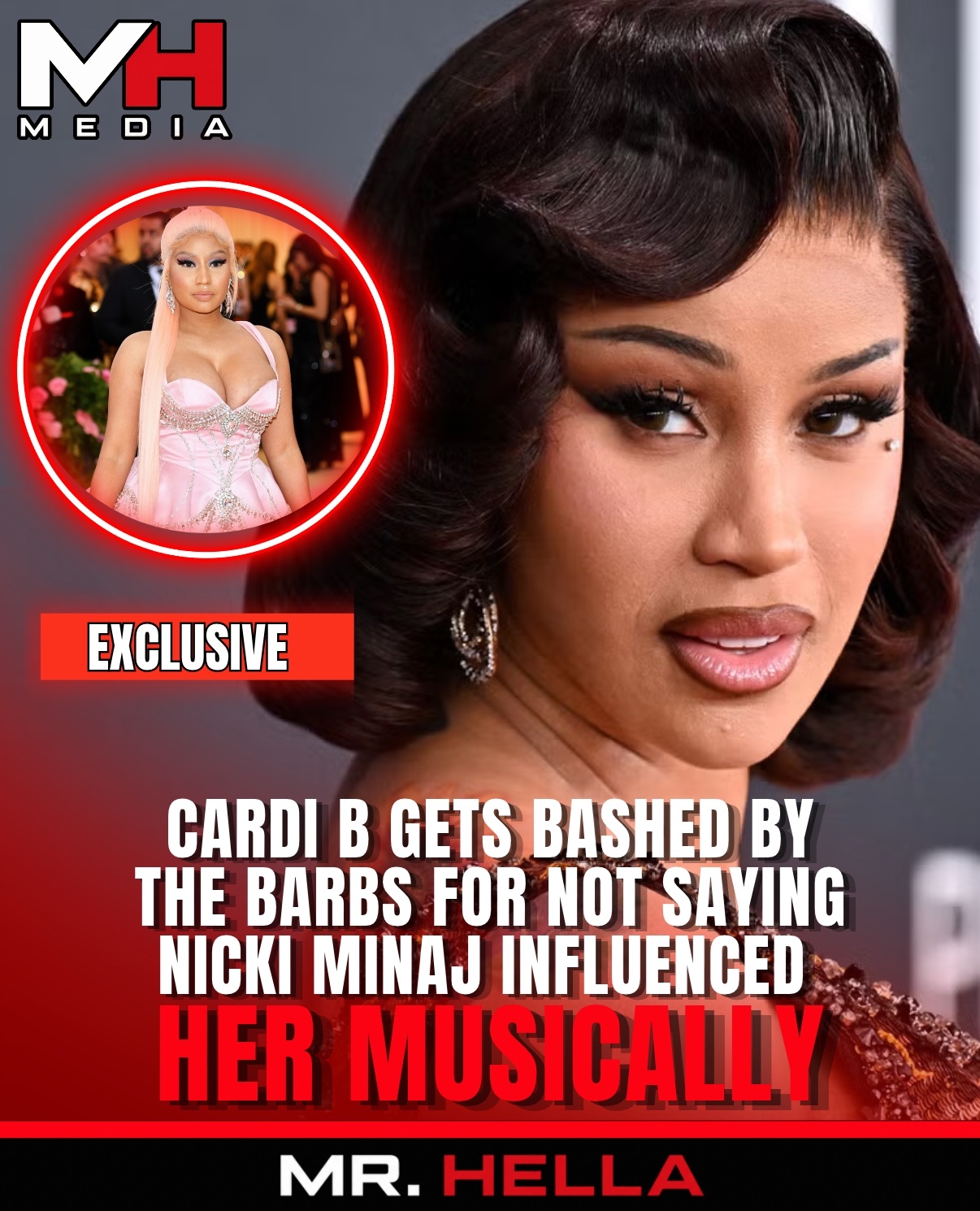
Cardi B Explains Why Nicki Minaj Isn’t One of Her Biggest Influences, Says Her Musical Identity Was Shaped Before Nicki’s Rise
October 23, 2026 | Mr. Hella Media
Cardi B is pushing back against criticism surrounding her musical influences after fans questioned why Nicki Minaj was noticeably absent from a recent discussion about the women who helped shape her career.
The 34-year-old Bronx rapper addressed the controversy during an X Spaces conversation on Wednesday, October 21, following the publication of her profile in T: The New York Times Style Magazine. The interview highlighted several influential women who helped shape Cardi’s musical taste, fashion choices and personality, including Madonna, Lil’ Kim, Foxy Brown and Trina.
However, the absence of Nicki Minaj immediately became a subject of discussion among hip-hop fans, particularly given Minaj’s significant influence on female rap throughout the 2010s.
Cardi responded by explaining that her list reflected the artists she grew up watching and listening to, rather than every successful female rapper whose music she had encountered.
Her comments also reignited discussion surrounding the longstanding rivalry between the two New York rappers.
Cardi B Says Her Biggest Influences Came Before Nicki Minaj’s Breakthrough
During the X Spaces conversation, Cardi explained that her musical identity began developing long before she entered the entertainment industry.
She recalled watching Madonna’s performances on DVDs owned by her mother and growing up with the music and imagery of Lil’ Kim, Foxy Brown and Trina.
According to Cardi, those artists influenced her understanding of confidence, femininity, fashion and self-expression at an early age.
The rapper acknowledged listening to another prominent female artist who emerged when she was approximately 17 years old, an apparent reference to Minaj, whose breakthrough mixtape Beam Me Up Scotty was released in 2009.
However, Cardi emphasized that listening to an artist during her teenage years did not necessarily mean that person had shaped her earliest musical identity.
“Yes of course, I was listening to them and everything, but it’s like, no,” Cardi explained.
She continued by emphasizing that the women she originally named were the performers she remembered watching on television throughout her childhood.
Her explanation drew a distinction between appreciating someone’s music and considering that person a foundational influence on one’s artistic development.
Cardi Questions Why Fans Are Upset About Her Personal List
Cardi also expressed frustration with people who accused her of deliberately excluding certain artists.
She argued that she has consistently credited the same women throughout her career and questioned why her personal musical history was suddenly being challenged.
“Why y’all be getting so fucking triggered?” she asked.
The rapper suggested that some critics were attempting to rewrite her experiences by insisting that she acknowledge artists they personally considered more influential.
For Cardi, the disagreement appeared to center on the difference between recognizing an artist’s historical importance and identifying the specific performers who inspired her own development.
Nicki Minaj is widely recognized as one of the most commercially successful female rappers of her generation. Her achievements and influence are well documented, regardless of whether Cardi identifies her as a primary inspiration.
Cardi’s comments did not dispute Minaj’s commercial accomplishments. Instead, she maintained that her personal influences should reflect her actual experiences growing up in the Bronx.
Cardi B Admits Foxy Brown Has Never Liked Her but Still Gives Her Credit
One of the more revealing moments from the conversation involved Foxy Brown, another influential Brooklyn rapper whose career helped define female hip-hop during the 1990s.
Cardi admitted that she does not always enjoy mentioning Foxy during interviews because she believes the veteran rapper has never particularly liked her.
Nevertheless, Cardi insisted that their personal relationship should not prevent her from acknowledging Foxy’s influence.
She explained that she listened to Foxy Brown’s music when she was younger and would not deny that history simply because of their perceived personal differences.
The remarks were significant because they demonstrated Cardi’s willingness to credit an artist even when she believes the admiration is not mutual.
That distinction also challenged the suggestion that her decision to exclude Minaj was necessarily motivated by personal hostility.
Cardi’s position was that musical influences should be based on genuine experiences rather than public expectations or relationships between artists.
Cardi Praises Megan Thee Stallion, GloRilla and City Girls for Having Their Own Identities
Beyond discussing her influences, Cardi used the conversation to explain why she believes originality is essential for female rappers hoping to build successful careers.
She praised several contemporary artists for developing distinct identities rather than attempting to imitate established performers.
Cardi described Megan Thee Stallion as representing a confident, fun and sexually expressive style, while GloRilla brings a raw Southern energy that reflects her Memphis background.
She also credited City Girls with developing a Miami-influenced sound and attitude that draws from the tradition established by artists such as Trina.
According to Cardi, the differences between these performers are precisely what make them successful.
“When it comes to being a female rapper, the only way to make it is bringing your own swag,” she explained.
She argued that artists who imitate another rapper’s mannerisms, personality or overall presentation risk losing the individuality necessary to connect with audiences.
Cardi also emphasized that her own rise to fame began with the outspoken personality she developed on social media before becoming a recording artist.
Her message was that she achieved success by embracing her own identity rather than attempting to become another established female rapper.
The Comments Arrive Amid Cardi B and Nicki Minaj’s Longstanding Rivalry
The latest disagreement has attracted additional attention because of the complicated history between Cardi and Minaj.
Their relationship became increasingly strained following Cardi’s commercial breakthrough with “Bodak Yellow” in 2017.
Both artists initially faced frequent comparisons from fans and music commentators, with speculation surrounding their relationship intensifying as Cardi’s popularity grew.
The tension eventually escalated into a highly publicized confrontation during a New York Fashion Week event in September 2018.
Since then, the two rappers have periodically exchanged criticism, while their respective fan bases have continued debating their music, accomplishments and influence.
That history has made even indirect comments involving either artist a source of speculation.
However, Cardi did not explicitly name Minaj during the relevant portion of her October 21 X Spaces discussion. Her remarks were widely interpreted as addressing Minaj because of the timing, the criticism surrounding the magazine profile and her reference to an artist who emerged when she was 17.
There has been no confirmed direct response from Minaj to Cardi’s latest explanation in the reporting reviewed for this article.
Cardi B Says She Is Growing Tired of Female Rap Feuds
During the same conversation, Cardi also suggested that she has become increasingly uninterested in ongoing disputes with other female rappers.
The Grammy-winning artist indicated that constantly arguing with other performers has become repetitive and no longer holds the same appeal for her.
Her remarks come as conversations about competition among female rappers continue dominating portions of hip-hop social media.
While rivalries have historically played a role in rap culture, Cardi appeared more interested in emphasizing individuality and the different audiences that contemporary female artists serve.
Her comments suggest that she does not believe every successful female rapper needs to share the same influences, style or professional relationships.
Instead, she argued that the genre benefits when artists develop recognizable identities that distinguish them from their competitors.
Cardi B Stands by Her Musical Influences
Despite the criticism, Cardi has shown no indication that she intends to revise her list of influences to satisfy fans.
Her explanation was rooted in her childhood experiences, including the music she heard at home, the performers she watched on television and the women whose confidence and style helped shape her understanding of entertainment.
The controversy also highlights a broader question within hip-hop: Does acknowledging an artist’s influence on the genre mean every performer who follows must identify that artist as a personal inspiration?
Cardi’s answer appears to be no.
Although she acknowledged listening to music associated with Minaj’s generation, she maintained that her artistic foundation had already been shaped by an earlier group of performers.
For now, the debate continues among fans, but Cardi has made her position clear. She believes her success came from developing an identity rooted in her own experiences rather than following another rapper’s blueprint.
And despite the ongoing comparisons between the two artists, Cardi insists that the women who inspired her career should be determined by her personal history, not by the expectations of social media.



Comments