

Ed Sheeran’s Loop Tour was supposed to be one of the biggest stadium tours of the year.
Instead, the final stretch of its U.S. run has become an extraordinary test of whether one controversial decision can change the momentum of an entire tour.
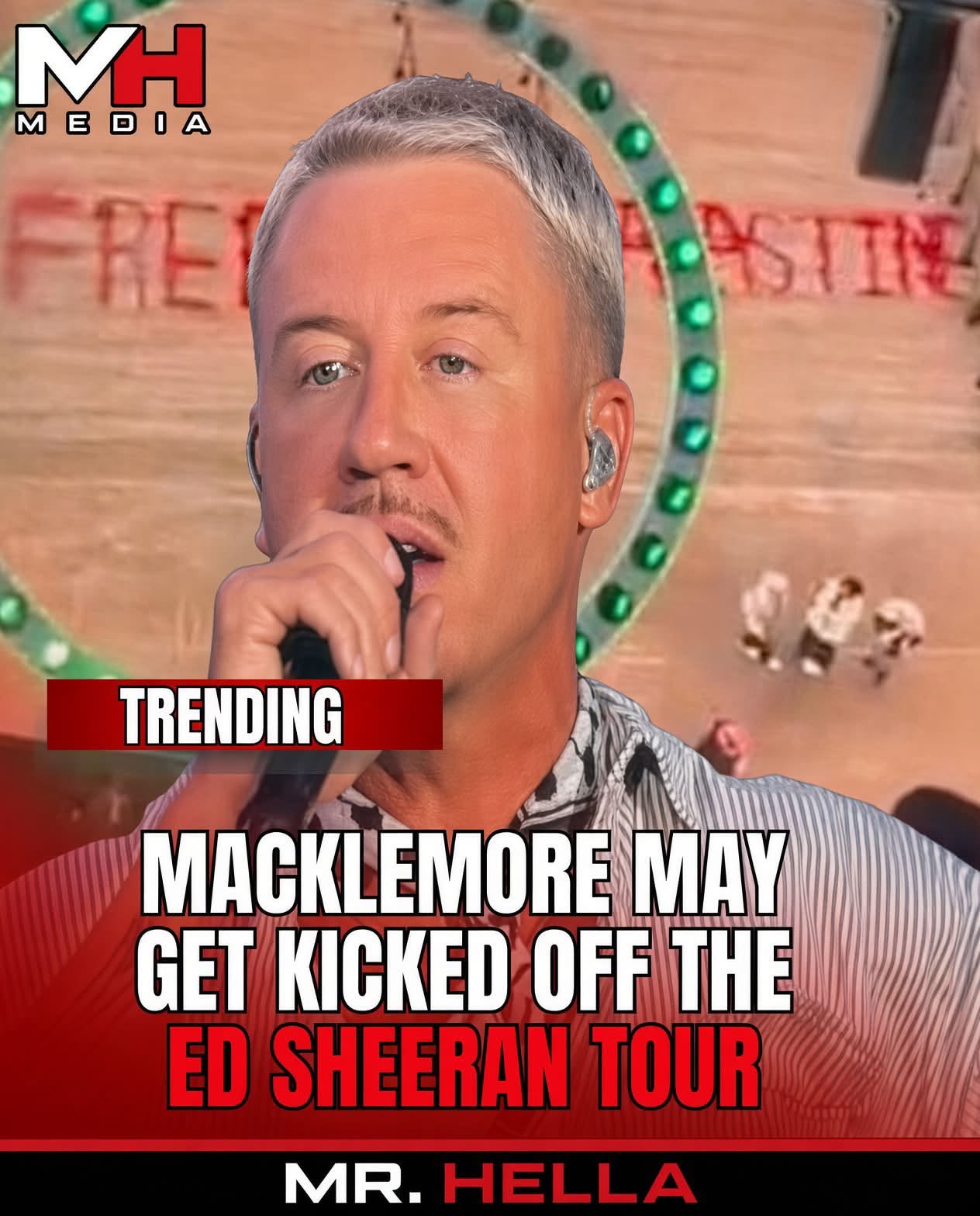
First, Macklemore was removed.
Then Ed Sheeran’s other opening acts walked away.
Then his backing band left.
Fans began demanding refunds and calling for boycotts.
When Sheeran finally returned to the stage in Philadelphia, there were visibly empty sections inside Lincoln Financial Field and tickets remained available shortly before showtime.
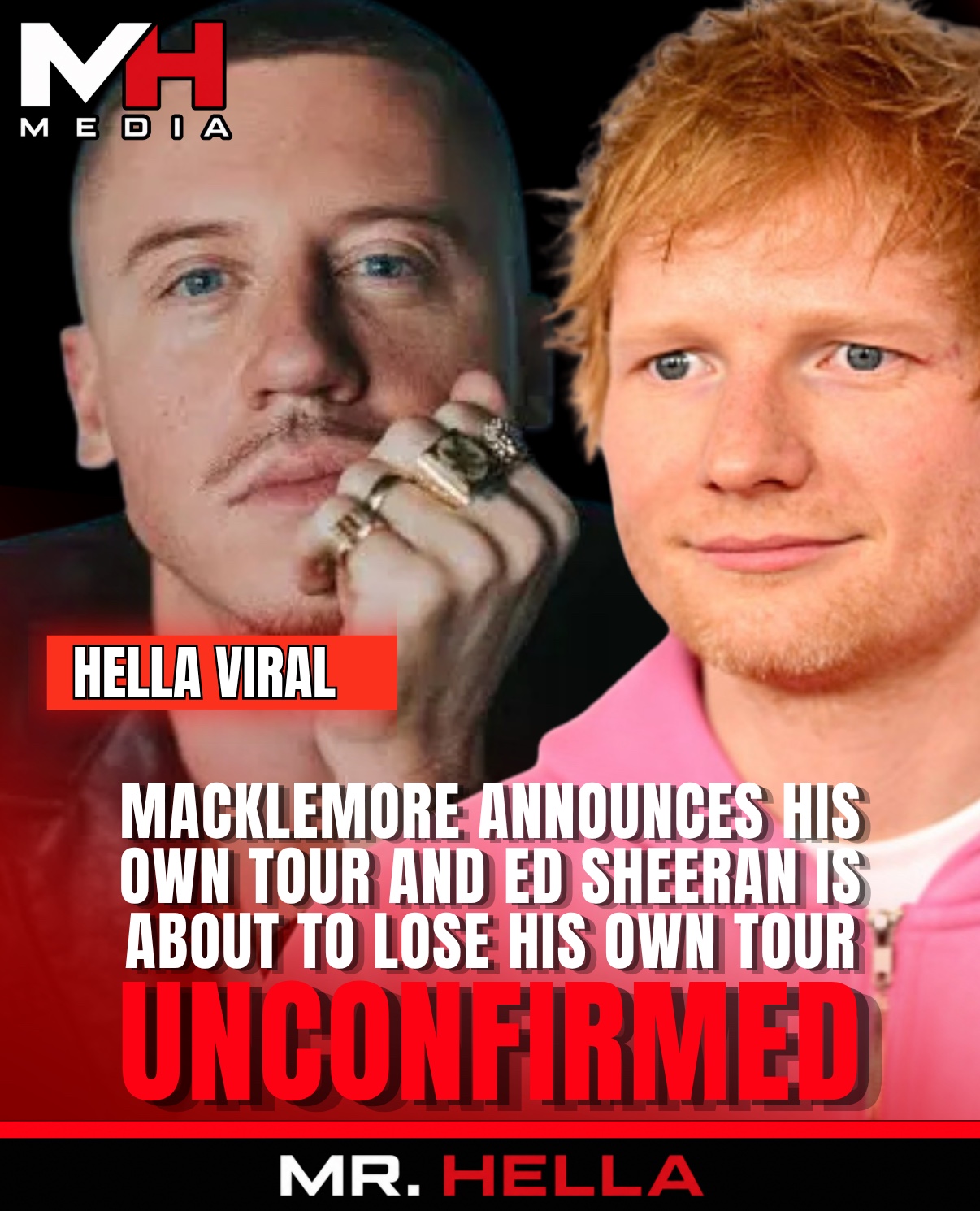
Now Macklemore has taken the controversy that got him removed from Sheeran’s tour and turned it into a tour of his own.
He announced the “Free Palestine Tour” on September 24, beginning with concerts in Dublin, Paris and London and promising North American dates later.
The contrast is difficult to miss.
Less than two weeks after promoters removed Macklemore in an effort to prevent Sheeran’s stadium dates from being canceled, Macklemore is building a new tour around the exact message that caused the dispute — while Sheeran is trying to keep his own tour moving after losing nearly everyone who was supposed to be on the road with him.
The Loop Tour has not been canceled.
There is also not enough verified evidence to say Sheeran is about to lose the tour because of poor attendance.
But something has unquestionably changed.
What was supposed to be a victory lap through American stadiums has become a week-by-week referendum on one of the messiest controversies of Sheeran’s career. (Investing.com)
It Started With Two Words
The crisis can be traced back to Macklemore’s opening performances at MetLife Stadium in New Jersey.
Macklemore had joined Sheeran’s U.S. Loop Tour as one of its most prominent supporting acts and was scheduled to appear at eight of the final 10 U.S. stadium shows.
During his September 4 performance, however, Macklemore used his stage time to speak about Palestinians in Gaza and the West Bank.
He eventually delivered the phrase that would change the direction of the tour:
“Free Palestine.”
Macklemore also performed “Hind’s Hall,” his pro-Palestinian protest song.
The performance immediately generated controversy.
Supporters praised Macklemore for using one of the largest stages available to him to draw attention to Palestinians.
Critics accused him of bringing divisive political messaging into a stadium concert and pointed to previous rhetoric and imagery they considered antisemitic. Macklemore has denied being antisemitic and has maintained that his criticism is directed at the Israeli government and its treatment of Palestinians rather than Jewish people. (Reuters)
Then the venues got involved.
Stadium Owners Were Prepared to Pull Shows
According to Messina Touring Group, the promoter responsible for the U.S. leg of Sheeran’s tour, upcoming venues informed organizers that they would not host concerts if Macklemore remained on the lineup.
That created an extraordinary ultimatum.
Keep Macklemore and potentially lose stadium dates.
Or remove Macklemore and keep the tour moving.
Messina chose the second option.
“As the concert promoter for Ed Sheeran’s US Loop Tour, we have been notified by venues on the upcoming US tour dates that they will not allow a concert to take place with Macklemore on the lineup, which would result in the cancellation of the tour and impact hundreds of thousands of fans,” the promoter said.
Macklemore was removed from his remaining appearances. (The Guardian)
The decision appeared designed to protect Sheeran’s tour.
Instead, it created another problem.
Everybody Started Leaving
The fallout moved quickly.
Aaron Rowe withdrew.
Lukas Graham withdrew.
Finneas withdrew.
Then Beoga — the Irish group serving as Sheeran’s live band — announced it was leaving the remaining U.S. dates as well.
Suddenly, Macklemore wasn’t the only artist missing.
Nearly the entire supporting structure surrounding Sheeran’s upcoming shows had disappeared. (The Guardian)
Finneas said artists should not be silenced for speaking on behalf of people they believe are oppressed.
Rowe connected his decision to his Irish background and his views on Palestine.
Beoga said it could not continue playing venues it believed were suppressing pro-Palestinian speech.
The decisions transformed the controversy.
It was no longer simply:
Macklemore vs. the venues.
Now other musicians were willing to walk away from major stadium exposure rather than remain on the tour.
And Sheeran was left standing in the middle.
Ed Said Removing Macklemore Wasn’t His Decision
Sheeran eventually responded publicly.
He made a crucial distinction: he said he did not fire Macklemore.
“Macklemore coming off tour was the promoter’s decision, it was not mine,” Sheeran wrote.
He said he had spoken with venues and attempted to mediate the situation, but the decision ultimately rested with the promoter and stadium operators.
Sheeran has also emphasized that he never intended his concerts to become political events.
His shows, he said, were supposed to be places where people with different beliefs could come together around music. (Los Angeles Times)
But once Macklemore was gone and the other artists followed him out, the technical question of who actually made the decision mattered less to some angry fans.
Sheeran was still the name on the ticket.
And the backlash began affecting the tour carrying his name.
Then Came Philadelphia
September 19 became the first real test.
Sheeran was scheduled to perform at Lincoln Financial Field in Philadelphia, his first Loop Tour concert since the lineup collapsed.
The atmosphere around the show was radically different from what had originally been planned.
There were no opening acts.
Sheeran had to assemble replacement musicians on extremely short notice.
Pro-Palestinian demonstrators gathered outside the stadium.
Fans online were demanding refunds.
And tickets remained available as showtime approached. (ITVX)
Inside the stadium, reporters noticed empty seats.
Rolling Stone UK described sections of Lincoln Financial Field with no one sitting in them shortly before Sheeran performed. Fans inside the stadium were openly commenting on how empty portions of the venue appeared.
Tickets were still available close to showtime, including floor seats reportedly selling for around $90. (Rolling Stone UK)
The images quickly spread online.
For an artist accustomed to enormous crowds, they created an obvious narrative:
Had the backlash begun hitting ticket sales?
There is evidence that demand softened.
But the available evidence requires some caution.
A stadium photograph taken before or near the beginning of a concert does not establish final paid attendance. Neither does the existence of resale inventory automatically prove a boycott caused weak sales.
Published reports have described empty seats and declining ticket prices, but a definitive audited attendance figure establishing that the Philadelphia show was commercially disastrous has not emerged. (International Business Times UK)
That makes “Sheeran’s tour is collapsing” too strong.
“His tour is under pressure” is supported by considerably more evidence.
Ed Walked Onto the Stage and Addressed It
Sheeran didn’t pretend nothing had happened.
Before beginning his Philadelphia performance, he addressed the controversy directly.
He acknowledged that the situation had placed him in a debate over politics and free speech that he never expected to become part of his tour.
Sheeran also addressed Gaza.
He described the devastation and civilian deaths there as “catastrophic and unjustifiable” and said the response had become disproportionate.
At the same time, he condemned the October 7 attacks in Israel and acknowledged the suffering experienced by Jewish and Israeli communities.
Sheeran argued that his concerts should remain spaces where people with different views can coexist.
He also made clear that he intended to continue performing. (AP News)
That matters.
Because despite all the online claims that Sheeran’s tour is finished, it isn’t.
The Tour Is Still Going
As of September 25, Sheeran still has a substantial U.S. schedule ahead of him.
His Loop Tour is scheduled for two shows at Gillette Stadium in Massachusetts on September 25 and 26.
Atlanta follows October 3.
Indianapolis is scheduled for October 10.
Charlotte follows October 17.
Additional dates are scheduled in Florida and elsewhere before the North American run concludes.
Those shows have not been canceled because of poor attendance. (Ticketmaster US)
That distinction is essential.
There are people online saying Sheeran’s tour is collapsing.
There are boycott calls.
There were empty seats in Philadelphia.
There has been softer ticket demand reported.
But there is not currently enough verified evidence to state that mass nonattendance has forced Sheeran to cancel concerts.
In fact, the irony is that Macklemore was originally removed specifically because organizers said keeping him could cause venues to cancel the shows.
The tour survived that threat.
What followed was a completely different threat.
They Saved the Venues and Lost the Artists
This is where the story becomes bigger than a typical celebrity controversy.
The promoter’s decision solved one immediate problem.
Stadium owners threatening to reject Macklemore no longer had Macklemore on the bill.
But removing him triggered a chain reaction.
Supporting artists walked.
The backing band walked.
Some fans revolted.
Refund demands appeared.
Protests followed the tour.
Ticket demand became part of the story.
And Sheeran had to publicly explain himself from the stage. (Investing.com)
In other words, organizers protected the tour from one kind of cancellation threat and created an entirely different kind of instability.
Then Macklemore made his next move.
Macklemore Turned His Firing Into His Own Tour
On September 24, Macklemore announced the Free Palestine Tour.
The name alone makes clear that he isn’t retreating from the position that caused the controversy.
He is building an entire concert series around it.
The initial shows are scheduled for Dublin on October 26, Paris on October 29 and London on October 30.
Additional performers are expected to be announced.
North American dates are coming later.
Macklemore says proceeds will benefit organizations supporting Palestinians through humanitarian relief, medical assistance, education, advocacy and other work. (Investing.com)
His announcement included a pointed acknowledgment of how the opportunity emerged.
His schedule, after all, had suddenly become much more open.
Macklemore said the moment created momentum and that there was work to do.
The tour is therefore both a new business venture and an extension of his political advocacy.
The thing that got him removed has become the product.
Now There Are Two Tours Telling Opposite Stories
That creates a fascinating split.
Sheeran is trying to stabilize the Loop Tour.
Macklemore is trying to build the Free Palestine Tour.
Sheeran says concerts should be places where people come together regardless of political beliefs.
Macklemore says artists should use their stages to speak about injustice.
Sheeran wanted to remain largely outside political activism.
Macklemore has made political activism central to his performances.
Neither artist appears to be treating the other as a personal enemy.
Macklemore has said Sheeran isn’t the victim in the situation, but he has directed much of his criticism toward powerful venue owners and institutions.
Sheeran has said Macklemore’s removal wasn’t his decision and that he attempted to find a compromise.
But whatever their personal relationship may be, their tours now represent two very different answers to the same controversy. (Business Insider)
The Next Few Shows Matter More Than Philadelphia
One stadium with empty seats doesn’t determine the fate of a tour.
The real test comes next.
If Sheeran continues playing stadiums with strong crowds, the Philadelphia images may ultimately look like a temporary consequence of an unusually chaotic week.
If ticket prices continue dropping, visible empty sections become common and additional dates begin facing serious commercial problems, the narrative changes.
And if shows actually begin getting canceled because demand has weakened, that would represent an entirely different level of crisis.
None of those outcomes should be assumed before they happen.
For now, the evidence supports something more measured:
The Loop Tour has suffered a serious disruption, and Sheeran is attempting to rebuild its momentum while the controversy remains active.
Gillette Stadium Is the Next Major Test
The timing couldn’t be more significant.
Sheeran’s next concerts are scheduled for September 25 and 26 at Gillette Stadium in Foxborough, Massachusetts.
That isn’t just another venue.
Gillette is controlled by Robert Kraft’s organization, and Kraft became one of the central figures in the Macklemore dispute.
Kraft publicly objected to Macklemore performing at the stadium, citing rhetoric and imagery he considered antisemitic.
Macklemore has strongly rejected the accusation that his support for Palestinians amounts to antisemitism.
Now Sheeran is scheduled to perform two nights inside the stadium at the center of the controversy — without Macklemore and without the artists who left in solidarity with him. (Al Jazeera)
That makes Foxborough more than another tour stop.
It becomes a test of the decision that started this entire chain reaction.
Macklemore’s Test Comes Next Month
Macklemore has his own questions to answer.
Announcing a politically charged tour is one thing.
Selling it is another.
The initial European dates will reveal whether the enormous online attention surrounding his removal translates into people buying tickets.
His eventual North American dates will be even more revealing.
If Macklemore can turn the controversy into successful concerts of his own, his removal from Sheeran’s tour may ultimately expand his platform rather than diminish it.
If the shows struggle, the enormous social-media response may prove larger than the actual concert market.
That story has not been written yet.
The Tour They Tried to Save
There is a remarkable irony hanging over the Loop Tour now.
Macklemore was removed because organizers said venues were prepared to cancel concerts if he remained.
The stated goal was to protect the tour and the hundreds of thousands of fans expected to attend.
Macklemore left.
The shows remained.
But then the artists left.
The band left.
Some fans demanded refunds.
Protests appeared.
Philadelphia showed visible empty seats.
And Macklemore announced another tour with the political message that venues had rejected attached directly to its name. (The Guardian)
Whether that sequence actually causes serious long-term financial damage to Sheeran’s tour remains unknown.
It would be premature to declare the Loop Tour dead.
Ed Sheeran is still performing.
His remaining dates are still on the calendar.
Thousands of fans are still showing up.
But this is no longer the same tour that rolled into MetLife Stadium at the beginning of September.
What happened there changed the story.
And the next several weeks will determine whether this was simply the most turbulent chapter of Ed Sheeran’s Loop Tour — or the moment the tour began losing its momentum while the artist who was removed from it built something of his own.

Comments