


Egyptian television presenter and producer Sarah Khalifa has been sentenced to death by hanging after a Cairo court convicted her and 11 other defendants in a sprawling synthetic-drug manufacturing and trafficking case that involved more than two dozen defendants and hundreds of kilograms of narcotics and production materials.
Khalifa, 39, is best known for hosting Mission Impossible, an Egyptian television program focused on crime and security issues. Her transformation from a recognizable media personality discussing crime on television to a defendant facing a death sentence has made the case one of Egypt’s most closely watched celebrity criminal proceedings.
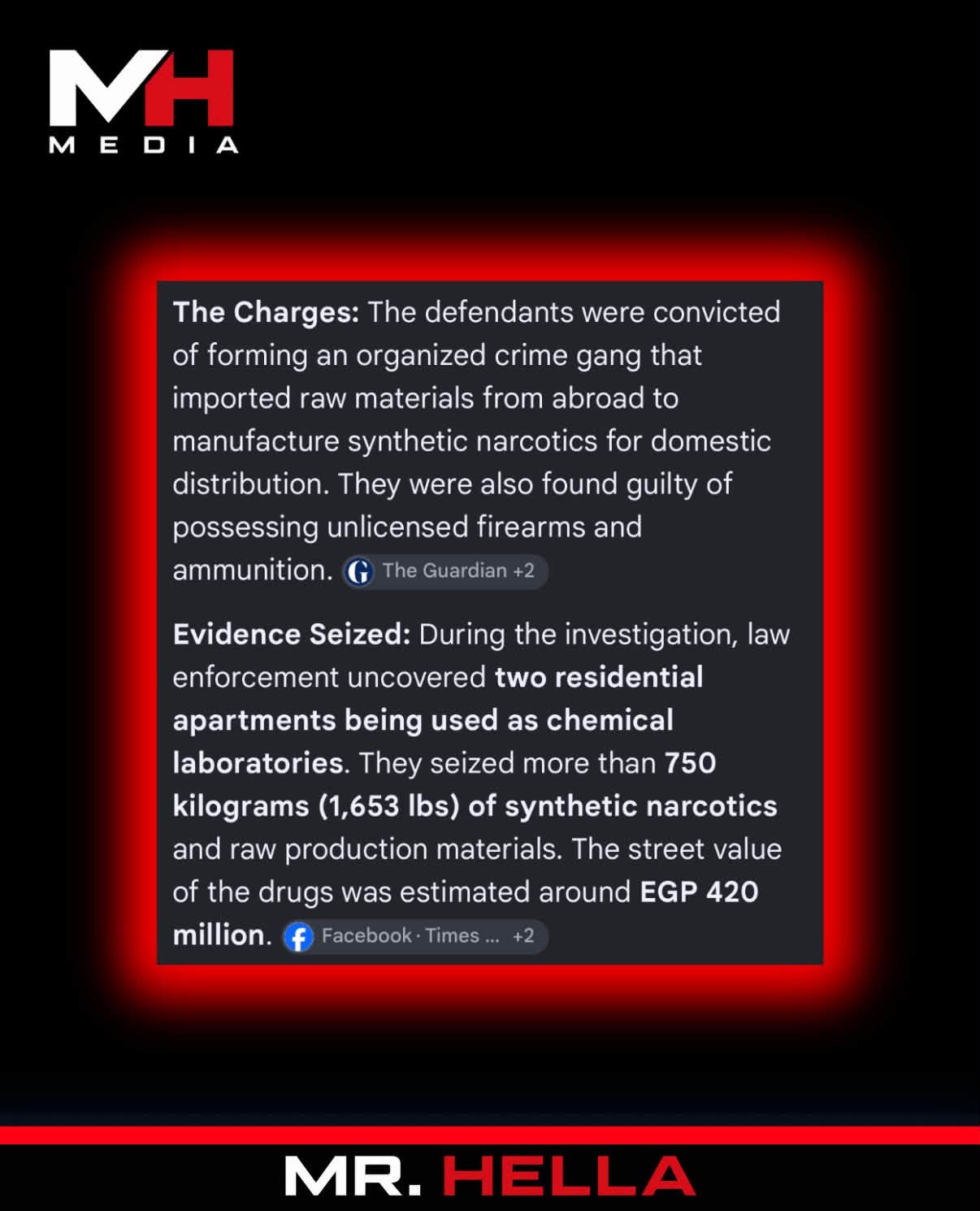
The Cairo Criminal Court handed down the sentences on Sept. 5 after convicting Khalifa and 11 others of participating in an organized criminal group prosecutors said imported raw materials used to manufacture synthetic narcotics for distribution. Some defendants were also convicted in connection with unlicensed firearms and ammunition.
Khalifa has denied involvement in the operation.
And the legal battle is not over.
On Sept. 15, Khalifa and 20 other defendants formally appealed the death and life-imprisonment sentences handed down in the case, meaning the convictions and sentences remain subject to further judicial review.
More Than 750 Kilograms Seized
The scale of the alleged operation was substantial.
Prosecutors accused the defendants of forming an organized network in which different members were assigned roles involving the importation of raw materials, manufacturing of synthetic drugs and distribution of the finished narcotics.
Investigators said they seized more than 750 kilograms of synthetic narcotics and materials used in their production. Authorities also identified two apartments allegedly being used as drug laboratories and recovered unlicensed firearms and ammunition.
The prosecution built its case using testimony from 20 witnesses along with technical and digital evidence, including messages, photographs and videos that prosecutors said documented criminal activity by members of the group.
Khalifa was arrested in Cairo in April 2025.
According to The National, she denied the allegations during proceedings and told the judge she had never seen drugs until authorities photographed her with them at anti-narcotics offices.
Her attorneys have also challenged the prosecution's case and alleged that procedural errors occurred during the proceedings.
12 Death Sentences, Nine Life Sentences and Seven Acquittals
Khalifa was only one defendant in a much larger case.
Twenty-eight people were prosecuted.
The Cairo Criminal Court sentenced Khalifa and 11 others to death by hanging, sentenced nine defendants to life imprisonment and acquitted seven others.
The defendants sentenced to death were also reportedly fined 500,000 Egyptian pounds each, while the court ordered the confiscation of seized drugs, vehicles, equipment, gold jewelry and mobile phones connected to the case.
Before imposing the death sentences, the court referred the cases to Egypt's Grand Mufti for an advisory religious opinion, a required procedural step in Egyptian capital cases. The court subsequently issued the sentences unanimously.
Referral to the Grand Mufti does not itself constitute a final death sentence, and the Mufti's opinion is advisory. The court issued its formal judgment after receiving that opinion.
From Crime Television to One of Egypt's Biggest Drug Cases
Khalifa's involvement has attracted particular attention because of her public career.
She became known for Mission Impossible, which focused on security and criminal issues and aired on Egypt's Al-Mehwar television channel. Khalifa has also worked as a producer and reportedly operated businesses involving events and cosmetic services.
The contrast has become an unavoidable part of the story: a presenter known for a program about crime and security was ultimately prosecuted in a case Egyptian media dubbed the “Grand Drug Case.”
But Khalifa has consistently maintained her innocence.
Her defense has argued that there were procedural irregularities during the case and expressed confidence that the judgment could be overturned on appeal.
That appeal is now underway.
Death Sentence Is Not Yet Final
The distinction is particularly important because some coverage of the case has presented Khalifa's sentence as though execution were now inevitable.
It is not.
Egyptian criminal court judgments can be challenged through the appeals process, and Khalifa and 20 other defendants filed appeals on Sept. 15 challenging the death and life sentences imposed against them.
The appeal means a higher court will have an opportunity to review the convictions and sentences.
For Khalifa, the stakes could hardly be higher.
She went from hosting a television program centered on crime and security to becoming one of the most recognizable defendants in a massive narcotics prosecution involving 28 people, alleged drug laboratories, firearms and more than 750 kilograms of drugs and production materials.
A Cairo court has now sentenced her to death.
But with Khalifa maintaining her innocence and formally challenging the judgment, the final outcome of one of Egypt's most closely watched drug cases remains unresolved.



Comments