

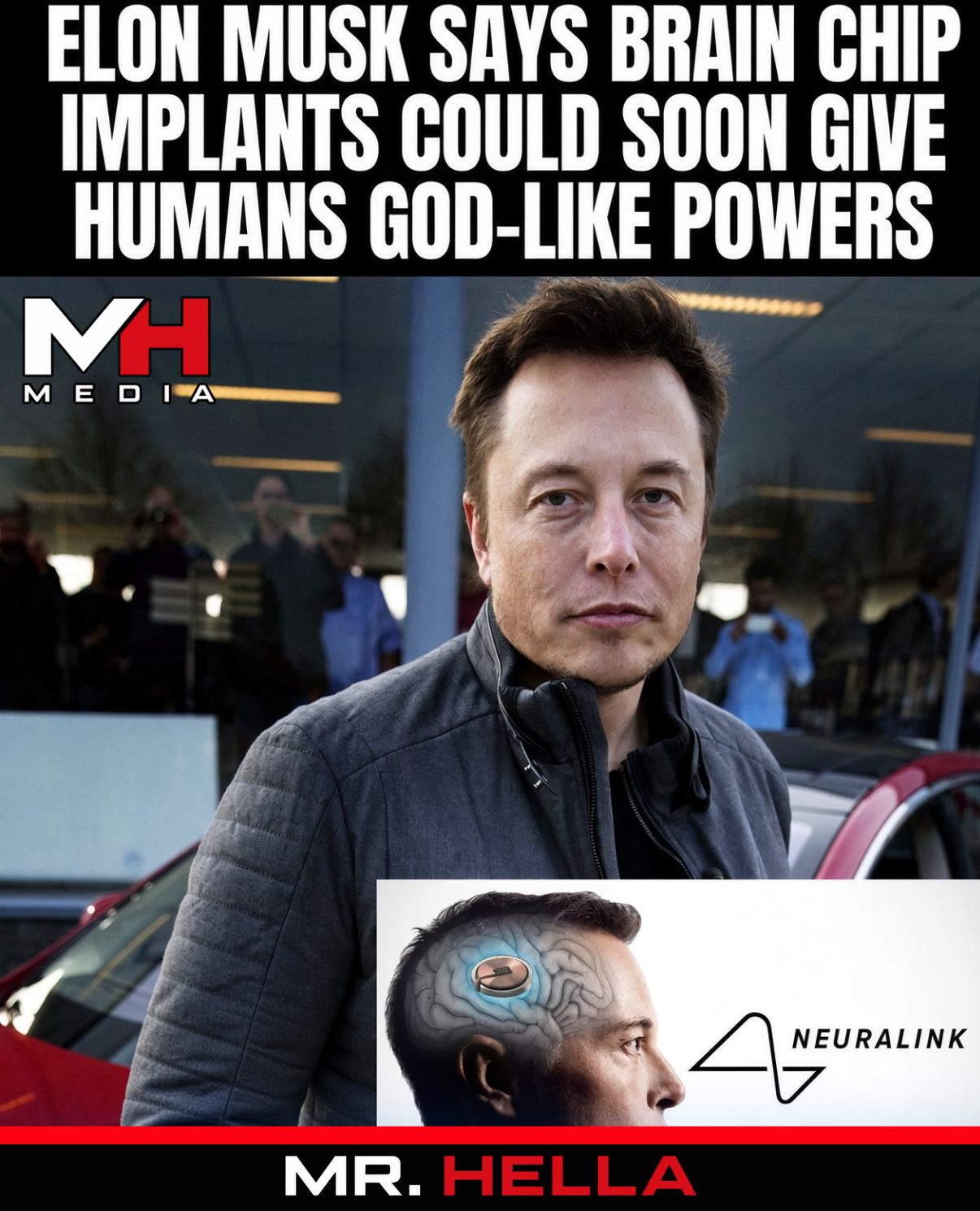
Elon Musk Says Brain Chip Implants Could Soon Give Humans God-Like Powers
Tel Aviv, remotely from Texas. Samson International Smart Mobility Summit, May 18, 2026.
What he said, per IBTimes UK: restoring control for tetraplegic patients and restoring sight are pretty big deals. “Jesus-level technologies.” Miracles in the scientific sense. Blindsight, the visual-cortex product, might give “perhaps superhuman vision” because it does not need working eyes. First patient use targeted by end of 2026.
What Neuralink president DJ Seo said in the same window: an otherwise healthy person on the implant calendar by 2030. That is the leap from wheelchair and blindness trials to elective bandwidth. It is a company goal, not an FDA stamp.
The graphic’s “god-like powers” is the sermon version of those two sentences. Musk has used religious adjectives for rockets and tunnels too. The substance underneath is narrower and more serious. Telepathy — the current N1-class implant — is a high-channel interface sitting in motor cortex so a person who cannot move a hand can move a cursor, play chess, type. Public demos through 2026 still look like that: thought to pointer, not thought to weather. Channel counts in the industry roadmaps go from thousands toward tens of thousands if the company hits its own slides. That is engineering. It is not omniscience.
Two clocks. Medical: people who have lost a body function and want a bridge. Augmentation: people who have a body function and want a faster pipe to the machine. The second clock is the one that scares ethicists and thrills keynotes. Seo put a year on it. Musk put a parable on the first clock.
xAI, Tesla, and Neuralink sit in the same founder’s sentence so the internet treats every quote as one product. They are not. A brain implant that lets a paralyzed patient click is already historic if it holds. A brain implant that lets a healthy commuter skip the keyboard is a different device, a different risk table, and a different regulator. 2030 is four years of trials, infections, explants, and congressional hearings away from a slogan.
Call it Jesus-level if the patient walks or sees. Call it marketing if the only thing that changed is the adjective. The chip is real enough that people are using it to play chess. The god part is still a keynote.

Comments