

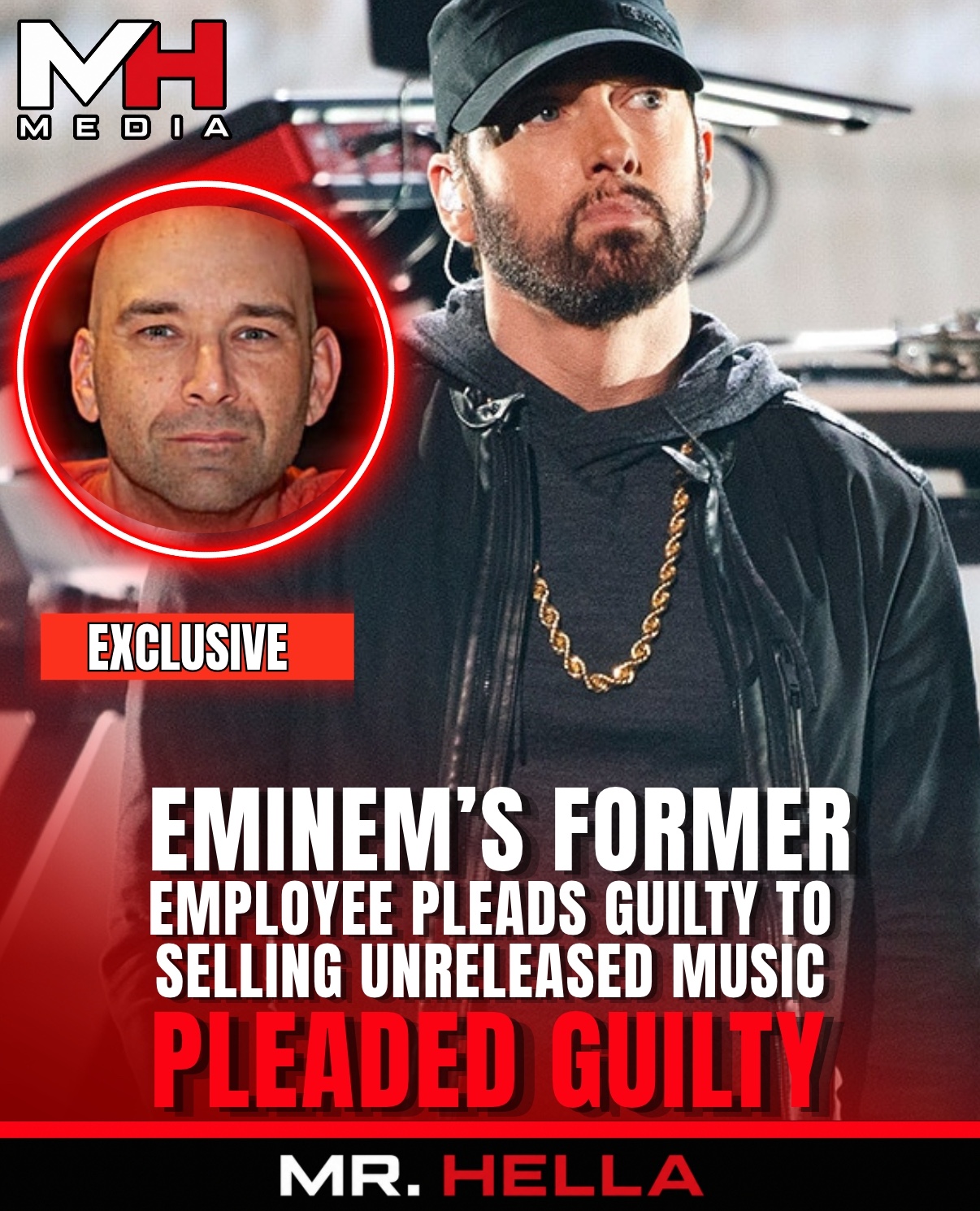
Eminem’s Former Employee Pleads Guilty to Selling Unreleased Music for $50,000 as Prosecutors Reveal More Than 8 Million Streams
October 23, 2026 | Mr. Hella Media
A former employee of Eminem has pleaded guilty to federal criminal copyright infringement after admitting that he secretly copied and sold unreleased recordings belonging to the Detroit rap legend, bringing a major development in a case involving stolen music, unauthorized distribution and an estimated $750,000 in infringement value.
The United States Department of Justice announced Thursday, October 22, that Joseph Strange, 48, of Holly, Michigan, entered a guilty plea in federal court in the Eastern District of Michigan. Strange previously worked for Eminem, whose real name is Marshall Mathers, for approximately 14 years and had access to sensitive recording equipment and music archives inside the rapper’s private studio.
According to federal prosecutors, Strange copied at least 10 audio files containing unreleased Eminem material and sold them to buyers over the internet between July and August 2024. The transactions generated approximately $50,000, but the consequences extended far beyond the original sales.
Authorities revealed that recordings connected to the unauthorized distribution eventually appeared on public streaming platforms, where the infringing files had been accessed more than eight million times by November 2025.
Strange now faces a maximum of five years in federal prison, with sentencing scheduled for January 27, 2027.
Former Employee Had Access to Eminem’s Private Studio Archives
Strange worked for Eminem from approximately 2007 until 2021 at a recording studio in Ferndale, Michigan, where the rapper developed music intended for potential future release.
His responsibilities included helping establish and operate computer systems used to store Eminem’s recordings. That position gave him access to password-protected hard drives containing songs, unfinished recordings and other musical material at various stages of production.
According to court documents, Strange copied at least 10 files from those storage devices without authorization. The material included music that had not been released publicly and, in some cases, had undergone professional preparation for possible commercial distribution.
The Justice Department emphasized that the songs were not necessarily scheduled for release. Some recordings remained works in progress, while others had reached more advanced production stages, including studio mastering.
That distinction matters because unreleased music often represents years of creative work, experimentation and collaboration. Artists may record dozens of songs that never appear on official albums, retaining the ability to revisit, revise or abandon those recordings.
In this case, prosecutors said Strange took that decision away from Eminem by distributing material without the rapper’s knowledge or permission.
Prosecutors Say Strange Sold the Recordings for Approximately $50,000
Federal investigators determined that Strange sold and transmitted the unreleased music files to internet buyers during a roughly two-month period in the summer of 2024.
The sales reportedly generated approximately $50,000.
However, the government’s estimated infringement amount was considerably higher. Prosecutors valued the infringement involving the stolen recordings at no less than $750,000.
The difference reflects the broader commercial implications of distributing copyrighted material without authorization, rather than simply the amount Strange received from buyers.
Once the recordings entered circulation, they spread beyond the individuals who originally purchased them.
Federal authorities said the files eventually appeared on multiple public streaming platforms. Data obtained from several streaming services showed that the infringing recordings had been accessed more than eight million times as of November 2025.
The figure represents the scale of unauthorized distribution, not necessarily the number of individual listeners or the amount of money earned from streaming.
The case illustrates how quickly unreleased music can circulate once it leaves a controlled studio environment, particularly when the artist involved has an international audience.
FBI Investigation Began After Studio Employees Discovered the Leaks
The case first became public in March 2025, but the investigation began months earlier.
According to federal court documents, employees at Eminem’s Ferndale recording studio contacted the FBI in January 2025 after discovering that unreleased recordings had appeared online.
Investigators learned that the material had originated from storage systems inside the studio, where access was restricted to a relatively small group of people.
The FBI subsequently identified individuals who had purchased the recordings. Those buyers reportedly identified Strange as the person who supplied the music.
During the investigation, authorities searched Strange’s home and recovered storage devices containing Eminem’s music, along with handwritten lyrics associated with the rapper.
The discovery helped investigators establish how the material had left the studio and reached online buyers. Strange was charged in March 2025, more than three years after his employment with Eminem ended.
Eminem’s Representatives Previously Condemned the Breach of Trust
When the charges were first announced in March 2025, Eminem’s representatives expressed serious concerns about the impact of the unauthorized releases.
His spokesperson, Dennis Dennehy, thanked federal investigators for pursuing the case and emphasized that the damage extended beyond potential financial losses.
The statement pointed to the effect that unauthorized leaks can have on an artist’s creative legacy, particularly when unfinished recordings are distributed without context or permission.
The concern also extended to producers, songwriters and other collaborators who contributed to the recordings.
For an artist such as Eminem, whose recording career spans nearly three decades, private archives can contain alternate versions of songs, unfinished ideas, abandoned projects and material that was never intended for public consumption.
Releasing those recordings without authorization can undermine the artist’s ability to decide which versions of a song represent their work.
Following Strange’s guilty plea, his attorney, Wade Fink, acknowledged that his client had accepted responsibility but argued that the circumstances were more complicated than the public narrative suggested.
Eminem’s representatives have not announced any additional legal action following the October 22 plea.
Justice Department Says Strange Abused His Position of Trust
Federal officials emphasized that the case involved more than the unauthorized distribution of copyrighted music. They also described it as a serious breach of the trust placed in someone who had been given access to an artist’s private creative work.
Assistant Attorney General A. Tysen Duva said Strange had exploited his position to obtain and sell recordings that Eminem had not authorized for public release.
Duva described the conduct as an infringement of both the rapper’s legal rights and his artistic control.
Jennifer Runyan, the special agent in charge of the FBI’s Detroit Field Office, also emphasized the importance of protecting intellectual property and acknowledged the cooperation of Mathers Music Studio throughout the investigation.
The case was investigated by the FBI and prosecuted by attorneys from the Eastern District of Michigan and the Justice Department’s Computer Crime and Intellectual Property Section.
Former Employee Faces Up to Five Years in Federal Prison
Strange’s guilty plea resolves the criminal copyright infringement charge, but the case is not yet over.
His sentencing hearing is scheduled for January 27, 2027, when a federal judge will determine the appropriate punishment.
The offense carries a maximum sentence of five years in prison, although that does not mean Strange will necessarily receive the maximum penalty. The court must consider federal sentencing guidelines, the circumstances of the offense and other relevant factors.
The plea agreement also reflects Strange’s acceptance of responsibility, which prosecutors have agreed to recognize in their sentencing recommendation.
A separate charge involving interstate transportation of stolen goods was included in the original case, but prosecutors agreed to dismiss that charge as part of the plea arrangement.
The Case Highlights the Growing Problem of Unreleased Music Leaks
The case underscores a persistent challenge facing recording artists in an era when unreleased music can be copied, sold and circulated globally within hours.
While some leaks originate from hacked accounts or compromised cloud storage, the Eminem investigation involved a former employee who had legitimate access to the artist’s recording systems during his employment.
That distinction makes the case particularly significant for the music industry, where artists regularly depend on engineers, producers, managers and technical employees to safeguard recordings long before they reach the public.
Eminem’s situation also demonstrates the potential scale of unauthorized distribution. What prosecutors described as approximately $50,000 in private sales eventually led to millions of accesses across streaming services.
The eight-million figure shows how far the material traveled after the initial transactions, although authorities have not established that every access represented a paid stream or direct financial loss.
The case may prompt renewed discussion about studio security, access to archival recordings and the responsibilities of employees who handle unreleased creative material.
Sentencing Scheduled for January 2027
With Strange’s guilty plea now entered, attention turns to his January sentencing hearing.
The Justice Department has confirmed the unauthorized copying and sale of at least 10 audio files, approximately $50,000 in proceeds and an estimated infringement value of at least $750,000.
For Eminem, the case represents a significant step toward accountability following the unauthorized release of music that had remained under his control for years.
It also illustrates the broader stakes of protecting unreleased recordings. Beyond their commercial value, those files represent creative decisions that belong to the artists and collaborators who made them.
Strange’s final punishment remains undecided, but his guilty plea establishes criminal responsibility for the unauthorized distribution of Eminem’s music.



Comments