

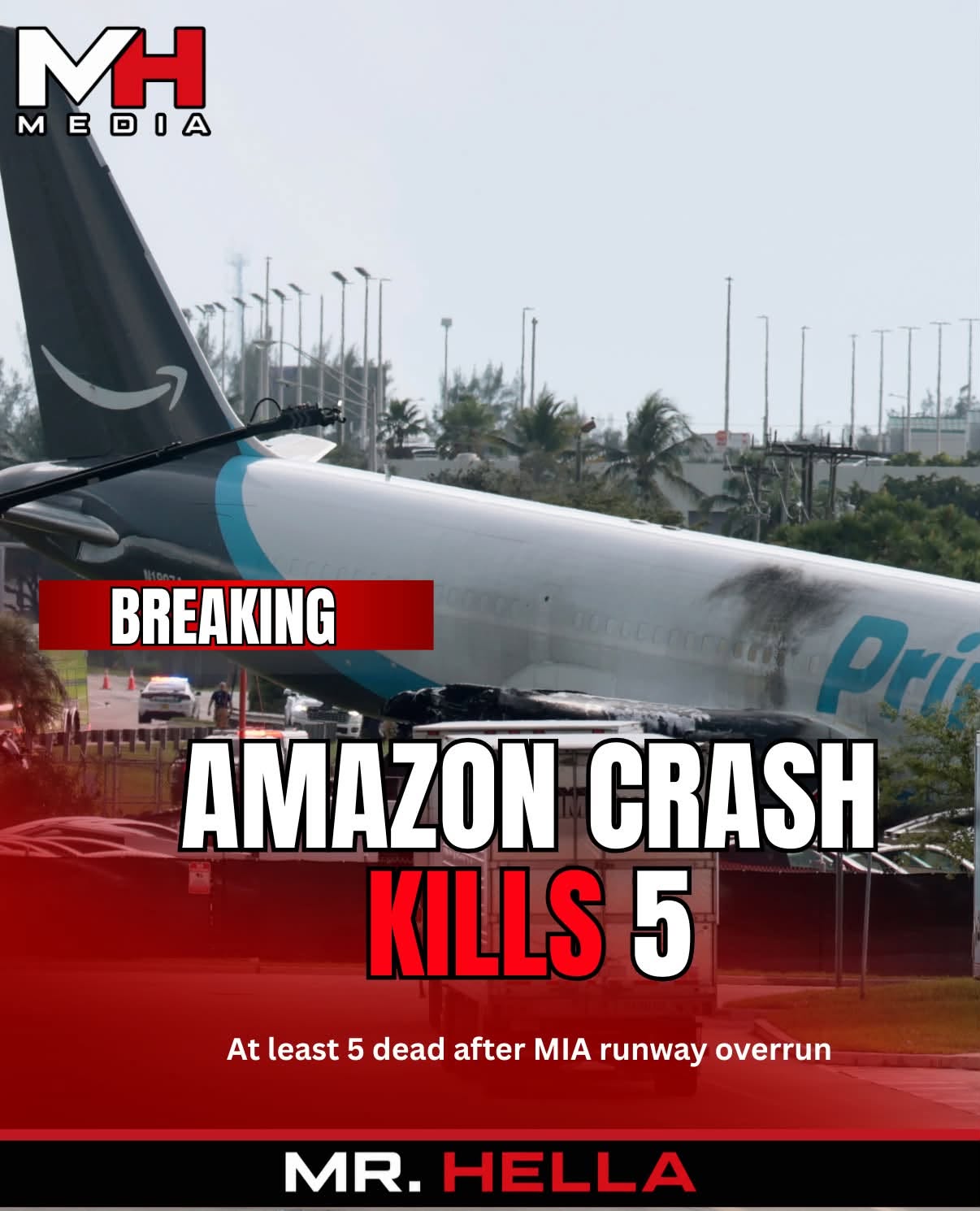
Five people were killed and five others injured after an Amazon-branded cargo plane overran a runway while landing at Miami International Airport, tore through the airport perimeter and crashed into vehicles before coming to a stop approximately 1,300 feet beyond the end of the runway.
The accident happened at approximately 1:53 p.m. Sunday, Sept. 6, when Amazon Air Flight 7598, a Boeing 767-300 operated by cargo carrier 21 Air, was landing on Runway 30 after arriving from Luis Muñoz Marín International Airport in San Juan, Puerto Rico.
The aircraft failed to stop before reaching the end of the runway.
It continued across airport property, struck navigational equipment and slammed into a white Ford Econoline van carrying seven people who worked for Professional Ocean Service Corp., a company that cleans aircraft at the airport.
The plane then broke through the airport perimeter fence and struck a Toyota Corolla Cross traveling outside the airport on Northwest 67th Avenue before finally coming to a stop.
A fire erupted following the crash.
Five people were killed and five others were injured.
All five people who died were inside the airport cleaning company's van, according to authorities. The two pilots aboard the Boeing 767 survived and were treated for injuries before being released from the hospital.
Plane Traveled 1,300 Feet Beyond Runway
The scale of the accident became clearer as investigators began examining the wreckage.
National Transportation Safety Board Chair Jennifer Homendy said the aircraft traveled approximately 1,300 feet beyond the paved runway surface.
The Boeing 767 first struck navigational equipment before colliding with the van on airport property. Seven people were inside that vehicle.
It then went through the perimeter fence and collided with the Toyota SUV outside the airport.
Homendy described the wreckage scene as “utter devastation,” with aircraft parts, vehicle debris and sections of fencing scattered throughout the area.
Miami-Dade Fire Rescue mounted a massive emergency response involving approximately 200 personnel.
Firefighters extinguished the aircraft fire, addressed a significant fuel leak and rescued victims from the damaged vehicles. One person became trapped beneath one of the vehicles and required specialized technical rescue equipment to be freed.
The crash temporarily brought operations at one of the country's busiest airports to a halt.
A ground stop remained in effect for approximately three hours before limited runway operations resumed.
Amazon-Branded Plane Was Operated by 21 Air
Although the Boeing 767 carried Amazon branding and was flying as part of the Amazon Air cargo network, the aircraft was operated by 21 Air LLC.
The distinction is important.
Amazon contracts with outside cargo airlines to operate portions of its air transportation network, and investigators said they plan to examine the relationship between Amazon and 21 Air as part of the investigation.
The aircraft had already completed two flights earlier that day.
According to the NTSB, it flew from Cincinnati to Miami, then from Miami to San Juan before beginning its return flight to Miami.
The accident occurred during that third flight of the day.
The Boeing 767 involved was manufactured in 1994 and originally operated as a passenger aircraft before later being converted into a freighter.
Both Amazon and 21 Air issued statements expressing condolences to the victims' families and pledging cooperation with federal investigators.
Investigators Recover Black Boxes
The NTSB dispatched a team of 32 investigators to Miami following the crash.
Investigators recovered both the cockpit voice recorder and flight data recorder from the aircraft and sent them for analysis.
Those devices could provide crucial information about the aircraft's speed, braking systems, engine performance and conversations between the pilots during the final moments of the flight.
The investigation is expected to examine a broad range of possible factors, including crew training, aircraft systems, engine performance, air traffic control communications, weather conditions, airport infrastructure and the plane's performance during landing.
Investigators are also examining whether an Engineered Materials Arresting System, or EMAS, at the end of the runway could have affected the outcome.
EMAS uses crushable material beyond a runway to help slow aircraft that cannot stop before reaching the end. It is not required at every airport.
Officials have not determined what caused Flight 7598 to overrun the runway, and the NTSB has cautioned against drawing conclusions while investigators continue collecting evidence.
Five Airport Workers Killed
Authorities later identified the five people killed as Rolando Aleman Leon, 55; Yoel Rodriguez Naranjo, 53; Julio C. Pineda, 75; Carlos Acosta Fajardo, 53; and Javierkys Reyes Quevedo, 47.
All five were traveling in the Professional Ocean Service Corp. van struck by the aircraft.
Of the five people injured in the accident, three remained hospitalized as of Tuesday. Two were listed in critical condition and another was stable.
The two pilots had already been released.
Professional Ocean Service Corp. said it was grieving alongside the families of the employees killed and praying for those recovering from their injuries.
The investigation into why the Boeing 767 failed to stop remains ongoing.
For now, investigators have established the basic sequence: Flight 7598 landed at Miami International Airport, continued beyond the end of Runway 30, struck a van filled with airport workers, broke through the airport perimeter and collided with another vehicle before coming to rest and catching fire.
Five people never made it out of that van.
Federal investigators are now trying to determine why the aircraft never stopped.



Comments