

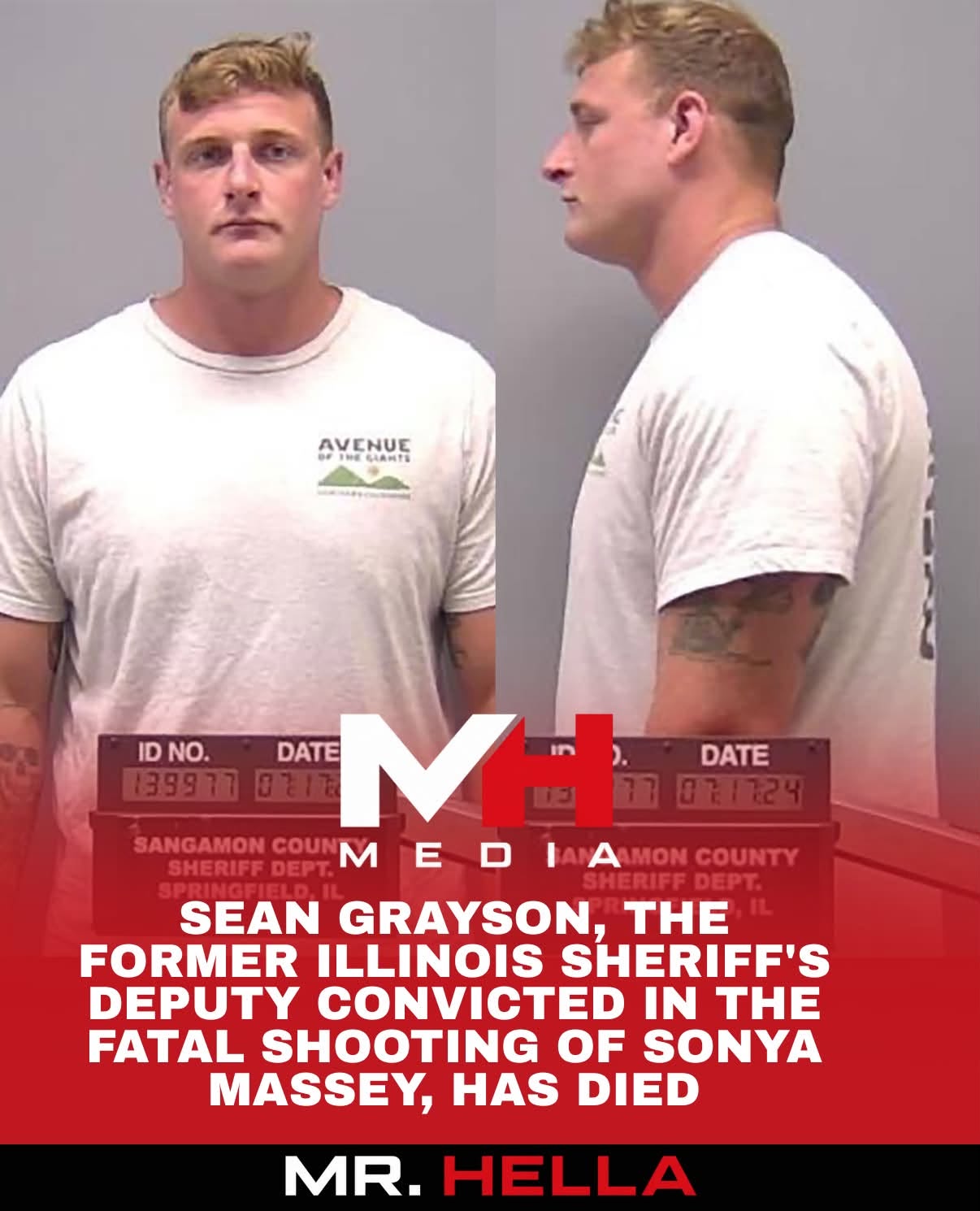
Sean Grayson, the former Sangamon County sheriff’s deputy convicted of second-degree murder for fatally shooting Sonya Massey inside her Illinois home, died Sunday while serving a 20-year prison sentence, bringing another chapter in one of the nation’s most closely watched police-shooting cases to an unexpected end.
Grayson was 32. His attorney, Daniel Fultz, confirmed that his client died on August 23, approximately six months into the maximum sentence imposed for second-degree murder. Grayson had been battling advanced colon cancer and had recently sought compassionate medical release, arguing that his deteriorating condition warranted allowing him to leave custody. The Illinois Prisoner Review Board unanimously rejected that request on July 31, leaving Grayson incarcerated as his illness progressed.
The circumstances surrounding Grayson’s death were not immediately detailed publicly. Fultz confirmed the death but initially declined to provide a cause, while the Illinois Department of Corrections later confirmed that Grayson had died while being held at a facility outside Illinois. Grayson’s cancer had progressed to Stage 4 and spread to multiple organs, but in the immediate aftermath of his death authorities had not publicly established cancer as the official cause.
His death came just over two years after Massey, a 36-year-old mother, called 911 because she believed someone was outside her Springfield-area home. Instead of receiving the protection she had sought, Massey was shot and killed in her kitchen by one of the deputies who responded to help her. The encounter, captured on body-camera video, generated national outrage and eventually led to Grayson’s conviction, a $10 million settlement for Massey’s family and changes to Illinois law intended to strengthen scrutiny of law-enforcement hires.
Grayson Had Been Battling Advanced Cancer
Grayson’s cancer diagnosis predated Massey’s killing. His attorneys said he was diagnosed with Stage 3 colon cancer in 2023, approximately a year before the July 2024 shooting. By the time he was sentenced in January 2026, defense attorneys told the court that the disease had progressed to Stage 4 and spread to his liver, lungs and rectum.
His declining health became a significant issue during sentencing. After a jury convicted Grayson of second-degree murder in October 2025, the defense asked the court to consider his cancer when deciding how much time he should spend behind bars. The judge nevertheless imposed the maximum 20-year prison term in January.
By May, Grayson had filed an application seeking medical release under Illinois law. His request relied on the Joe Coleman Medical Release Act, which allows certain incarcerated people with terminal illnesses or severe medical incapacitation to seek release before completing their sentences.
The application placed the Prisoner Review Board in the position of weighing Grayson’s rapidly deteriorating health against the severity of the crime for which he had only recently been sentenced.
Medical evidence presented during the process demonstrated just how serious his condition had become. A medical professional evaluating Grayson for the state determined that his illness made it likely he would die within 18 months. Grayson himself had not checked that designation on his handwritten application, but the independent medical assessment concluded that he met the medical standard associated with a terminal prognosis.
The medical findings, however, did not automatically require the state to release him.
The Prisoner Review Board Unanimously Refused to Release Him
On July 31, a three-member panel of the Illinois Prisoner Review Board voted 3-0 to deny Grayson’s application for medical release. The decision meant he would continue serving his 20-year sentence despite the advanced cancer and terminal prognosis documented during the review process.
Massey’s family strongly opposed the request, as did Sangamon County State’s Attorney John Milhiser. Prosecutors argued that Grayson already knew he had cancer when he killed Massey and that his medical condition had been considered when the judge imposed the sentence only months earlier.
The state’s attorney’s office argued that Grayson’s illness did not eliminate the public-safety considerations surrounding his conviction, writing in its opposition to release that cancer did not make him less dangerous. Prosecutors also emphasized how little of his sentence Grayson had actually served.
Another point of contention was Grayson’s description of Massey’s killing in his medical-release application. Grayson maintained that Massey had attacked him with a pot of boiling water, a characterization disputed by prosecutors and Massey’s family. The application renewed arguments that had been central to his criminal trial rather than simply focusing on his medical condition.
The board ultimately sided against release.
Illinois Gov. JB Pritzker issued a statement following the decision, saying Massey had been “innocent, unarmed, and calling law enforcement for help” and emphasizing the importance of accountability while noting that Illinois law provides a process for terminally ill prisoners to seek medical release.
Less than a month later, Grayson was dead.
Sonya Massey Had Called 911 for Help
The case that sent Grayson to prison began shortly before 1 a.m. on July 6, 2024, when Massey called 911 to report what she believed might be a prowler outside her home near Springfield.
Grayson and another Sangamon County deputy responded. After checking outside the property, the deputies entered Massey’s home and interacted with her in the kitchen. What followed was recorded on the other deputy’s body camera and would eventually become central evidence in the prosecution.
Attention turned to a pot of hot water on Massey’s stove. The deputies asked her to move it, and Massey picked up the pot. During the exchange, she said, “I rebuke you in the name of Jesus.” Grayson responded with a threat to shoot her before drawing his weapon.
The video showed Massey ducking down behind the kitchen counter and apologizing. Grayson then fired, striking her in the face and killing her.
Grayson maintained that he believed Massey presented a threat involving the hot water. The other deputy who was present testified that he did not believe Massey posed a threat to them.
The body-camera footage transformed what initially might have remained a local police shooting into a national story. The fact that Massey herself had summoned law enforcement to her home made the circumstances particularly disturbing to her family and supporters: she had called police because she was afraid someone might be outside, only to be killed by one of the deputies who answered the call.
Grayson Was Initially Charged With First-Degree Murder
Eleven days after Massey was killed, prosecutors charged Grayson with first-degree murder following an Illinois State Police investigation and review of the body-camera footage. He was fired from the Sangamon County Sheriff’s Office as the criminal case moved forward.
The case eventually went before a Peoria County jury in October 2025. Rather than convicting Grayson of first-degree murder, jurors found him guilty of the lesser offense of second-degree murder.
The distinction centered on Grayson’s assertion that he believed deadly force was necessary. Under Illinois law, second-degree murder can apply when a defendant kills someone while genuinely believing circumstances justified deadly force, but that belief is found to be unreasonable.
His conviction therefore did not mean jurors accepted Grayson’s justification for shooting Massey. It meant the jury concluded that the circumstances supported second-degree murder rather than the first-degree murder charge prosecutors originally pursued.
In January 2026, Grayson received the maximum sentence available for the conviction: 20 years in prison.
He would serve only a fraction of it.
Massey’s Killing Led to Changes Beyond the Criminal Case
The consequences of Massey’s death extended far beyond Grayson’s prosecution.
Questions emerged about Grayson’s employment history and how he had been able to move through multiple law-enforcement agencies before joining the Sangamon County Sheriff’s Office. Those questions contributed to a broader examination of hiring practices and how departments share information about prospective officers.
Illinois eventually enacted legislation in Massey’s name designed to strengthen law-enforcement hiring scrutiny and improve the sharing of information about officers moving between agencies. The changes were intended to make it more difficult for warning signs in an applicant’s employment history to disappear as that person moves from one department to another.
The U.S. Department of Justice also launched a civil-rights investigation following Massey’s death, while Sangamon County reached a $10 million settlement with her family.
The case therefore developed into more than a prosecution of one former deputy. It became part of a larger debate about police hiring, accountability, use of force and what safeguards should exist when law-enforcement officers move between departments.
Massey’s Family Responded to Grayson’s Death
Civil-rights attorney Ben Crump, who represents Massey’s family, issued a measured statement after Grayson’s death.
“Sonya Massey’s death was unjustifiable, and she should be alive today,” Crump said, adding that Grayson’s death did not bring Massey back. The statement also extended prayers of peace to Grayson’s family while emphasizing that Massey’s loved ones understood the permanent grief created by losing a family member.
The response reflected the unusual circumstances surrounding the end of a case in which the person convicted had only recently begun serving his punishment.
Grayson had received the maximum 20-year sentence in January. By May, he was seeking release because his cancer had advanced. On July 31, the state unanimously rejected that request.
On August 23, less than a month after that decision and approximately six months after his sentence began, his attorney announced that Grayson had died.
His death does not alter the conviction or the circumstances that brought the case national attention. Sonya Massey called 911 seeking help on July 6, 2024, and was killed inside her own home by one of the deputies sent to respond.
Two years later, the former deputy convicted of killing her was dead at 32, while the legal reforms, public scrutiny and grief created by Massey’s death continued well beyond both of their lives.



Comments