

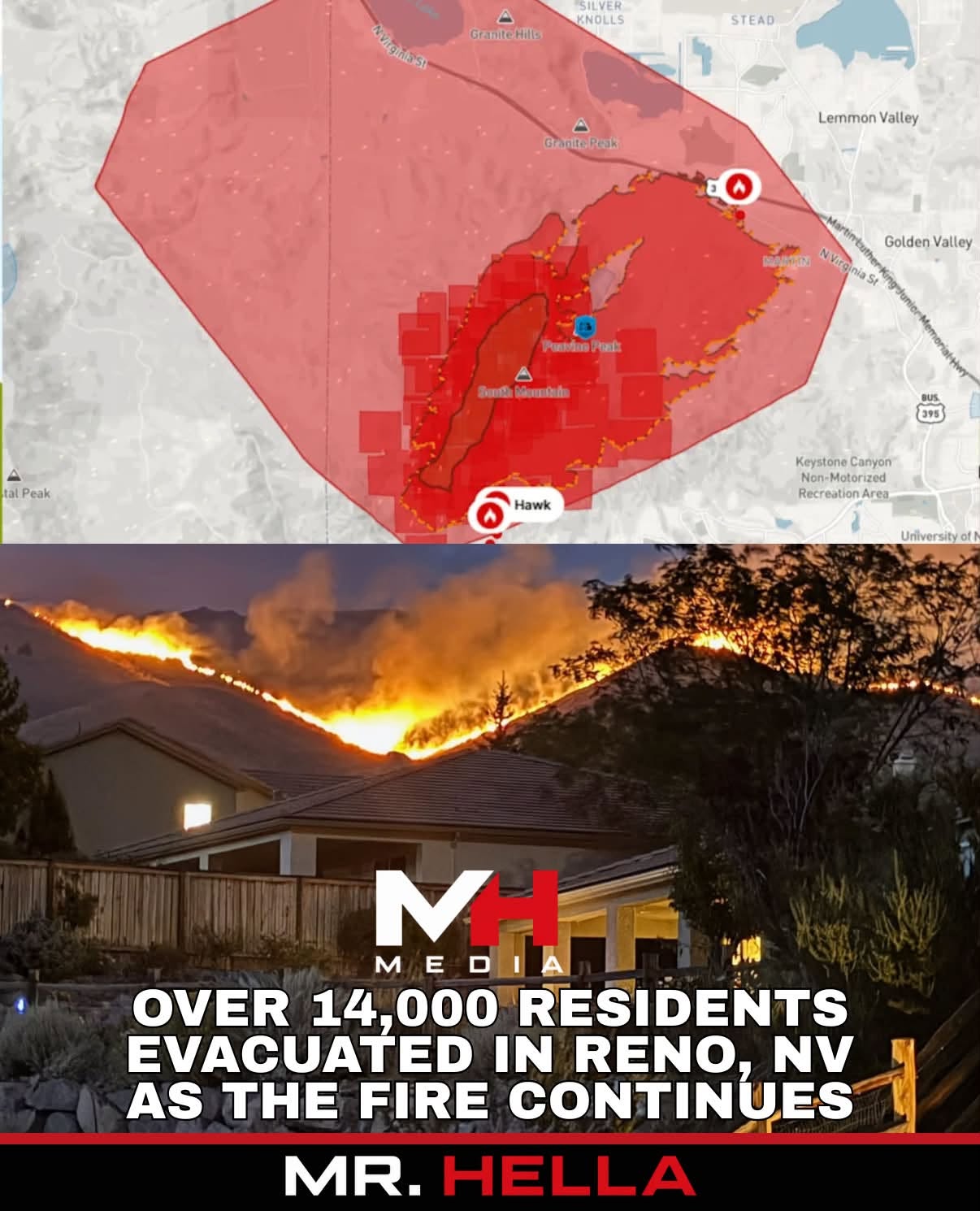
A fast-moving wildfire that erupted near northwest Reno grew from a brush fire into one of the region's most destructive emergencies of the summer, burning more than 15,000 acres, destroying dozens of homes and forcing tens of thousands of Nevada residents to flee as powerful winds pushed flames toward populated neighborhoods.
The Hawk Fire began Saturday, August 22, near Peavine Mountain and expanded with extraordinary speed through dry grass, brush and timber. By Saturday evening, the fire had already burned approximately 10,523 acres and remained completely uncontained, prompting Nevada Gov. Joe Lombardo to declare a state of emergency in Washoe County as evacuation zones rapidly expanded around Reno and the North Valleys.
What followed was a massive firefighting operation involving local, state and federal agencies, the Nevada National Guard and hundreds of firefighters. At the height of the emergency, evacuation orders and warnings affected roughly 90,000 people, widespread power disruptions hit the region, major roads were closed and flames reached residential areas before firefighters were eventually able to slow the fire's advance.
By the time the immediate crisis began giving way to recovery, the Hawk Fire had burned approximately 15,085 acres. Damage assessments found 47 homes and one commercial structure destroyed, with additional properties suffering serious damage. At least seven people were injured, including three first responders, but officials reported no deaths—an outcome fire officials described as remarkable considering the speed with which the flames moved through populated areas.
The Fire Exploded Across Thousands of Acres in Hours
The Hawk Fire was first reported late Saturday morning northwest of Reno. Fueled by exceptionally dry vegetation, low humidity and strong, gusty winds, the fire quickly became difficult to control. Truckee Meadows Fire & Rescue Chief Richard Edwards described the incident as highly dynamic, warning that wind-driven fires can move rapidly into residential neighborhoods and leave firefighters with very little time to protect both homes and lives.
The speed of the fire became one of its defining characteristics. Officials later reported that the blaze moved approximately four miles in just three hours during its first day and ultimately traveled about six miles as it pushed across the landscape. That rapid advance gave residents in threatened neighborhoods little time to make decisions about what belongings to take before leaving their homes.
By Saturday night, mapping showed the fire at more than 10,500 acres with no containment. Its proximity to Reno made the acreage particularly alarming. This was not simply a remote wildfire burning across unpopulated Nevada terrain; flames were advancing toward neighborhoods, roads, utility infrastructure and other developed areas along the city's northwestern edge.
Lombardo declared a state of emergency that evening, directing state agencies to coordinate through the Nevada Emergency Operations Center and provide additional resources to local authorities. He urged residents to take evacuation orders seriously rather than waiting to see how close the flames would come.
The formal written declaration issued the following day said the fire had already exceeded 13,000 acres and threatened tens of thousands of homes in northwest Reno and Stead. The emergency order directed Nevada's emergency-management agencies to coordinate with the Nevada Division of Forestry and federal authorities as the state mounted a broader response.
Tens of Thousands Were Told to Leave
As the fire advanced, evacuation zones expanded dramatically. At one point, approximately 90,000 residents were either ordered to evacuate or warned to prepare to leave, according to reporting from the height of the emergency. Roughly 40,000 people had already evacuated while tens of thousands more remained under warning as authorities watched shifting winds and attempted to predict where the fire would move next.
The evacuation effort extended across communities near Peavine Mountain, northwest Reno, Somersett and the North Valleys. The threat eventually moved close enough to the University of Nevada, Reno, that evacuation warning zones approached the campus as thousands of students prepared for the beginning of fall classes.
Emergency shelters were established for displaced residents while authorities worked to keep evacuation routes open. Traffic became another challenge for emergency personnel as thousands of people attempted to leave threatened neighborhoods at the same time firefighters and equipment were moving toward the flames.
The Nevada National Guard was activated to support the response. Fire crews from multiple agencies converged on the region, and the operation eventually grew to more than 800 personnel. Helicopters, engines, hand crews and bulldozers were deployed as firefighters attempted to build containment lines between the advancing fire and populated neighborhoods.
Homes Were Lost as Flames Reached Residential Areas
Despite those efforts, firefighters could not save every structure in the fire's path. Damage teams initially counted 32 destroyed homes, but the number increased as inspectors gained access to neighborhoods that had been too dangerous to enter during the height of the fire.
By August 25, officials said 47 homes and one commercial structure had been destroyed. Eight additional homes suffered serious damage in the initial assessment, with much of the destruction concentrated west of U.S. 395 and additional impacts occurring on the highway's eastern side.
The destruction left some residents returning not to damaged houses but to properties that had been almost completely consumed. At the same time, canine search teams moved through affected neighborhoods looking for possible victims. Officials reported no indications of fatalities during those searches.
That absence of deaths stood out because of how quickly the fire had reached populated areas. Edwards said it was remarkable that nobody had been killed given the fire's speed. The blaze had traveled miles during its first day, leaving residents and emergency crews with an unusually narrow window to respond.
At least seven people were reported injured during the emergency, including three firefighters who suffered minor burns during the initial attack.
Power and Transportation Infrastructure Were Hit
The fire's impact extended beyond destroyed homes. Electrical infrastructure was heavily damaged, contributing to widespread outages as NV Energy crews attempted to restore service in areas that firefighters had only recently made safe enough to enter.
At one point, approximately 10,000 customers remained without power, primarily in the North Valleys, and utility crews were working to replace or repair more than 100 damaged or destroyed power poles.
Earlier in the emergency, outages had affected substantially larger numbers of customers as utilities de-energized equipment and fire damaged infrastructure across the region. Major transportation routes were also affected, including portions of U.S. 395, while the Reno-Stead Airport temporarily restricted normal operations so firefighting and military aircraft could use the airspace.
Fire officials later reported impacts to other critical infrastructure, including a railway line and a communications tower.
Those disruptions demonstrated how a wildfire approaching a metropolitan area can become more than a firefighting emergency. Even residents whose homes never encountered flames could lose electricity, face road closures, be forced from their neighborhoods or experience interruptions to transportation and communications.
Wind Was the Firefighters’ Biggest Enemy
The Hawk Fire's rapid expansion was driven in large part by weather and fuel conditions. Northern Nevada's dry vegetation provided abundant material for the flames, while low humidity and strong winds helped carry the fire across the landscape.
Fire officials repeatedly identified wind as the most important variable. Gusts could push flames through brush and grass faster than ground crews could establish defensive lines, and shifting winds created the possibility that neighborhoods previously considered relatively safe could suddenly face a new threat.
That unpredictability continued even after firefighters began gaining ground. Officials remained concerned that stronger afternoon winds could test containment lines and reignite areas where heat remained in vegetation.
The combination of dry fuels and wind helps explain how the fire grew from its initial report to more than 10,000 acres in less than a day. It also explains why authorities issued evacuation warnings well beyond the immediate fire perimeter. In a wind-driven wildfire, waiting until flames are visible from a home can leave residents with dangerously little time to escape.
Officials Say the Hawk Fire Was Human-Caused
Investigators classified the Hawk Fire as human-caused. Officials had not, in the incident updates reviewed here, publicly identified a specific person responsible or established whether the ignition was intentional.
That distinction matters. A “human-caused” classification can encompass a wide range of potential ignition sources and should not automatically be interpreted as arson. Until investigators announce a more specific determination, the established public finding is that human activity caused the fire.
The Hawk Fire also arrived during an exceptionally difficult period for northern Nevada. Other major wildfires—including the Bug and Stallion fires—had already burned enormous areas around the region during the preceding weeks. Nevada officials described widespread fire activity aggravated by dry conditions, high temperatures and severe winds.
For residents and emergency crews, that meant the Hawk Fire was not an isolated disaster. It arrived while resources and communities were already dealing with the effects of other large fires.
Firefighters Eventually Turned the Corner
After the frightening first days, firefighters began making substantial progress. By August 25, the fire had reached approximately 15,051 acres and 27% containment, with 816 personnel assigned to the incident. Crews were using 81 engines, 14 crews, 10 helicopters and nine bulldozers as they strengthened containment lines and protected neighborhoods.
Containment then improved rapidly. By August 27, the fire stood at 15,085 acres and 93% containment. Crews shifted increasingly toward mop-up operations, patrols and strengthening existing lines while continuing to monitor pockets of heat in heavy vegetation.
Containment does not mean a wildfire is completely extinguished. It refers to the percentage of the fire perimeter that firefighters believe has been secured sufficiently to prevent additional spread. Interior vegetation can continue burning or smoldering even after the perimeter is largely contained, which is why crews remained on scene after the immediate danger to most neighborhoods had diminished.
By August 31, the Hawk Fire was 98% contained at 15,085 acres. Personnel had been reduced to 187 as the operation transitioned away from the massive emergency response that had been necessary during the fire's initial advance. Crews continued repairing areas affected by suppression work and monitoring isolated heat along the western portion of the fire.
The Emergency Shifted From Evacuation to Recovery
As containment increased, authorities gradually lifted or downgraded evacuation orders and allowed thousands of residents to return home. For many, the return brought relief. For others, it revealed the scale of what had been lost.
Nevada officials began shifting resources toward recovery, including housing assistance, debris removal and restoration of damaged infrastructure. Northern Nevada Public Health declared a local public-health emergency covering communities affected by the Hawk and other recent fires, warning that burned properties could contain hazardous ash and debris that residents should not attempt to remove without proper guidance.
Lombardo also requested a presidential emergency declaration to secure additional federal assistance for the Hawk Fire response and recovery. The governor said Nevada needed federal support to protect communities, restore infrastructure and assist people whose homes and property had been affected.
The fire also triggered Nevada's emergency protections against price gouging. Attorney General Aaron Ford said his office received reports of possible excessive price increases involving essentials such as lodging, food and gasoline in disaster areas and warned businesses that emergency pricing protections were in effect.
For residents who lost homes, however, containment was only the beginning of a much longer process. Insurance claims, temporary housing, debris removal, utility repairs and rebuilding can continue for months or years after the flames disappear.
A Fire That Went From Brush to Neighborhoods in Hours
The Hawk Fire demonstrated how quickly the line between wilderness and city can disappear in northern Nevada.
On the morning of August 22, it began as a new wildfire near Peavine Mountain. Within hours, wind had pushed the flames across thousands of acres and toward Reno neighborhoods. By that night, more than 10,500 acres had burned, the fire remained uncontained and Nevada's governor had declared a state of emergency.
The fire would ultimately grow to approximately 15,085 acres. Tens of thousands of residents were displaced or warned to prepare for evacuation. Forty-seven homes and a commercial building were destroyed, additional properties were seriously damaged, electrical and transportation infrastructure was disrupted, and at least seven people—including three firefighters—were injured.
Yet amid the destruction, officials reported no fatalities.
By the end of August, the emergency had largely shifted from stopping a rapidly advancing wall of fire to helping communities recover from what it left behind.
For northwest Reno, the Hawk Fire became a reminder of how little time a wind-driven wildfire can provide. The distance between an ignition in dry brush and flames reaching someone's neighborhood can be measured not in days, but in hours.


Comments