

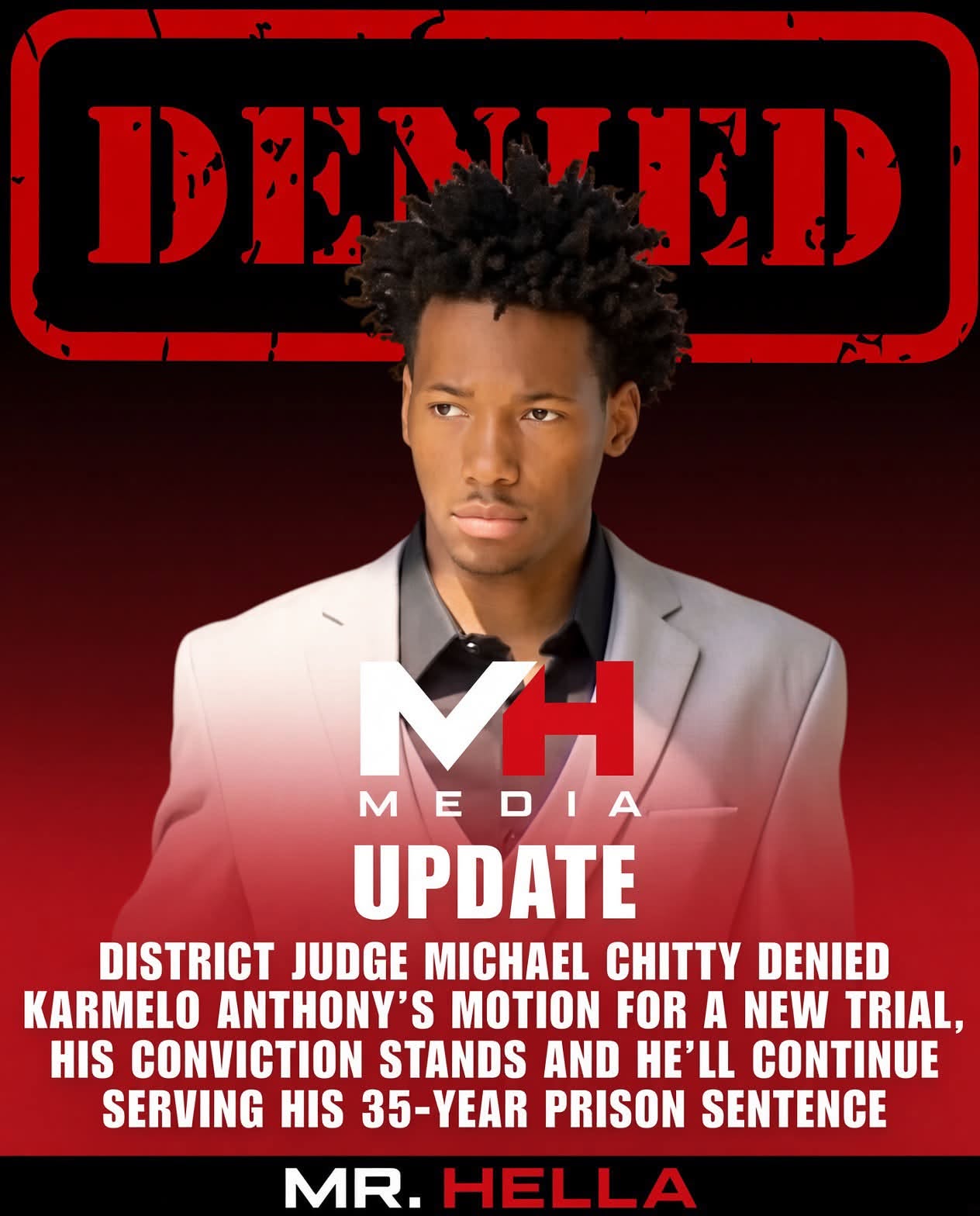
Karmelo Anthony will not receive a new trial after a Texas judge rejected his attempt to overturn the murder conviction that resulted in a 35-year prison sentence for the fatal stabbing of 17-year-old Austin Metcalf.
Retired Kaufman County District Judge Michael Chitty denied Anthony's motion for a new trial on August 22, following an extraordinary two-day evidentiary hearing that revisited some of the most controversial decisions made behind closed doors during Anthony's original murder trial.
Anthony, now 19, was convicted in June 2026 of murdering Metcalf during a confrontation at a high school track meet in Frisco, Texas, on April 2, 2025.
Anthony admitted that he stabbed Metcalf but maintained that he acted in self-defense.
Jurors rejected that defense.
They found Anthony guilty of murder after approximately three hours of deliberations and later sentenced him to 35 years in prison.
His new attorneys subsequently launched an aggressive attempt to have the conviction thrown out.
That attempt has now failed at the trial-court level.
But Anthony's legal battle isn't over.
His attorneys say they will continue challenging the conviction through the Texas appellate courts.
Judge Michael Chitty Denies the Motion
Judge Chitty issued his decision in a short written order after reviewing the testimony and arguments presented during the two-day hearing.
The order did not provide an extensive explanation addressing each of the defense's claims individually.
Instead, Chitty wrote that after reviewing the motion, record, evidence, arguments, briefs and relevant case law, the court determined that the request should be denied.
The decision means Anthony's original conviction remains intact.
So does his sentence.
Unless Anthony successfully challenges the conviction through the appellate process or obtains some other form of post-conviction relief in the future, he continues serving the 35-year prison term imposed by the jury.
The New-Trial Hearing Lasted Two Days
Anthony's request wasn't rejected without a significant examination of what occurred during the original trial.
The new-trial hearing stretched across two days.
Former defense attorneys testified.
A prosecutor testified.
Arguments that had previously occurred behind closed doors were discussed publicly.
And the court examined an unusual unwritten agreement between prosecutors and Anthony's original defense team.
Much of the hearing centered around one fundamental question:
Did decisions made during the original trial unfairly prevent Anthony from presenting his complete defense?
His new attorneys argued they did.
Prosecutors strongly disagreed.
The ‘Gentleman’s Agreement’ Became a Major Issue
One of the biggest revelations involved an informal agreement between Anthony's original attorneys and prosecutors.
Both sides possessed potentially damaging character evidence.
The defense had information it potentially wanted to introduce concerning Austin Metcalf.
Prosecutors possessed information they potentially wanted to introduce concerning Anthony.
Rather than turning the murder trial into a battle over each teenager's character and history, the attorneys reached an informal understanding to keep much of that evidence away from the jury.
The agreement wasn't formally written.
It became known during the post-trial proceedings as a “gentleman's agreement.”
For much of the trial, it apparently worked.
Then Anthony considered testifying.
That's where the disagreement became critical.
Anthony Considered Taking the Witness Stand
Anthony did not testify during his murder trial.
The new-trial hearing revealed more about why.
According to testimony from his former defense attorney Mike Howard, Anthony had been preparing to take the stand and tell jurors his version of the confrontation with Metcalf.
That could have been enormously significant.
Anthony's defense was self-defense.
Having Anthony personally explain what he saw, what he feared and why he used the knife could have allowed jurors to hear directly from the only surviving person who participated in the confrontation.
But putting a defendant on the witness stand also carries major risks.
The prosecution gets to cross-examine him.
And the disagreement over the informal evidence agreement suddenly became critical.
Defense Lawyers Feared the Agreement Would Collapse
Anthony's original attorneys believed the agreement restricting character evidence should continue protecting their client if he testified.
Prosecutors disputed how broadly the agreement applied.
According to testimony presented during the new-trial hearing, the disagreement became heated.
Anthony's attorneys feared that if he took the stand, prosecutors could potentially introduce damaging evidence that jurors hadn't previously heard.
Howard testified that Anthony ultimately decided against testifying because he believed he wasn't going to receive a “fair shake.”
Anthony's new attorneys later argued that this effectively coerced him into giving up his constitutional right to testify in his own defense.
They contended that the dispute prevented Anthony from presenting his complete self-defense case.
Prosecutors rejected that argument.
Anthony ultimately remained silent during the original trial.
Jurors never heard directly from him.
The Hearing Revealed Evidence Jurors Never Heard
The post-trial proceedings also revealed potentially damaging information about both Anthony and Metcalf that had largely been kept away from the original jury.
According to prosecutors, evidence concerning Anthony included what they described as an interest in guns, knives and fighting, along with allegations involving threats toward a girlfriend.
Those claims became part of the discussion surrounding why the original attorneys had agreed to keep certain character evidence outside the trial.
The defense, meanwhile, had potential character evidence concerning Metcalf and his twin brother, including allegations involving bullying and racism.
The jury that convicted Anthony did not hear the case as an unrestricted battle over those allegations.
Instead, the attorneys had attempted to keep the trial focused on what occurred during the fatal confrontation.
The new-trial hearing exposed how complicated that decision became once Anthony considered testifying.
Courtroom Access Became Another Major Defense Argument
Anthony's new attorneys also attacked the restrictions imposed during his original trial.
Because of intense national attention and security concerns surrounding the case, access to the courtroom was tightly controlled.
The defense argued those restrictions went too far.
Anthony's attorneys claimed limitations on public access violated his Sixth Amendment right to a public trial.
Prosecutors argued that the measures were necessary because of legitimate security concerns surrounding the highly publicized case.
The dispute became one of the central issues in Anthony's motion for a new trial.
Judge Chitty ultimately declined to overturn the conviction on that basis.
The Original Trial Judge Was Removed From the Post-Trial Proceedings
Another unusual development occurred immediately before the new-trial hearing.
Judge John Roach Jr., who presided over Anthony's original murder trial, was recused from handling the post-trial proceedings.
Anthony's new defense team sought Roach's removal after the judge gave a post-trial interview in which he agreed that the jury had reached the correct result.
Visiting Judge Sid Harle granted the recusal request.
That meant another judge needed to decide whether the trial Roach had overseen should be thrown out.
Retired Judge Michael Chitty was brought in to handle the motion.
Chitty ultimately left the conviction intact.
The Fatal Confrontation Happened at a Track Meet
The case began on April 2, 2025.
Anthony and Metcalf were both 17 at the time.
They attended different Frisco-area high schools and were participating in a district track meet at Kuykendall Stadium.
Rain had moved athletes underneath team tents in the stadium stands.
According to trial testimony, Metcalf confronted Anthony because Anthony was underneath Memorial High School's tent despite attending Centennial High School.
Witnesses said Metcalf told Anthony to leave.
The confrontation escalated.
According to witnesses cited by prosecutors, Anthony reached into his bag and warned Metcalf about touching him.
Metcalf subsequently pushed or made physical contact with Anthony.
Anthony pulled a knife.
He stabbed Metcalf once in the chest.
The wound proved fatal.
Metcalf Died Despite Attempts to Save Him
Emergency responders attempted lifesaving measures.
Metcalf's twin brother, Hunter, was nearby when the stabbing occurred and tried to help his brother.
Police and fire personnel performed emergency treatment, but Austin could not be saved.
The 17-year-old died following the stabbing.
The circumstances immediately turned what had been an ordinary high school athletic event into a homicide investigation that would eventually receive national attention.
Anthony Never Denied the Stabbing
One important distinction remained consistent throughout the case.
The central question wasn't whether Anthony stabbed Metcalf.
Anthony acknowledged that he did.
The legal dispute was whether that stabbing constituted murder or legally justified self-defense.
Anthony told authorities that he believed he had been protecting himself.
Prosecutors argued that his use of deadly force wasn't justified.
That became the fundamental issue presented to the jury.
Prosecutors Said It Was Murder
The prosecution argued that Anthony escalated the confrontation by introducing a knife into what had otherwise been a relatively brief dispute between two teenagers.
They emphasized witness testimony concerning Anthony reaching into his bag and allegedly warning Metcalf before the stabbing.
From the state's perspective, being pushed did not legally justify the use of deadly force under the circumstances presented at trial.
Prosecutors characterized the killing as murder.
The Defense Said Anthony Was Protecting Himself
Anthony's attorneys told a different story.
They emphasized that Metcalf initiated physical contact.
Anthony was smaller.
The confrontation happened quickly.
And according to the defense, Anthony believed he was facing a physical threat.
His attorneys argued that he reacted in self-defense.
The defense therefore wasn't asking jurors to decide whether Anthony used the knife.
They were asking jurors to determine whether Texas self-defense law legally justified his decision to use it.
The jury ultimately decided that it did not.
The Jury Convicted Anthony in June
After hearing the evidence, the Collin County jury deliberated for approximately three hours before returning a murder conviction.
The same jury later considered punishment.
Anthony was sentenced to 35 years in prison.
The sentence was substantial but below the maximum punishment available for murder under Texas law.
The verdict ended the original trial.
It didn't end the case.
Almost immediately, attention shifted toward appeals and post-trial challenges.
The Jury Instructions Are Also Being Challenged
Anthony's new legal team has raised another important issue involving how jurors were instructed to consider self-defense.
The defense has challenged language concerning provocation.
Under Texas law, self-defense can become unavailable under certain circumstances if someone provokes the confrontation that leads to the use of force.
Anthony's attorneys argue the jury instructions improperly affected jurors' consideration of the central issue in the case: whether Anthony acted in self-defense.
Judge Chitty's denial of the new-trial motion leaves that argument unresolved in Anthony's favor at the trial-court level.
But it can continue being litigated on appeal.
The Defense Says the Fight Isn't Over
Following Chitty's decision, Anthony's attorneys made clear that they aren't abandoning the case.
His legal team said it was disappointed but “not deterred.”
The defense continues to maintain that constitutional and legal errors prevented Anthony from receiving a fair trial.
Attorneys specifically pointed again to public-access restrictions, the dispute over the evidence agreement and alleged problems with the jury instructions.
Lead appellate attorney Russell Wilson said the issues deserve meaningful appellate review.
The next major battleground will be the Fifth Court of Appeals in Dallas.
The District Attorney Says the Jury’s Verdict Should Stand
Collin County District Attorney Greg Willis welcomed the decision.
Willis said prosecutors respected and expected Chitty's ruling.
“The jury's guilty verdict stands, and we remain confident in the process,” Willis said.
He also acknowledged Anthony's legal right to appeal and expressed support for the Metcalf family following the emotionally difficult post-trial hearing.
A New Trial Would Have Reset the Case
Had Chitty granted the motion, the consequences would have been significant.
Anthony's murder conviction would have been vacated.
The prosecution would then have needed to decide whether to try him again.
Anthony also could potentially have returned to pretrial status while another prosecution was pending, subject to bond conditions determined by the court.
Instead, none of that happened.
The original verdict remains legally operative.
Anthony remains convicted of murder.
And his 35-year sentence remains in effect.
Now the Case Moves to the Appeals Court
The denial doesn't mean Anthony has exhausted his legal options.
A motion for a new trial and a direct appeal are separate parts of the post-conviction process.
Anthony can ask the Fifth Court of Appeals to examine alleged legal errors from the original proceedings.
The appellate court doesn't simply conduct another murder trial.
Instead, appellate judges review the trial record and legal arguments to determine whether reversible errors occurred.
Potential issues could include the public-trial argument, jury instructions and other alleged constitutional or procedural errors preserved for appellate review.
The defense has already made clear that it intends to pursue that process.
The Case Has Remained Nationally Controversial
From its earliest days, the killing of Austin Metcalf generated an enormous online response.
The fact that both boys were teenagers contributed to the attention.
So did the setting.
This wasn't a confrontation outside a nightclub or an incident involving adults with long criminal histories.
It happened at a high school track meet.
Both teenagers were athletes.
Anthony is Black.
Metcalf was white.
Those facts quickly became central to social-media narratives surrounding the case, with online commentators frequently interpreting the killing through racial and political lenses.
Attorneys in the courtroom maintained that the criminal trial itself was about the evidence and Texas law—not race.
The online conversation often looked very different.
Two Families Were Permanently Changed
Lost beneath much of the national argument are two families whose lives changed on April 2, 2025.
Austin Metcalf was 17.
He went to a track meet and never came home.
His twin brother witnessed the aftermath of the stabbing and tried to save him.
His family has now spent more than a year navigating grief, a murder prosecution, a sentencing hearing and another round of court proceedings over whether the conviction should be thrown out.
Anthony was also 17 when the confrontation occurred.
He is now 19 and serving a 35-year prison sentence.
His family has continued supporting him and his legal challenges.
Regardless of the enormous social-media debate surrounding the case, those consequences are permanent.
Judge Chitty’s Decision Preserves the Status Quo
After two days of testimony revisiting the original trial, Judge Michael Chitty ultimately declined to change its outcome.
The informal evidence agreement wasn't enough to secure a retrial.
The dispute surrounding Anthony's decision not to testify wasn't enough.
The courtroom-access argument wasn't enough.
And the broader challenges raised by Anthony's attorneys did not persuade Chitty to vacate the conviction.
His written order was short.
Its impact was not.
Karmelo Anthony remains convicted of murdering Austin Metcalf.
His 35-year prison sentence remains intact.
But the legal fight now moves beyond the trial court.
Anthony's attorneys say they will take their arguments to the Fifth Court of Appeals and continue pursuing every legal remedy available.
For now, however, the jury's June 2026 verdict stands.
Comments