

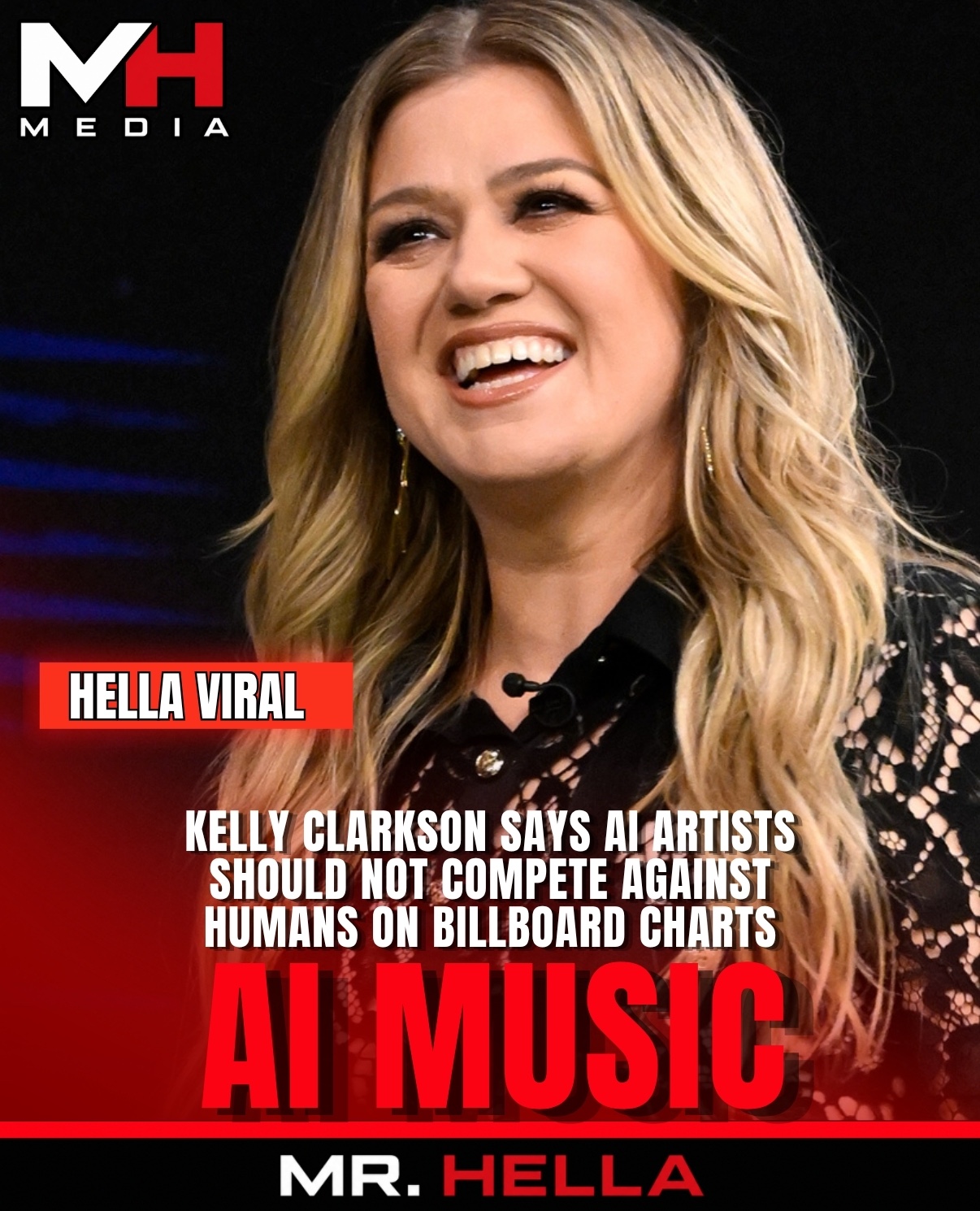
Kelly Clarkson says artificial intelligence has a place in the music industry — but she doesn’t believe AI-generated artists should be allowed to compete directly against human musicians on the same charts.
The Grammy-winning singer weighed into one of the industry’s fastest-growing debates during the September 30 episode of Las Culturistas, the podcast hosted by Bowen Yang and Matt Rogers. Clarkson surprised the hosts by making clear that she isn’t opposed to artificial intelligence itself. In fact, she said she “loves AI” and is fascinated by what the technology can do artistically.
Her objection begins when AI-generated performers enter the same competitive ecosystem as human musicians.
“When you see AI artists competing on a chart with humans, I have an issue,” Clarkson said. “I think there should be a separate chart.”
The distinction puts Clarkson in an unusual position in the increasingly heated AI debate. She isn’t asking the music business to ban AI songs, nor is she arguing that listeners shouldn’t consume them. Instead, Clarkson believes AI music should have its own lane — including its own charts — while human artists continue competing against other humans.
“I think it’s welcome to the table,” Clarkson said, adding that she believes AI will produce interesting and creative musical possibilities.
Clarkson Compares It to Robots Entering the Olympics
Clarkson used sports to explain why she believes the current system doesn’t make sense.
She compared AI artists competing against human musicians to robots entering the Olympics and competing directly against human athletes.
The implication was straightforward: even if the technology is impressive, Clarkson doesn’t believe the two forms of creation necessarily belong in the same competition.
“It’s basically like having the Olympics and then you’re having robots compete with humans,” Clarkson said.
Clarkson stressed that she is still interested in seeing what musicians, producers and creators ultimately do with the technology. Her concern isn’t experimentation itself.
It’s competition.
She believes there can be an audience for both human-created music and AI-generated music without forcing the two into the same chart race.
AI Artists Are Already Reaching Billboard Charts
Clarkson’s comments aren’t about a hypothetical future.
AI-generated performers have already begun appearing on Billboard rankings.
One of the biggest examples has been Xania Monet, an AI-generated R&B act created by Mississippi songwriter Telisha “Nikki” Jones. Jones writes the lyrics behind the project, while artificial-intelligence tools are used in the production and performance process.
Xania Monet became the first known AI act to generate enough radio airplay to enter a Billboard radio chart, turning what had largely been a philosophical argument about AI music into a real industry issue.
That development raises a difficult question for chart companies.
If listeners stream an AI-generated song millions of times, should those streams count differently from streams of a song recorded by a human vocalist?
If radio stations play it, should those spins count?
If people purchase the song, should those purchases be excluded because the performer isn’t human?
Those are questions the music industry is increasingly being forced to confront.
Clarkson’s answer isn’t to erase those numbers.
She wants them measured separately.
Billboard Hasn’t Banned AI Music
Billboard currently doesn’t have a blanket rule excluding music simply because artificial intelligence was involved in its creation.
That becomes complicated because “AI music” can describe dramatically different things.
One recording might be almost entirely generated by artificial intelligence.
Another might feature a human singer who used AI to clean up a vocal.
A producer could use an AI-powered tool during mixing.
A songwriter could use artificial intelligence during brainstorming but ultimately write and perform the record personally.
And then there are fully virtual performers whose voices, appearances and public identities may largely or entirely be generated.
Those aren’t necessarily the same thing.
Billboard has been moving toward greater identification and labeling of AI-generated music rather than simply banning anything involving the technology.
That distinction could become critical if the industry ever attempts to implement something resembling Clarkson’s proposal.
What Counts as an “AI Artist”?
Creating a separate AI chart sounds relatively simple until someone has to decide who belongs on it.
Consider a human songwriter who writes every lyric but uses an AI-generated voice.
Is that an AI artist?
What about a human singer who records the vocals but uses generative AI to build the instrumental?
What if a producer uses AI on only one element of a track?
What happens if a completely artificial avatar performs a song written and produced entirely by humans?
The line between AI-generated and AI-assisted music could become one of the biggest regulatory challenges facing chart companies.
Music-industry organizations are already attempting to distinguish between those categories as artificial intelligence becomes integrated into ordinary production software.
Clarkson’s broader principle, however, is clear.
She doesn’t want technology to eliminate the competitive space occupied by human creators.
Clarkson Says AI Can Still Be Creative
What makes Clarkson’s comments particularly notable is that she isn’t approaching the subject from an anti-technology position.
Quite the opposite.
“I love AI,” she said during the podcast.
Clarkson described herself as fascinated by some of its possibilities and said she has fun experimenting with the technology. She also argued that AI could allow people who previously couldn’t execute certain creative ideas to bring those ideas to life.
That puts her at odds with the idea that embracing AI and defending human artists have to be mutually exclusive positions.
Clarkson believes both can exist.
What she wants is separation once the music becomes competitive.
“We Can’t Lose Human”
Clarkson’s larger concern appears to be preservation rather than prohibition.
“We can’t lose human,” she said while discussing the future of AI creativity.
She also called for regulation and respect as the technology becomes more sophisticated.
That concern extends beyond whether an AI song reaches No. 1.
Artificial intelligence has already created disputes involving voice cloning, copyright, songwriting credits, training data and whether AI systems can legally learn from copyrighted recordings without permission.
Artists are particularly concerned about technology capable of reproducing recognizable voices.
A convincing AI vocal can increasingly sound like an established singer even when that singer never entered a studio, approved the recording or participated in its creation.
For working musicians, that raises questions much larger than chart placement.
It raises questions about ownership and identity.
The Music Industry Is Trying to Decide Where the Line Goes
The arrival of generative AI has forced the recording business into territory that didn’t exist when most of its traditional rules were written.
For decades, the basic concept of a recording artist was obvious.
There was a person — or a group of people — behind the music.
Technology changed how those people recorded, but the performer remained human.
Auto-Tune altered vocals.
Drum machines replaced some live percussion.
Sampling allowed producers to repurpose older recordings.
Digital audio workstations transformed production.
None of those developments created an entirely artificial recording artist capable of releasing an unlimited catalog without physically existing.
Generative AI potentially does.
An AI act doesn’t need sleep.
It doesn’t lose its voice.
It doesn’t miss a studio session.
It doesn’t necessarily need months between albums.
Depending on how the project is operated, new recordings could potentially be generated at a scale difficult for human musicians to match.
That helps explain Clarkson’s Olympics comparison.
Her concern is not simply that AI exists.
It is whether the competitive conditions are comparable.
Other Countries Are Already Drawing Lines
The debate isn’t limited to the United States.
Australia has moved toward excluding wholly AI-generated recordings from eligibility on its official charts, while music-industry organizations in other countries have been developing their own approaches to distinguishing human recordings from predominantly AI-generated material.
That means Clarkson’s proposed solution isn’t entirely outside the direction parts of the international music industry are already exploring.
The harder issue is determining the threshold.
A prohibition on completely AI-generated songs is relatively easy to describe.
Regulating a song that is 10%, 30% or 70% AI-assisted becomes much more complicated.
Modern recording already relies heavily on software, and AI functionality is increasingly being built into tools used by ordinary musicians and producers.
Eventually, simply asking whether “AI was used” may become almost meaningless.
The more important question could become how much of the underlying creative performance was generated by it.
Clarkson’s Own Career Was Built Through Human Competition
There is also some historical irony to Clarkson becoming one of the artists publicly raising the issue.
Her career began through one of the most direct forms of musical competition possible.
Clarkson won the inaugural season of American Idol in 2002.
She competed against other singers based largely on live performances and public voting, eventually becoming the show’s first champion.
From there, Clarkson built a career that produced major records including “Since U Been Gone,” “Because of You,” “Stronger (What Doesn’t Kill You),” “Behind These Hazel Eyes” and “Miss Independent.”
She has spent more than two decades competing on the very charts she is now discussing.
That gives her comments a different perspective from someone examining the issue purely as a technology debate.
For Clarkson, charts represent a system in which human performers have historically competed based on recordings created through human performances, even when those recordings relied heavily on technology.
AI-generated artists challenge that assumption.
AI Music Is Becoming Harder to Dismiss as a Gimmick
For several years, AI songs were largely treated as internet curiosities.
Some went viral because they imitated famous performers.
Others gained attention because of the novelty of hearing a computer-generated singer.
But that period is rapidly changing.
AI-generated music is now being commercially released.
Virtual performers are accumulating streams.
AI tracks are reaching radio.
Labels, publishers and technology companies are investing in AI-related systems.
And listeners don’t always know when a performer isn’t human.
Once those songs enter the same marketplaces, streaming platforms and charts as traditional recordings, the industry’s philosophical debate becomes an economic one.
A chart position can influence playlists.
Playlists can produce streams.
Streams produce revenue.
Chart success creates press coverage.
Press coverage can generate additional listening.
That means an AI artist occupying a chart position isn’t merely a novelty.
It can potentially occupy commercial space that otherwise would have gone to a human artist.
That appears to be the line Clarkson is concerned about.
Separate Charts Would Create an Entirely New Category
If Billboard or other chart organizations eventually adopted Clarkson’s idea, it could produce an entirely new sector of music rankings.
There could theoretically be an AI songs chart alongside existing rankings such as the Hot 100, Billboard 200 and genre-specific charts.
AI music would still have a measurable marketplace.
Listeners could still determine which AI songs were most popular.
Creators using artificial intelligence could still compete with one another.
But those releases wouldn’t necessarily displace human performers from traditional rankings.
That would solve one problem while creating several others.
Would AI-assisted human songs remain eligible for the Hot 100?
Could the same song appear on both charts?
Would a human vocalist performing an AI-written song count as human?
Would a virtual singer performing a human-written song count as AI?
Who would certify how a recording was made?
Those are questions Clarkson didn’t attempt to solve during a one-minute podcast segment.
But her comments point directly toward the regulatory debate that chart companies may eventually have to confront.
Clarkson Doesn’t Want AI Replacing People
The singer repeatedly returned to one basic idea during the conversation: technology should expand creativity rather than erase the people who create.
She acknowledged that AI isn’t disappearing and argued that the conversation shouldn’t be reduced to simply being “for” or “against” the technology.
Her position is closer to coexistence.
There is room for AI.
There is room for humans.
But, in Clarkson’s view, they don’t necessarily need to compete for the same trophy.
She also emphasized the need for “regulation of respect” as AI develops and warned against losing the human element of art.
The Chart Debate Is Only Beginning
Clarkson’s comments arrive at a moment when the music business still hasn’t reached a universal definition of what an AI artist actually is.
That’s why her proposal could become more relevant as the technology improves.
Today, many listeners can still identify obviously synthetic vocals.
That may not remain true.
AI voices are becoming more convincing.
Virtual personalities are becoming more sophisticated.
Songs can increasingly be generated quickly and cheaply.
And the difference between a human-assisted AI recording and an AI-assisted human recording can become extremely difficult to see from the finished product alone.
Clarkson isn’t asking for that technology to disappear.
She’s asking the industry to decide where it belongs.
“I think it’s welcome to the table,” she said.
Just not, in her view, on exactly the same playing field.
For Clarkson, the solution is a separate chart — one where artificial artists can compete against artificial artists while human musicians continue competing against people.
As AI-generated performers increasingly move from internet experiments into commercial music, that once-futuristic question is quickly becoming something Billboard, streaming platforms, record companies and artists may have to answer in the real world.


Comments