

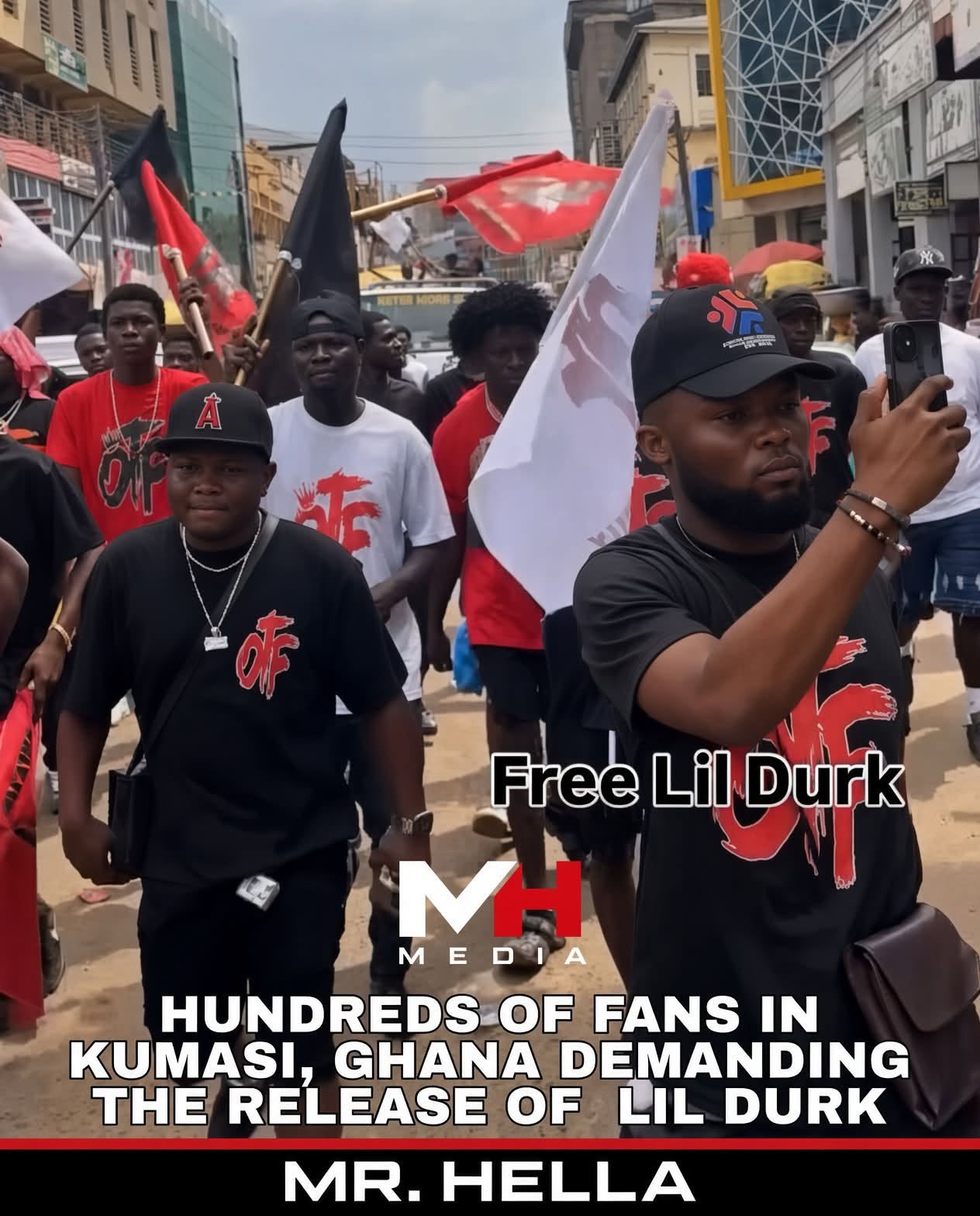
Thousands of miles from the federal courtroom in Los Angeles where Lil Durk was fighting some of the most serious charges of his career, supporters of the Chicago rapper took their message to the streets of Ghana.
Videos circulating across social media around August 22 showed a large group of Durk supporters marching through the streets in Ghana while carrying Only The Family flags, wearing OTF-branded clothing and calling for the rapper's release. The demonstration quickly spread across hip-hop pages and social platforms, creating one of the more unusual scenes surrounding Durk's federal case: fans in West Africa publicly rallying behind a rapper whose music originated in Chicago's drill movement.
The demonstration coincided with the opening days of Durk's federal murder-for-hire trial in Los Angeles, where the rapper was facing allegations connected with the 2022 shooting that killed Saviay'a Robinson, the cousin of rapper Quando Rondo. Durk had denied wrongdoing, and at the time of the Ghana demonstration, the allegations against him remained unresolved accusations being tested in federal court.
For the fans marching in Ghana, however, the message was considerably simpler: “Free Lil Durk.”
The Ghana Support Movement Didn't Begin in 2026
While the latest footage attracted renewed attention because it emerged during Durk's trial, Ghanaian fans had demonstrated on his behalf before.
On October 28, 2024—only days after Durk was arrested—supporters took to the streets of Kumasi wearing black and red clothing and carrying banners and shirts associated with Only The Family. Contemporary Ghanaian coverage documented fans marching through major streets accompanied by a live band as they called for Durk's freedom.
That earlier demonstration occurred at a dramatically different point in the case. Durk had only recently been taken into federal custody, and much of the public was still learning the details of the government's allegations against him.
Nearly two years later, similar images were circulating again.
This time, Durk was no longer newly arrested. His case had reached a federal courtroom, attorneys were beginning the trial process and supporters were watching developments unfold from around the world.
The persistence of that support made the Ghana demonstrations notable beyond the novelty of seeing OTF merchandise thousands of miles from Chicago.
Durk had developed an audience there strong enough that supporters were willing to turn their fandom into a public gathering.
Chicago Drill Traveled Far Beyond Chicago
The scenes in Ghana also illustrated how dramatically the geographical boundaries of drill music have expanded since the genre emerged from Chicago during the early 2010s.
Chicago drill was initially rooted in intensely local circumstances. Artists including Chief Keef, Lil Durk, King Louie, Fredo Santana and others built audiences by documenting neighborhoods, relationships and conflicts that were deeply connected to Chicago.
The internet changed the scale almost immediately.
YouTube allowed music created in Chicago bedrooms and studios to reach listeners internationally without requiring traditional radio exposure. Streaming platforms expanded that reach further, while social media allowed listeners in completely different countries to follow the artists themselves rather than simply hearing individual records.
Drill eventually developed distinct scenes in the United Kingdom, New York and elsewhere, with artists adapting the sound to their own cities and cultures.
Ghana became part of that broader evolution.
The country developed its own drill movement—often associated with the term “Asakaa”—with Kumasi emerging as an important center. Ghanaian artists incorporated elements associated with drill while combining them with local languages, rhythms and experiences.
That makes Kumasi a particularly interesting location for visible support of Lil Durk. The connection between Chicago and Ghana isn't simply a matter of people overseas listening to American rap. Drill itself became part of a much larger international musical conversation.
Durk is one of the artists whose career survived long enough to watch that transformation happen.
Durk Grew From Chicago Drill Artist Into an International Star
When Lil Durk first emerged during Chicago drill's early explosion, there was little indication that his career would eventually produce this kind of international following.
Durk, born Durk Banks, began releasing mixtapes in the early 2010s and developed a following through projects including the Signed to the Streets series. His melodic approach distinguished him from some of the harder-edged artists emerging from the same scene.
Over time, his music moved increasingly into mainstream American hip-hop.
Collaborations with artists including Drake helped introduce Durk to enormous audiences beyond his existing fan base. His appearance on Drake's “Laugh Now Cry Later” became one of the biggest records of his career, while subsequent albums and collaborations pushed him further into rap's commercial mainstream.
His 2023 collaboration with J. Cole, “All My Life,” became another major crossover record and earned Durk his first Grammy Award when it won Best Melodic Rap Performance at the 2024 ceremony.
By that stage, the artist who had once been primarily associated with Chicago's drill scene had become an internationally recognized rapper.
The Ghana demonstrations offered a different way of measuring that reach.
Streaming totals can demonstrate how many times an artist's songs are played. Social-media followers can show how many people have chosen to follow an account. Concert sales can measure demand in individual markets.
Seeing fans physically march through the streets of another country is something different.
The Demonstration Came as Durk's Trial Was Beginning
The timing made the August footage particularly significant.
Durk's federal trial had entered its opening stages in Los Angeles, with jury selection underway and intense attention surrounding the proceedings. Reporting from the courthouse indicated that supporters were also making their presence known inside the United States, including through “Free Durk” material connected with people attending the proceedings.
The federal case stemmed from a 2022 shooting in Los Angeles.
Prosecutors alleged that the shooting was part of a murder-for-hire plot targeting Quando Rondo. Rondo survived, but his cousin, Saviay'a “Lul Pab” Robinson, was killed.
Federal authorities accused Durk of involvement in the alleged plot, allegations that Durk contested.
Those distinctions are important when discussing the “Free Durk” movement. Fans were expressing support for an artist they believed should be released, but the demonstrations themselves did not establish anything about the underlying evidence or determine Durk's guilt or innocence. Those questions were being decided through the federal court process.
What the demonstrations did establish was the intensity of the public interest surrounding the case.
And that interest extended considerably farther than Chicago or Los Angeles.
Social Media Turned a Ghana Street March Into a Global Hip-Hop Moment
The demonstration might once have remained a local event witnessed primarily by the people who happened to be nearby.
Instead, smartphones transformed it almost instantly into international content.
Videos showing OTF supporters marching in Ghana circulated across hip-hop pages and social-media accounts, where audiences in the United States began reacting to the unusual sight of a “Free Durk” movement unfolding in West Africa. One widely circulated post about the demonstration accumulated hundreds of thousands of views and thousands of interactions.
That same infrastructure helped create Durk's international audience in the first place.
The internet carried Chicago drill around the world. Streaming platforms made Durk's catalog available virtually everywhere. Social media allowed international listeners to follow his career in real time.
Then those same platforms carried footage of those listeners back to American audiences.
The cycle illustrated how dramatically hip-hop fandom has changed.
An artist no longer needs to physically visit every country where they develop a significant following. Music can create communities in places an artist has never performed, while social media allows those communities to participate in moments surrounding the artist almost simultaneously with fans in the United States.
The Ghana footage was an unusually visible example.
Ghanaian Fans Had Already Gone Viral for Supporting Durk After His Arrest
The similarities between the 2024 and 2026 demonstrations are striking.
Following Durk's October 2024 arrest, footage showed Ghanaian supporters wearing OTF shirts, carrying banners and marching publicly in support of the rapper. Ghanaian outlets reported that the demonstration took place in Kumasi on October 28, only days after news of Durk's arrest spread internationally.
The footage generated significant discussion at the time, with some viewers surprised that Durk had inspired that level of organized support in Ghana.
By 2026, it was no longer unprecedented.
The renewed demonstration showed that the earlier gathering had not simply been an isolated viral stunt. Durk's case remained important enough to some Ghanaian supporters that similar imagery emerged as his trial finally began.
That persistence may ultimately be the more interesting part of the story.
A viral song can reach another country overnight. Maintaining an audience across years is considerably more difficult.
Durk's Ghanaian supporters had followed his situation from his arrest into the courtroom.
The March Showed How Far OTF's Identity Has Traveled
Only The Family began as a Chicago-based collective and label closely associated with Durk's career.
In the Ghana footage, however, OTF functioned almost like an international fan identity.
Supporters carried OTF flags and wore clothing bearing the group's branding while marching for Durk. The imagery would have been immediately recognizable to fans familiar with Durk's music despite appearing thousands of miles from the neighborhoods where the collective originated.
That represents a level of cultural export that would have been difficult to imagine during Chicago drill's earliest years.
The movement began as hyperlocal music.
Its language, production, artists and imagery eventually traveled around the world.
By August 2026, that journey had produced a striking scene: while Lil Durk sat inside a federal courtroom in Los Angeles, supporters in Ghana were walking through the streets carrying the symbol of a Chicago rap collective and demanding his freedom.
Whatever happened inside the courtroom would ultimately be determined through the legal process.
But outside of it, the Ghana march demonstrated something considerably easier to measure.
Lil Durk's audience was no longer confined to the city that created him—or even the country where his career began.
Chicago drill had traveled around the world, and some of the people it reached were now making themselves heard.
Comments