

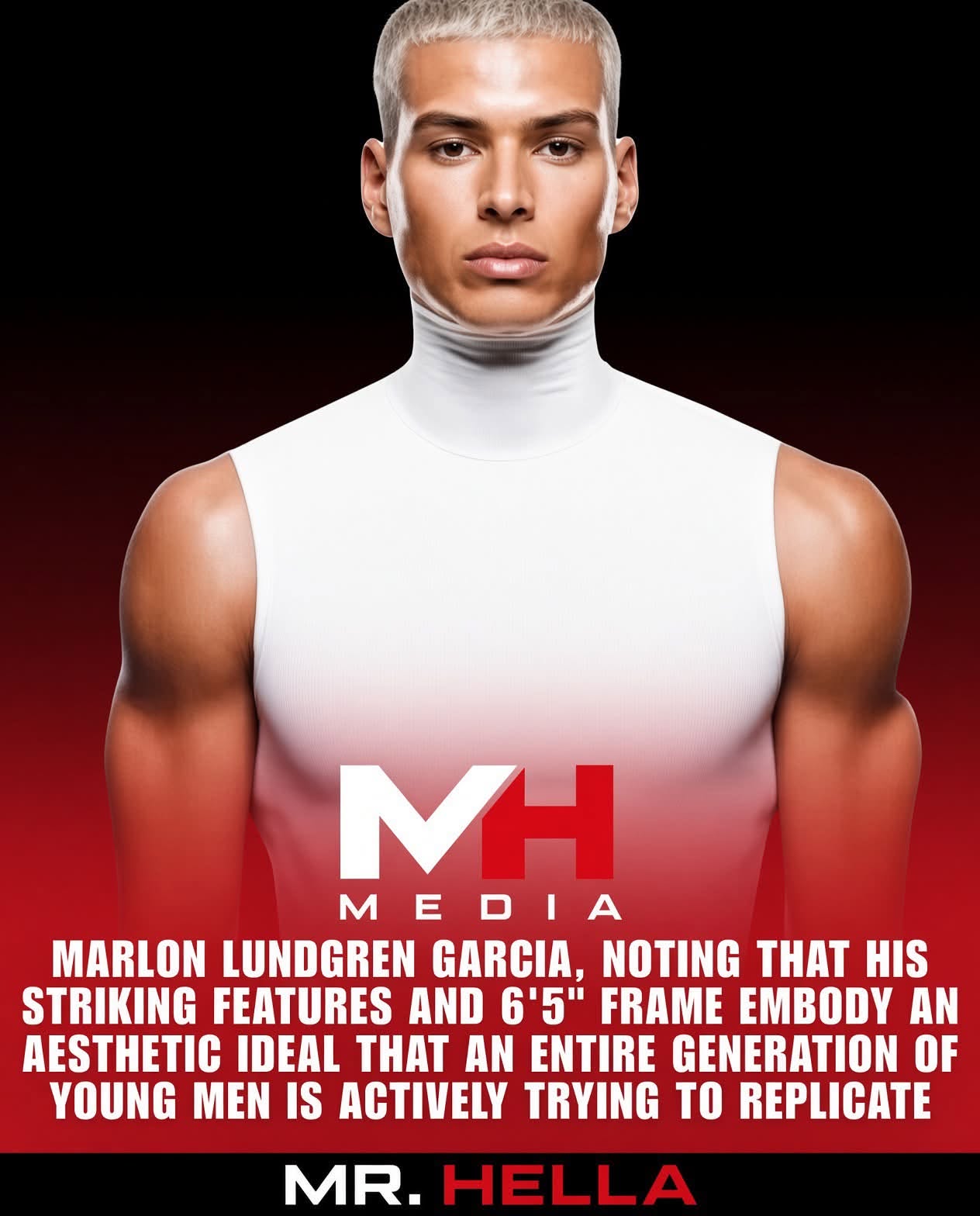
Marlon Lundgren Garcia’s rise from competitive basketball player to internet personality, streamer and high-fashion model has reached another level after Vanity Fair selected the 6-foot-5 Swedish-born creator to represent “The Face” in its September 2026 exploration of modern American style.
For years, social media users have dissected Marlon’s appearance through viral edits, reaction videos and the increasingly popular online world of “looksmaxxing”—a broad internet culture centered around attempting to optimize physical appearance.
Now that fascination has crossed over from internet subculture into traditional fashion media.
Vanity Fair included Marlon in its “State of American Style” portfolio, photographed by Luis Alberto Rodriguez and styled by longtime fashion editor Tonne Goodman.
The magazine divided contemporary style into different archetypes including “The Cowboy,” “The Clean Girls,” “The Body,” “The Swan,” “The Artisan” and others.
For Marlon, Vanity Fair chose one particularly direct description:
“The Face.”
Vanity Fair Declares Marlon ‘The Face’
Vanity Fair's description of Marlon directly acknowledged the online culture that helped make his appearance such a phenomenon.
“In the age of protein, peptides, and looksmaxxing, everybody wants to look new,” the magazine wrote while introducing him.
Vanity Fair then described Marlon as possessing the kind of face and 6-foot-5 physique that a generation of men are pursuing for themselves.
It was a remarkably direct acknowledgment of how much male beauty standards have changed during the social-media era.
Rather than selecting a traditional Hollywood leading man or established runway superstar to represent contemporary male beauty, Vanity Fair chose someone whose fame exists at the intersection of fashion, athletics and internet culture.
Marlon isn't simply a model.
He is also a streamer and social media personality whose appearance has become content itself.
From Internet Obsession to Mainstream Fashion
Marlon's appearance had been generating discussion online long before the Vanity Fair feature.
On TikTok, Instagram, YouTube and other platforms, clips of him routinely attract comments about his height, facial structure, physique and overall appearance.
Certain online communities have gone significantly further.
Users interested in “looksmaxxing” frequently break faces down into individual characteristics, discussing everything from jawlines and cheekbones to eye position, eyebrows, facial symmetry and proportions.
Marlon became a particularly popular subject within those communities.
Online edits and aesthetic-analysis videos frequently highlight his defined jawline, facial proportions, eye area and overall symmetry.
Those descriptions should not be confused with an objective scientific determination that someone possesses a “perfect” face.
Beauty remains subjective, and many of the extremely specific measurements promoted within looksmaxxing communities are internet-created standards rather than universally accepted medical or scientific measures of attractiveness.
But culturally, the fascination is significant.
Millions of young men are now being exposed to a vocabulary for male appearance that barely existed in mainstream conversation a decade ago.
And Marlon has become one of the faces most commonly associated with it.
What Exactly Is ‘Looksmaxxing’?
Looksmaxxing broadly refers to attempts to maximize or improve someone's physical appearance.
The concept can include relatively conventional habits such as exercising, improving nutrition, choosing a flattering haircut, practicing skincare, improving dental hygiene and dressing better.
But online communities sometimes take the concept significantly further.
Discussions can involve facial ratios, jaw development, eye shape, body-fat percentages, supplements, cosmetic procedures and increasingly obsessive analysis of tiny physical characteristics.
Terms such as “canthal tilt,” “facial harmony” and “lower third” have consequently moved from niche online communities into mainstream social-media vocabulary.
The phenomenon has become especially visible among teenage boys and young men.
Vanity Fair's decision to specifically mention looksmaxxing while presenting Marlon as “The Face” therefore wasn't accidental.
The magazine was recognizing a larger cultural shift.
Marlon Fits a Very Different Male Beauty Standard
For decades, mainstream male attractiveness was often represented by movie stars, musicians, athletes and fashion models selected by relatively traditional gatekeepers.
Social media changed that system.
TikTok and Instagram allow millions of users to collectively elevate individuals based almost entirely on appearance.
Streaming added another dimension.
A person can now become famous while spending hours interacting directly with an audience, allowing viewers to see what they look like outside carefully controlled photo shoots.
Marlon sits almost perfectly at the intersection of those worlds.
He has the height and proportions associated with traditional fashion modeling.
He has an athletic background.
He has the enormous online visibility of a creator.
And he possesses facial characteristics that have made him a recurring subject within appearance-focused internet communities.
That combination helps explain why his rise has been so unusual.
His 6-Foot-5 Frame Comes From an Athletic Background
Long before fashion shoots and viral streaming clips, basketball was a major part of Marlon's life.
Lower Columbia College's official athletics records list Marlon Lundgren-Garcia as a 6-foot-5 guard from Malmö, Sweden.
He played for Lower Columbia during the 2020-21 season.
His college biography listed psychology as his major and described basketball as his high-school sport.
Even more notably, his official player biography states that he had been ranked among the top five players in Sweden and had earned MVP honors at a Swedish tournament.
At the time, Marlon's ambitions were firmly focused on basketball.
When asked what he wanted to accomplish after Lower Columbia College, he said he wanted to work hard enough to receive a Division I offer, with the NBA ultimately being his goal.
His path eventually moved in a dramatically different direction.
But the physical foundation created through years of competitive basketball remained.
The 6-foot-5 frame that once made him a basketball prospect would eventually become one of the characteristics helping distinguish him in fashion and social media.
Basketball Didn't Become the Final Destination
Marlon's basketball career never developed into the NBA path he once envisioned.
Instead, his public identity gradually shifted.
Modeling provided one opportunity.
Internet content provided another.
Eventually, streaming became a major component of his career.
That transition represents one of the more interesting elements of his story.
In a previous generation, an athlete whose professional sports ambitions didn't materialize might have needed to completely reinvent himself in an unrelated career.
The creator economy has created an entirely different possibility.
Athleticism, appearance, personality and an ability to hold people's attention can themselves become the foundation of a career.
Marlon capitalized on exactly that combination.
Streaming Turns Marlon Into an Internet Celebrity
Marlon's rise accelerated dramatically through streaming.
Under his online identity, he built an audience through gaming, “Just Chatting” content and IRL streams.
By 2026, his following had expanded into the millions across multiple platforms.
Complex reported around the time of the Vanity Fair feature that Marlon had approximately 2.8 million followers on Twitch alone.
His broader social-media presence extends across Instagram, TikTok and YouTube, where clips of his streams frequently travel far beyond his direct followers.
That viral ecosystem has been essential to his growth.
A funny interaction during a stream can become a TikTok.
A TikTok can become an X post.
The X post can become a reaction video.
And sometimes the subject isn't what Marlon said at all.
It's simply how he looks.
That cycle helped transform his appearance into a recognizable part of his brand.
Fashion Begins Taking Marlon Seriously
Marlon's modeling career has developed alongside his streaming success.
Models.com lists him as represented by IMG New York, one of the most recognizable agencies in the modeling industry.
His professional modeling record includes runway and editorial work.
In 2025, he appeared in an Interview Magazine editorial titled “Big Dreams And A Lot of Faith.”
His runway credits include appearances connected with Willy Chavarria, H&M and other designers.
Then came Vanity Fair.
Unlike a traditional runway appearance, the September 2026 portfolio carried a much larger cultural statement.
Marlon wasn't simply being photographed wearing clothing.
He was being used to represent an archetype.
The Gucci Tank Top Makes the Message Simple
For the Vanity Fair shoot, Marlon was styled in a Gucci tank top.
The simplicity of the outfit was significant.
The feature wasn't attempting to hide him beneath elaborate clothing.
The subject itself was the aesthetic.
His face.
His height.
His physique.
His overall presentation.
That allowed Vanity Fair to make a larger point about contemporary male style: increasingly, the body and face themselves are becoming part of the fashion conversation.
Skincare, fitness, grooming and physical optimization now sit alongside clothing in conversations about men's style.
Why Marlon’s Face Became Such a Major Online Topic
Much of the online discussion surrounding Marlon centers on what looksmaxxing communities refer to as “facial harmony.”
Rather than focusing on one feature, users analyze how different characteristics appear to work together.
His sharp jawline is frequently highlighted.
So are his cheekbones, eye area, eyebrows and facial proportions.
Some online aesthetic breakdowns describe characteristics such as his eye spacing, eyebrow angle and lower-face proportions using highly technical-sounding terminology.
Again, those descriptions largely belong to online beauty-analysis communities rather than representing a universally accepted scientific ranking system.
But their popularity tells us something important.
Young men are increasingly analyzing their own faces in ways previously associated much more heavily with female beauty culture.
The male face has effectively become another optimization project.
Male Beauty Culture Is Changing
For generations, men were often encouraged to treat appearance as something relatively simple.
Get a haircut.
Stay in shape.
Wear decent clothes.
That was essentially the mainstream formula.
Social media has dramatically expanded the conversation.
Men now openly discuss skincare routines.
They compare hairstyles based on facial shape.
They debate body-fat percentages and jaw definition.
They discuss teeth whitening, eyebrow grooming, fragrances and clothing fits.
Some use facial-analysis applications and artificial intelligence tools to evaluate perceived symmetry.
Others explore cosmetic procedures.
The entire male grooming and beauty ecosystem has become considerably more sophisticated—and considerably more intense.
Marlon's rise occurred almost perfectly alongside that transformation.
Genetics Versus ‘Optimization’
There is also an obvious contradiction at the center of Marlon's association with looksmaxxing.
Many of the characteristics people admire about him aren't things someone can simply reproduce through a skincare routine.
Height is the clearest example.
Marlon's 6-foot-5 stature is largely determined by genetics.
The underlying structure of someone's face is similarly influenced heavily by genetics and development.
Exercise can change body composition.
A haircut can change presentation.
Skincare can affect the appearance of skin.
Clothing can dramatically alter someone's silhouette.
But none of those things guarantee that someone will look like another individual.
That is important because the more extreme corners of online appearance culture can create unrealistic expectations.
Marlon can inspire someone's personal style without becoming a literal physical blueprint everyone can reproduce.
Why Vanity Fair’s Choice Matters
Vanity Fair's selection represents something larger than one model receiving a magazine feature.
The publication essentially acknowledged that internet culture is now helping determine mainstream beauty standards.
Marlon didn't become culturally relevant exclusively because fashion editors decided he should be.
The internet had already elevated him.
Vanity Fair recognized what was happening and incorporated it into its examination of contemporary style.
That reverses the traditional relationship between fashion media and audiences.
Previously, magazines frequently told consumers who was beautiful or fashionable.
Today, TikTok, Instagram, Twitch and YouTube can establish the person first.
Traditional fashion media then responds.
Even His Swedish Background Became Part of the Conversation
There was another interesting element surrounding Vanity Fair's choice.
Marlon was born in Malmö, Sweden, yet he appeared in a portfolio specifically examining American style.
That immediately generated discussion online.
Some users questioned why a Swedish-born model had been selected for a feature centered around American aesthetics.
But the choice also reflects how international modern culture has become.
Marlon's career exists largely within an internet ecosystem where national borders matter considerably less than they once did.
A creator born in Sweden can play basketball in the United States, build an international streaming audience, model for major fashion brands and ultimately become part of an American magazine's examination of modern style.
His career itself reflects the globalization of internet culture.
Marlon Is No Longer Simply ‘The Good-Looking Streamer’
The biggest shift may ultimately be how Marlon is perceived professionally.
Internet audiences initially helped turn his appearance into a recurring topic.
But traditional fashion institutions are now validating his potential as a model independently of viral edits.
He has agency representation.
He has runway credits.
He has appeared in major editorials.
And now Vanity Fair has explicitly placed him inside a broader cultural discussion surrounding modern male aesthetics.
That doesn't mean the internet conversation surrounding his appearance will disappear.
If anything, Vanity Fair's designation will likely intensify it.
But the conversation has changed.
Marlon is no longer simply an attractive streamer who happens to model.
Modeling has become a legitimate pillar of his career.
From Malmö Basketball Courts to Vanity Fair
Marlon Lundgren Garcia's path wasn't conventional.
He grew up in Malmö with serious basketball ambitions.
Lower Columbia College's records show a 6-foot-5 guard who once openly stated that his goal was to earn a Division I opportunity and eventually reach the NBA.
That dream didn't become the defining story of his career.
Instead, the same height and athletic foundation that benefited him on the basketball court became part of an entirely different opportunity.
Streaming gave him an audience.
Social media amplified his image.
Fashion provided another platform.
And internet beauty culture transformed his physical appearance into a subject of fascination in its own right.
Now Vanity Fair has provided perhaps the clearest indication yet that the transition is complete.
In a portfolio designed to capture the archetypes defining American style in 2026, the magazine could have chosen an established actor, longtime supermodel or traditional celebrity to represent contemporary male beauty.
Instead, it chose Marlon Lundgren Garcia.
A Swedish-born former college basketball player.
A streamer.
A model.
And, according to Vanity Fair, “The Face” of an era in which protein, peptides, social media and looksmaxxing are fundamentally changing how a generation of men thinks about beauty.



Comments