

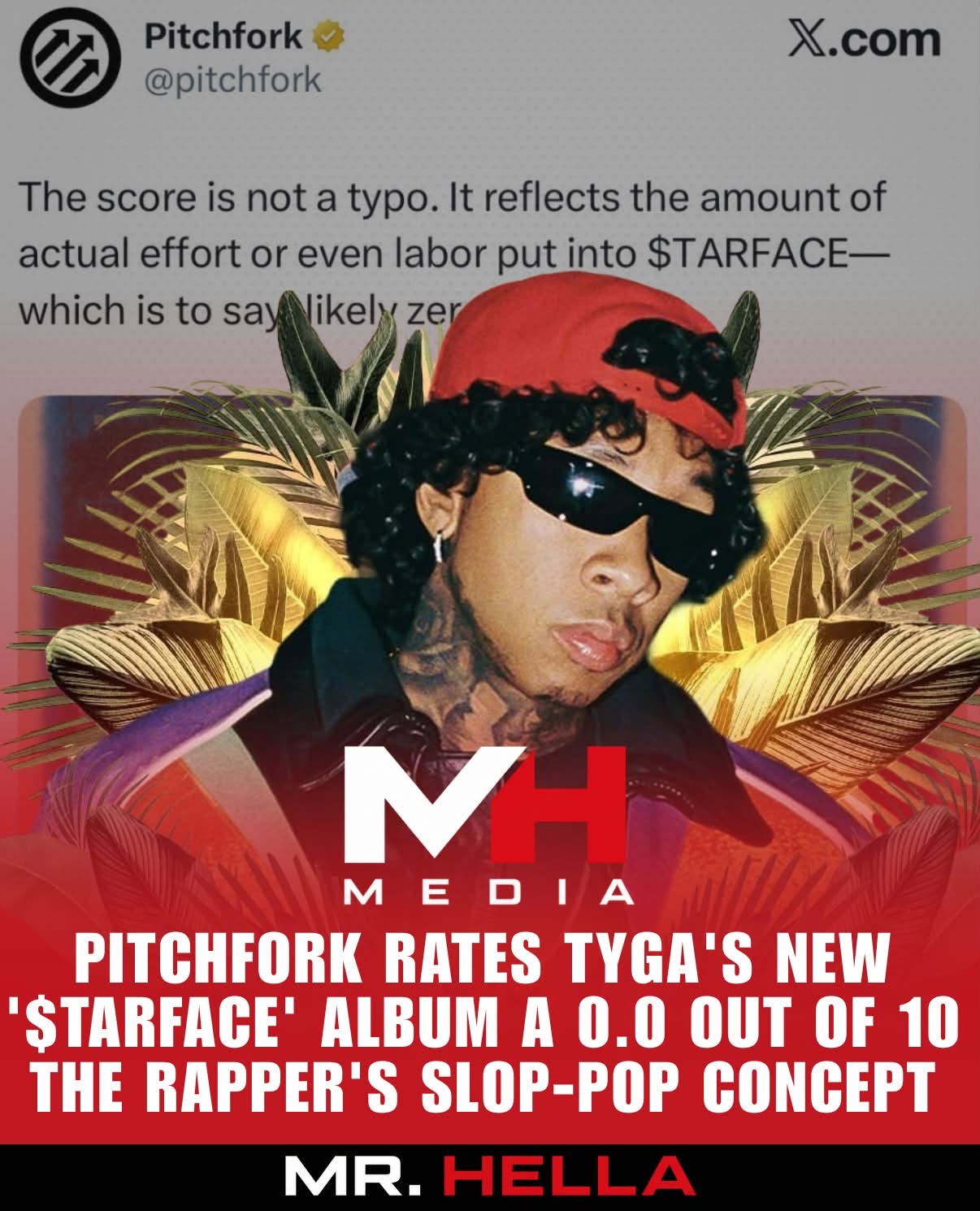
Pitchfork Gave Tyga’s $TARFACE a 0.0. Drew Millard Wrote That the Album Is Smug, Complacent, Depressing, and That Its Existence Made the World Worse. Tyga Said He Used AI on the Synths and Solos and Compared the Panic to Auto-Tune.
August 12, 2026. The number on the page is 0.0. Pitchfork had not printed that score in almost twenty years. The last famous zero was Jet’s Shine On in 2006. The Verge filed the streak. Last Kings / EMPIRE. Reviewed by Drew Millard.
The pull quote the blogs all grabbed is the one in the user’s brief:
“The rapper’s slop-pop concept album is smug and complacent and depressing. Its very existence has made the world a worse place.”
The longer cut in The Verge is the same temperature: ’80s synth-pop and disco assembled by someone who does not appear to have sat with either genre; stream only out of morbid curiosity; even one play risks making it profitable.
That is a critic’s tantrum with a decimal point. It is not a statute.
What the record was supposed to be
Millard’s frame: a concept that asks what if Scarface, as Pacino played him, were a pop star, and also Tyga. $TARFACE as the alias. Retro sheen. The internet’s first reaction was not the concept. It was “this sounds generated.” Millard wrote that he could prompt something that sounded like the album. He also wrote that he was not declaring the LP fully machine-made — then noted Tyga’s public walk from denial-adjacent to “for sure.”
What Tyga said about the tools
To VIBE, after the accusations: yes. Technology as a tool. The public’s AI allergy is the Auto-Tune argument again. Writing and vocals are him. Why over-explain how you make something good?
To TMZ, after the zero: he does not really know what Pitchfork is; the devil uses a pitchfork. Gen Z cannot read. He used AI-assisted production — ’80s synths and some guitar solos — not a full AI album. Three months in a studio. Doja Cat, in a separate clip Complex tied to the same week, called him a penis for making an AI album; he called her project demonic. That is the side quest.
Auto-Tune is a useful analogy only if you remember Auto-Tune did not get a 0.0 for existing. It got fights about taste. Pitchfork’s zero is a taste fight that used the machine as accelerant.
What a 0.0 is for
Pitchfork’s scale has always been a performance. Tens are canon. Zeros are punishment and traffic. Calling an album a moral injury to the planet is the house style at maximum. Readers can decide whether $TARFACE is unlistenably smug or whether a website just found a new way to say they hated a Tyga record. Both can be true. Neither replaces sitting with the file — or refusing to.
The interesting industry fact is narrower than the score. A mainstream rapper said out loud that the glossy 1980s layer came from a model, kept the credit for words and voice, and still caught the rarest grade in the shop. Disclosure did not save him. Silence would not have either. The review is about whether the songs feel assembled. He conceded the assembly line for the parts that sound most assembled.
Leave the decimal where it is
Tyga is not the first person to lean on software. Pitchfork is not the first magazine to confuse disgust with a public service. $TARFACE is an album that now has a trivia answer attached: last 0.0 in two decades. If the record is as empty as Millard says, the empty will age without help. If it finds the audience that never read the review, the 0.0 becomes a sticker. He asked why people overexplain making things good. The review is 700 words of the opposite. The score is one character and a point. That was enough.


Comments