

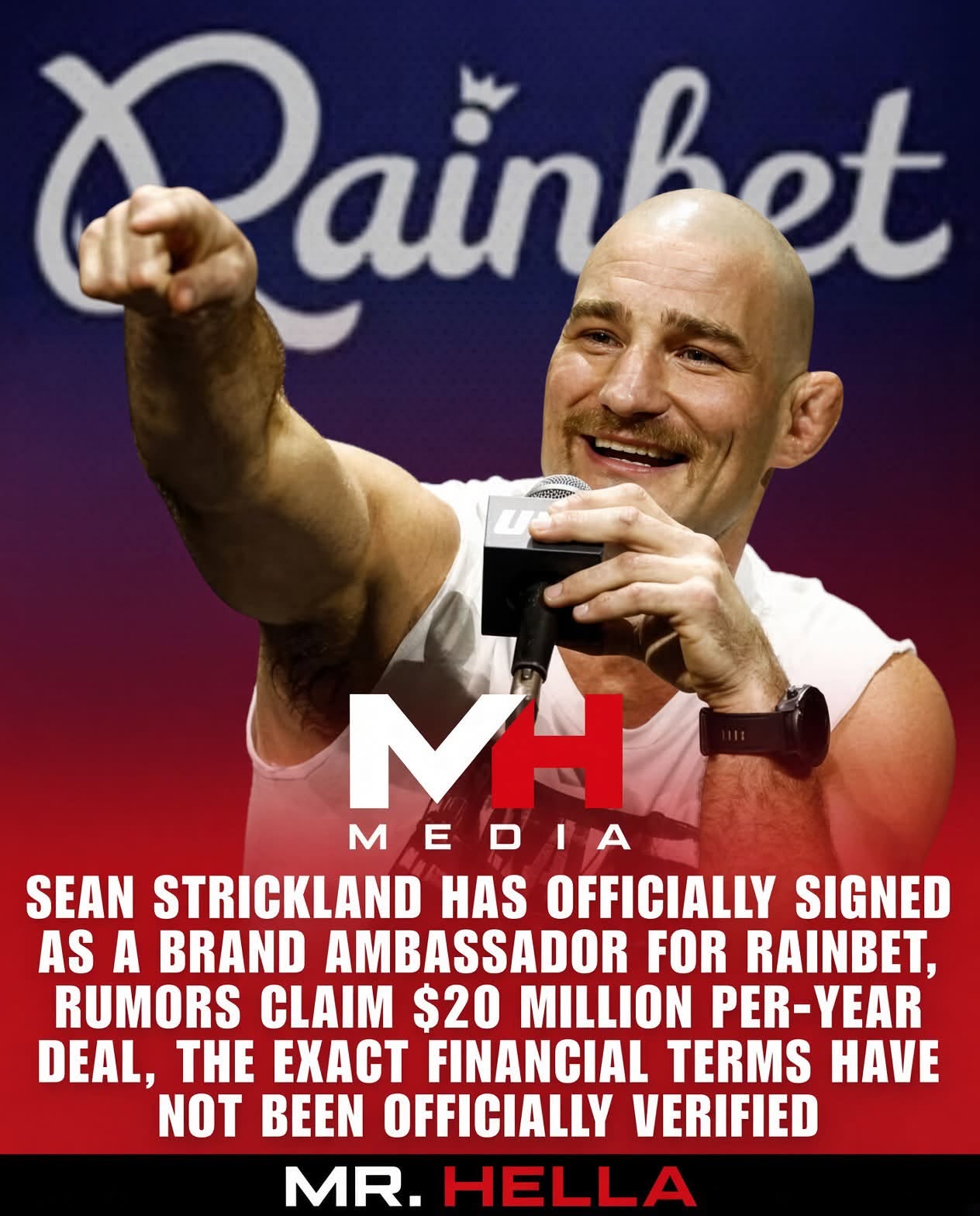
Former UFC middleweight champion Sean Strickland has officially entered the growing world of combat-sports gambling partnerships, announcing a new brand ambassador deal with online gaming platform Rainbet.
The partnership was unveiled through a characteristically chaotic promotional video featuring Strickland wielding a flamethrower—a marketing approach perfectly aligned with the outspoken fighter's unpredictable public persona.
But almost immediately after the announcement, another part of the story began attracting even more attention.
Money.
Social media posts began circulating claims that Strickland's Rainbet agreement could be worth an astonishing $20 million per year.
If accurate, that would represent an enormous endorsement agreement for an MMA fighter and potentially one of the most lucrative publicly discussed sponsorship arrangements involving a UFC athlete.
There is just one major problem:
Neither Strickland nor Rainbet has publicly verified that figure.
For now, the partnership is confirmed.
The reported $20 million annual compensation is not.
Sean Strickland Officially Joins Rainbet
Rainbet announced Strickland as one of its newest brand ambassadors as the company continues expanding its presence within combat sports.
The announcement immediately stood out from a traditional corporate sponsorship reveal.
Instead of Strickland sitting in a studio discussing the partnership or posing next to a company logo, the promotional content leaned directly into the personality that has made him one of the UFC's most recognizable—and controversial—fighters.
Strickland appeared with a flamethrower.
For anyone familiar with his social-media presence, it was an unsurprising choice.
Strickland has built a substantial following partly because his public personality feels almost completely disconnected from conventional athlete marketing.
He frequently speaks without a filter.
His interviews can become unpredictable.
His training footage regularly goes viral.
And his social-media content often generates attention far beyond the traditional MMA audience.
For a brand attempting to get people talking, that personality carries obvious marketing value.
The $20 Million Claim Explodes Online
Following the announcement, viral posts began claiming Strickland had secured a deal worth approximately $20 million annually.
That figure quickly became part of the conversation surrounding the partnership.
A $20 million annual endorsement would be extraordinary.
For perspective, UFC fighters traditionally generate most of their direct combat-sports income through fight purses, bonuses, pay-per-view participation for select stars and sponsorship opportunities outside the Octagon.
An eight-figure annual endorsement could potentially rival or exceed what many elite fighters earn from actually competing.
That is exactly why the number has generated so much attention.
But extraordinary numbers require extraordinary confirmation.
As of the announcement, no publicly verified contract, official company statement or direct statement from Strickland has established that Rainbet is paying him $20 million every year.
That doesn't necessarily mean the number is false.
It means the number remains unverified.
Until either side confirms the financial terms, reporting the figure as an established fact would be premature.
The Confirmed Story Is Already Significant
Even without a $20 million price tag, Strickland joining Rainbet is notable.
It demonstrates how aggressively online gaming and betting companies are moving into the combat-sports audience.
MMA fans are particularly attractive to these platforms.
The UFC operates year-round.
Major cards generate enormous online conversation.
Fight predictions naturally overlap with sports betting.
And fighters often have intensely loyal audiences that follow their social-media accounts, podcasts, interviews and training content.
Instead of advertising only during events, gambling platforms can partner directly with fighters and gain access to those audiences every day.
Strickland is particularly valuable because people pay attention to him even when he isn't fighting.
Strickland Has Become a Marketing Machine Without Trying to Look Like One
Sean Strickland doesn't have the carefully managed public image traditionally associated with major athlete endorsements.
That's arguably part of his value.
Traditional endorsement deals often pair brands with athletes who project polished, relatively predictable personalities.
Strickland represents almost the opposite.
His appeal is built around unpredictability.
Fans expect him to say something outrageous.
They expect unusual training videos.
They expect confrontational interviews.
They expect clips capable of immediately spreading across X, Instagram, TikTok and YouTube.
That creates an enormous amount of organic attention.
A company doesn't necessarily have to convince people to watch a Sean Strickland advertisement.
If the advertisement is bizarre enough, social media does the distribution for them.
The flamethrower announcement demonstrates that strategy almost perfectly.
Rainbet Is Building Around MMA
Strickland isn't Rainbet's first major connection to combat sports.
The platform has increasingly aligned itself with prominent names from the MMA world, including former UFC interim lightweight champion Justin Gaethje.
That makes the Strickland partnership appear less like an isolated celebrity endorsement and more like part of a deliberate strategy.
Rainbet wants combat-sports fans.
And rather than simply purchasing conventional advertising around MMA content, the company is attaching itself directly to fighters those fans already follow.
It's a strategy that has become increasingly common throughout sports.
Online gambling platforms compete for attention in an extremely crowded marketplace.
Athlete ambassadors give companies recognizable faces capable of differentiating one platform from another.
Why MMA Fans Are So Valuable to Betting Platforms
Combat sports and gambling have always had a natural relationship.
Every fight creates obvious questions.
Who wins?
Does the fight go the distance?
Will there be a knockout?
Will there be a submission?
Which round does it end?
Sportsbooks can create numerous betting markets around a single matchup.
And unlike sports with long regular seasons, major UFC events can feel like individual spectacles.
That creates concentrated periods of audience attention.
The UFC also attracts a highly engaged digital fanbase.
Fans debate fights on Reddit.
They argue on X.
They watch breakdowns on YouTube.
They follow fighters on Instagram.
They consume podcasts discussing upcoming cards.
A fighter ambassador allows a betting company to enter those conversations through someone the audience already recognizes.
Justin Gaethje Demonstrated the Strategy
Gaethje's association with Rainbet gives the company another major name within the UFC audience.
Gaethje has spent years as one of the promotion's most popular action fighters.
His reputation for violent, high-paced fights has produced a loyal following.
Strickland offers something different.
His fighting career matters, but his personality is arguably just as important to his commercial appeal.
Together, partnerships with fighters possessing different audiences allow Rainbet to broaden its visibility throughout the MMA ecosystem.
Strickland's Career Has Changed Dramatically
A few years ago, describing Sean Strickland as a potential eight-figure brand ambassador would have sounded improbable.
His career trajectory changed significantly after his rise through the UFC middleweight division.
The defining moment came in September 2023.
Strickland entered UFC 293 in Sydney as a substantial underdog against Israel Adesanya.
Adesanya was one of the biggest stars in the UFC and was widely expected to retain his middleweight championship.
Instead, Strickland produced one of the biggest upsets in recent UFC history.
He pressured Adesanya throughout the fight, famously dropped him in the opening round and ultimately won a unanimous decision.
Sean Strickland was suddenly UFC middleweight champion.
The victory transformed his profile overnight.
Losing the Championship Didn't Kill His Popularity
Strickland's title reign ended in January 2024 when he lost a closely contested split decision to Dricus Du Plessis at UFC 297.
But something unusual happened.
Losing the championship didn't significantly diminish Strickland's popularity.
His fanbase continued growing.
His interviews continued generating headlines.
His sparring sessions continued going viral.
His opinions continued creating controversy.
That demonstrates an important distinction in modern combat sports.
An athlete doesn't necessarily need to hold a championship to remain commercially valuable.
Attention itself has value.
And Strickland generates enormous amounts of it.
Social Media Has Changed Fighter Endorsements
Twenty years ago, athlete sponsorship value was largely connected to television exposure.
Today, an athlete can generate millions of impressions without competing.
A single Instagram Reel can spread across numerous platforms.
A podcast appearance can create dozens of viral clips.
A controversial statement can dominate MMA discussion for an entire day.
Strickland operates extremely well within that environment.
His content rarely feels corporate.
Even when he's promoting something, his personality remains the primary attraction.
That can make advertisements feel less like conventional advertisements and more like another episode in the ongoing Sean Strickland show.
The Flamethrower Video Is a Perfect Example
The Rainbet announcement could have been simple.
Strickland could have held up a phone.
He could have worn a branded shirt.
He could have explained the partnership.
Instead, there was a flamethrower.
That immediately made the announcement more shareable.
People who didn't care about Rainbet could still watch because Strickland was doing something ridiculous.
Once the video spreads, the company's branding spreads with it.
That's modern influencer marketing.
The advertisement doesn't have to interrupt entertainment.
The advertisement becomes the entertainment.
Could the Deal Really Be Worth $20 Million?
Without access to the contract, there is no responsible way to confirm the viral $20 million annual figure.
There are numerous ways athlete endorsement agreements can be structured.
A headline number might represent guaranteed compensation.
It could include performance bonuses.
It could include affiliate revenue.
It could involve equity or cryptocurrency.
It could represent a multi-year total that becomes incorrectly described online as an annual salary.
Or it could simply be inaccurate.
Until the parties disclose the financial structure, none of those possibilities should be presented as fact.
That's why the distinction between confirmed and rumored information matters.
Confirmed:
Sean Strickland has partnered with Rainbet.
Unconfirmed:
Rainbet is paying Sean Strickland $20 million per year.
If Confirmed, $20 Million Would Be Enormous
If either Strickland or Rainbet eventually verifies that the agreement is actually worth $20 million annually, the story becomes considerably bigger.
That level of compensation would demonstrate how valuable direct access to MMA audiences has become.
It would also show how athlete economics are changing.
A fighter's income would no longer be defined exclusively by what happens inside the Octagon.
Someone with a sufficiently large and engaged audience could potentially make enormous amounts from businesses wanting access to that following.
Conor McGregor demonstrated the extreme version of this concept through ventures including Proper No. Twelve Irish Whiskey.
Other fighters have built businesses around supplements, clothing, podcasts, gyms and digital platforms.
Brand ambassador agreements are another extension of the same idea.
UFC Fighters Have Historically Faced Sponsorship Limitations
The sponsorship conversation carries additional significance in MMA because UFC athletes once had considerably more freedom to display individual sponsors during fights.
That changed dramatically after the UFC introduced standardized apparel partnerships.
Fighters could no longer simply cover their shorts and banners with personal sponsors during UFC events as they had in previous eras.
That pushed many fighters to pursue sponsorship opportunities outside official fight broadcasts.
Social media became increasingly important.
A fighter may not be able to walk into the Octagon covered in independent sponsor logos, but they can promote brands to millions of followers outside the cage.
For fighters with major audiences, those external partnerships can become extremely valuable.
Rainbet Is Betting on Personality
Strickland's partnership makes sense precisely because he doesn't behave like a traditional spokesperson.
Rainbet isn't purchasing a perfectly polished corporate representative.
It's purchasing access to Sean Strickland's audience and personality.
That means unpredictability is part of the product.
A traditional company might view that as risky.
An online gambling brand targeting younger combat-sports fans may view it as an advantage.
The more outrageous the content becomes, the more likely people are to share it.
The more people share it, the more exposure Rainbet receives.
There Is Also a Larger Gambling Conversation
The growing relationship between sports and gambling has generated controversy.
Legal sports betting has expanded dramatically across the United States since the Supreme Court struck down the federal prohibition that had limited state-authorized sports wagering in 2018.
Since then, betting advertising has become increasingly visible throughout professional sports.
Leagues partner with sportsbooks.
Television broadcasts display betting odds.
Athletes promote gambling companies.
Podcasts are sponsored by betting platforms.
Critics have raised concerns about problem gambling, younger audiences and the normalization of constant wagering.
Supporters argue that legal, regulated betting brings an activity that already existed into more transparent markets.
Strickland's Rainbet partnership sits inside that much larger transformation.
The Athlete Is Becoming the Media Company
Perhaps the most interesting part of deals like Strickland's is what they reveal about modern celebrity.
Strickland isn't simply a UFC fighter anymore.
He's a media property.
Every interview generates content.
Every training session can become content.
Every social-media post can become content.
Every controversy can become content.
That audience exists independently of whether the UFC has him booked for a fight.
For brands, that means the relationship isn't simply:
“Pay fighter to wear logo.”
It's:
“Pay fighter for access to an audience.”
That distinction can dramatically increase what certain athletes are worth commercially.
For Now, the Partnership Is Bigger Than the Rumored Number
The $20 million figure is naturally going to dominate social-media discussion because it's enormous.
But Rainbet signing Strickland is notable even if the actual contract is worth considerably less.
One of the UFC's most recognizable personalities has become an ambassador for a company aggressively building its identity around combat sports.
Rainbet gains access to Strickland's enormous MMA audience.
Strickland gains another major commercial partnership outside the Octagon.
And the promotional strategy is already doing exactly what the company presumably wanted.
People are talking about it.
The flamethrower video attracted attention.
The partnership attracted attention.
And the rumored contract value generated even more attention.
Whether that viral $20 million-per-year figure eventually proves accurate remains to be seen.
Until Strickland or Rainbet confirms it, the number should remain exactly where it belongs:
In the rumor column.
The partnership itself, however, is official.
Sean Strickland is now part of Rainbet's growing roster of combat-sports ambassadors—and the company is making it increasingly clear that MMA fans are a major part of its strategy.
Comments