

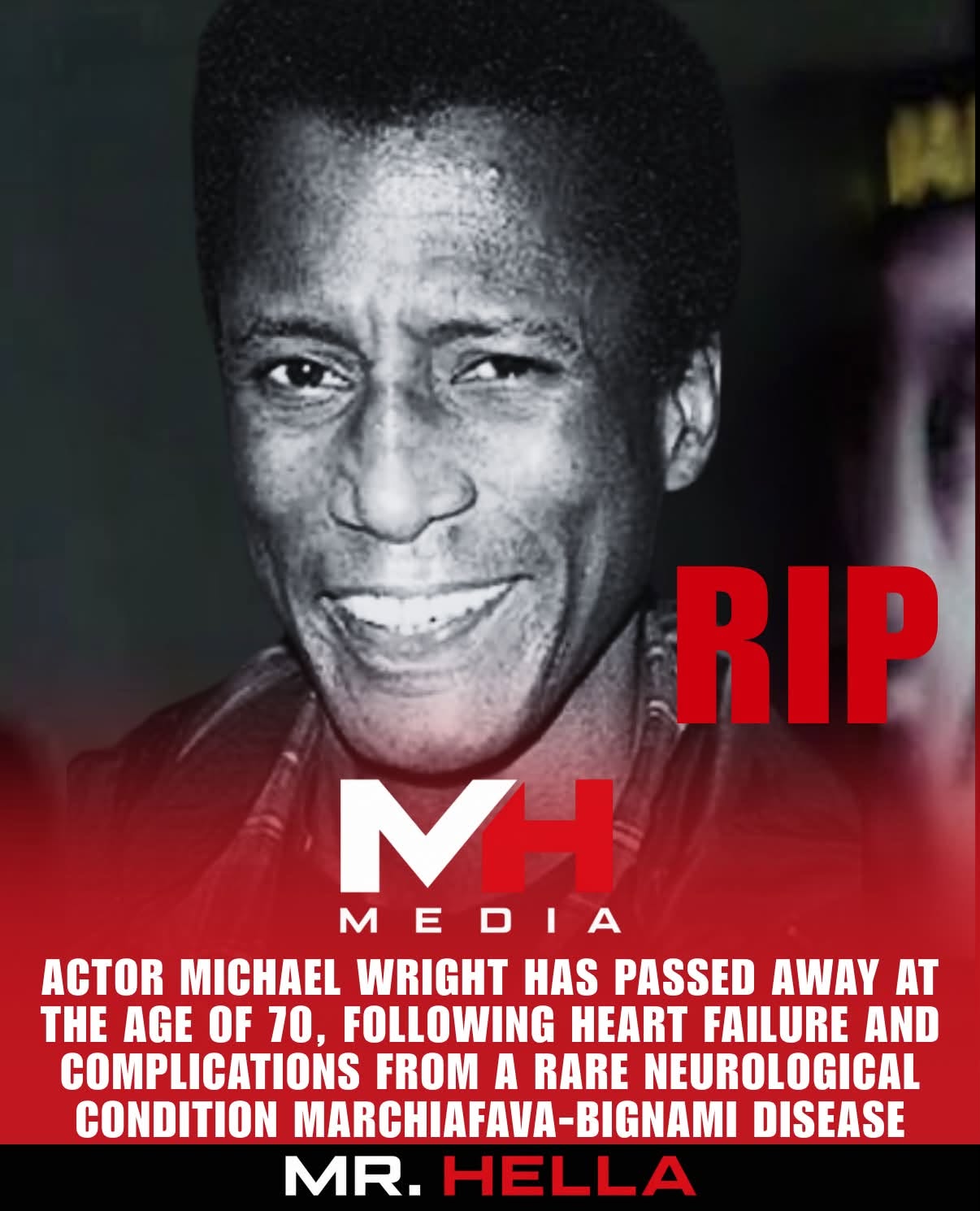
For generations of movie fans, Michael Wright didn't simply play Eddie King Jr.
The heartbreaking journey of a tremendously gifted performer whose personal struggles threatened to destroy everything his talent had helped build.
Wright's portrayal of Eddie in the 1991 musical drama The Five Heartbeats became one of the most memorable performances in Black cinema, but reducing Michael Wright's career to a single character would dramatically undersell what he accomplished.
Wright spent nearly five decades working across film and television.
He acted for acclaimed filmmakers.
He shared a major acting honor at the Venice Film Festival.
He became part of a landmark science-fiction franchise.
He portrayed villains, addicts, gangsters, soldiers and deeply complicated men.
He worked alongside performers including Wesley Snipes, Louis Gossett Jr., Jim Belushi, Chris Tucker, Nicole Kidman and Sean Penn.
He appeared in more than 70 screen projects over the course of his career.
And long after The Five Heartbeats left theaters, audiences continued quoting, discussing and celebrating Eddie King Jr.
Now the entertainment industry is mourning the man behind those performances.
Michael Wright died August 19, 2026, in Los Angeles. He was 70 years old.
His family said his death followed heart failure and complications associated with Marchiafava-Bignami disease, a rare degenerative neurological condition.
But before discussing his death, it's worth remembering the extraordinary body of work that came before it.
Michael Wright's Career Started Long Before ‘The Five Heartbeats’
Wright was born April 30, 1956, in New York City.
His screen career began during the late 1970s, well before audiences would eventually associate him with Eddie King Jr.
One of his earliest major appearances came in director Philip Kaufman's 1979 film The Wanderers.
Set in the Bronx during the 1960s, the film followed teenage gangs navigating violence, race, friendship and changing neighborhoods.
Wright played Clinton Stitch, establishing early the kind of intense screen presence that would become a defining feature of his career.
He didn't need to be the conventional leading man to command attention.
That ability would follow him throughout the next several decades.
‘Streamers’ Brought International Recognition
One of the most important early achievements of Wright's career arrived with Robert Altman's Streamers.
The 1983 film centered on young soldiers awaiting deployment to Vietnam and explored race, sexuality, masculinity, violence and fear.
Wright played Carlyle.
His work in the film contributed to an unusual and prestigious achievement.
The principal male cast of Streamers collectively received the Best Actor prize at the Venice Film Festival.
That meant Wright had received international acting recognition years before The Five Heartbeats made him a cult-film icon.
It also demonstrated what directors and audiences would repeatedly see from him:
Michael Wright could play volatile characters without reducing them to caricatures.
There was often something underneath the aggression.
Pain.
Fear.
Confusion.
Pride.
Humanity.
That ability would eventually become essential to his portrayal of Eddie King Jr.
He Became Part of the ‘V’ Phenomenon
Wright's career expanded substantially through television when he joined the science-fiction franchise V.
He portrayed Elias Taylor, becoming part of the resistance fighting against the alien Visitors who had arrived on Earth under seemingly peaceful pretenses.
V became a significant piece of 1980s television science fiction.
Wright appeared in the original miniseries universe and continued with the franchise as it expanded into V: The Final Battle and V: The Series.
For viewers who discovered Wright decades before The Five Heartbeats, Elias Taylor was one of the roles that established him.
It also demonstrated his versatility.
He could move from a serious Robert Altman drama to large-scale network science fiction without losing the intensity that made him distinctive.
‘The Principal’ Gave Wright Another Memorable Villain
In 1987, Wright appeared opposite Jim Belushi and Academy Award winner Louis Gossett Jr. in The Principal.
Wright portrayed Victor Duncan, a violent gang leader and drug dealer whose control over the troubled high school put him into direct conflict with Belushi's character.
Again, Wright played a threatening character.
And again, he made the character memorable.
Victor wasn't simply background muscle.
Wright's presence gave the film an antagonist audiences could genuinely fear.
By this point, Wright had already established an impressive résumé.
The Wanderers.
Streamers.
V.
The Principal.
Then came the role that would permanently change his legacy.
Eddie King Jr.
In 1991, Robert Townsend released The Five Heartbeats, a musical drama inspired by the experiences of legendary R&B vocal groups.
Townsend directed the film and co-wrote it with Keenen Ivory Wayans.
The story followed the fictional Five Heartbeats as they navigated success, racism, relationships, exploitation, addiction and the pressures that can tear a music group apart.
Michael Wright was cast as Eddie King Jr.
The group's lead singer.
The role became legendary.
Eddie possessed extraordinary talent but also carried the self-destructive tendencies capable of ruining it.
He was charismatic.
He was arrogant.
He was wounded.
He was funny.
He was angry.
He was addicted.
And underneath everything was a man desperate to be loved and respected.
Wright somehow made all of those elements coexist.
Robert Townsend Originally Had Another Major Actor in Mind
Years later, Robert Townsend revealed something remarkable about the casting process.
Denzel Washington had been in his mind for Eddie King Jr.
Then Michael Wright auditioned.
Townsend recalled realizing that Wright was the man who needed to play Eddie.
That decision ultimately produced one of the defining performances of Wright's career.
It's difficult today to imagine The Five Heartbeats without him.
Eddie's emotional instability drives much of the movie.
When he succeeds, the group feels unstoppable.
When he begins unraveling, viewers feel the group unravel with him.
And when Eddie's story eventually reaches its redemptive moments, Wright makes those scenes work because audiences remember how far the character had fallen.
The Movie Became Bigger With Time
The Five Heartbeats wasn't initially a massive theatrical blockbuster.
Its cultural significance grew over time.
Home video.
Cable television.
DVD.
Family movie nights.
Word of mouth.
Repeated television broadcasts.
Eventually, the film became deeply embedded within Black popular culture.
Lines from the movie became instantly recognizable.
Scenes became memes before social media even existed.
Songs remained beloved.
Cast reunions generated excitement decades later.
And Eddie King Jr. became one of those fictional characters audiences spoke about as though he had actually existed.
That's one of the clearest measurements of Wright's performance.
People didn't simply remember Michael Wright acting as Eddie.
They remembered Eddie.
Eddie King Jr. Became His Defining Role
Actors sometimes spend entire careers looking for one character capable of outliving the movie that introduced them.
Michael Wright found one.
Eddie's story dealt with issues that remained relevant decades after the film's release.
Addiction.
Fame.
Ego.
Exploitation.
Brotherhood.
Redemption.
Mental and emotional instability.
The dangers of allowing talent to convince someone they're indestructible.
Wright made those themes personal.
His performance could be explosive in one scene and devastatingly vulnerable in another.
That complexity helped The Five Heartbeats become more than a nostalgic musical film.
For many viewers, it became a movie they returned to repeatedly.
Then Came ‘Sugar Hill’
Wright followed his Five Heartbeats success with another performance that would become particularly important to Black film audiences.
In the 1994 crime drama Sugar Hill, Wright starred alongside Wesley Snipes.
Snipes played Roemello Skuggs.
Wright portrayed his brother, Raynathan “Raynate” Skuggs.
The brothers operated in Harlem's drug trade, but their personalities and perspectives created tension throughout the film.
Once again, Wright was playing a deeply complicated man.
Raynate could be dangerous.
He could be volatile.
But Wright refused to make him one-dimensional.
His chemistry with Snipes helped give the movie its emotional core.
The film wasn't simply about drugs and crime.
It was about brothers.
Family.
Ambition.
Trauma.
And the difficulty of escaping a world that has shaped your entire identity.
Wright Became a Familiar Face Across 1990s Film and Television
His résumé continued expanding.
He appeared in Money Talks, starring Chris Tucker and Charlie Sheen.
He appeared in Point Blank.
He worked in Piñero.
He appeared in Downtown: A Street Tale.
He later appeared in Sydney Pollack's The Interpreter, starring Nicole Kidman and Sean Penn.
His television work was equally varied.
Wright appeared in series including Miami Vice, New York Undercover and Nash Bridges.
He wasn't confined to one genre.
Crime drama.
Science fiction.
Comedy.
Prestige television.
Independent film.
Wright moved between them.
‘Oz’ Introduced Michael Wright to Another Generation
Then came HBO's Oz.
The prison drama became one of the defining shows of HBO's early push into ambitious original television.
Years before prestige television became the dominant conversation in Hollywood, Oz was pushing boundaries in violence, storytelling and character development.
Wright joined the series as inmate Omar White.
Originally, the role wasn't necessarily supposed to become a major long-term part of the show.
Wright later described auditioning and throwing himself completely into the performance.
He initially received an episode.
Then another script appeared.
Then another.
And another.
Eventually, Wright realized the show intended to keep him around.
He appeared across 22 episodes between 2001 and 2003.
For younger viewers who may not have discovered him through The Five Heartbeats, Oz provided another introduction to his abilities.
Omar White Was Perfect for Michael Wright
Omar was unpredictable.
Emotionally volatile.
Dangerous.
Addicted.
But also intelligent and capable of expressing himself in ways that complicated viewers' perception of him.
In other words, he was exactly the kind of character Wright excelled at portraying.
Michael Wright had a remarkable ability to find vulnerability inside men audiences might otherwise dismiss as villains.
He could make anger look like the surface of something deeper.
He could make danger coexist with sadness.
He could portray someone making terrible decisions without asking audiences to forget that the character was still human.
That quality connected Eddie King Jr., Raynate Skuggs and Omar White even though they existed in completely different stories.
More Than 70 Screen Roles
By the end of his career, Wright had accumulated more than 70 screen acting credits, according to career retrospectives published following his death.
That number matters because Wright is sometimes remembered almost exclusively for The Five Heartbeats.
His career was much larger.
It began in the 1970s.
It continued through the 1980s.
He achieved one of his most famous performances in the 1990s.
He became part of HBO's prestige television era during the 2000s.
And he continued appearing on screen decades later.
Among his later television appearances was a role on The CW's Black Lightning.
His final screen work included the 2025 crime drama Dope King.
Nearly five decades separated his earliest screen work from his final projects.
Wright Was an Actor's Actor
Michael Wright never became the conventional Hollywood superstar whose name automatically appeared above every movie title.
But longevity in acting isn't measured only through celebrity.
It can also be measured through impact.
Directors remembered him.
Actors respected him.
Audiences remembered his characters.
And filmmakers repeatedly trusted him with complicated roles requiring more than surface-level intensity.
Wright could enter a project and immediately make the world feel more dangerous, more unpredictable or more emotionally complicated.
That became his signature.
His Characters Were Often Broken Men
Looking across Wright's career reveals an interesting pattern.
He frequently portrayed men living near the edge.
Men fighting addiction.
Men surrounded by violence.
Men struggling with anger.
Men whose pride prevented them from expressing pain.
Men who could frighten audiences one moment and make them sympathize with them the next.
Wright understood those contradictions.
That may be why Eddie King Jr. continues resonating so strongly.
A lesser performance could have turned Eddie into a stereotype of the arrogant, drug-addicted singer who destroys his career.
Wright gave him a soul.
You could be angry at Eddie.
You could be disappointed in Eddie.
And somehow you still wanted Eddie to survive.
The Entertainment Industry Loses a Distinctive Performer
Michael Wright's death removes another link to several important periods of American entertainment.
He was there during the gritty New York filmmaking of the late 1970s.
He worked with Robert Altman.
He became part of the 1980s V phenomenon.
He helped create one of the most beloved Black films of the early 1990s.
He worked alongside Wesley Snipes during a defining era for Black cinema.
He later became part of Oz, one of the series that helped establish HBO's reputation for uncompromising prestige television.
That is an extraordinary span.
Wright didn't simply survive multiple eras of Hollywood.
He left memorable performances in nearly all of them.
His Passing at 70
Wright died peacefully in California on August 19, 2026, at age 70.
His family said his passing followed complications from multiple health conditions, including heart failure and Marchiafava-Bignami disease, a rare degenerative neurological disorder.
His wife, Susan Wright, announced his death publicly and described the loss as one carrying “profound sadness” and an “unimaginable heaviness.”
His family emphasized that while millions knew Wright through his performances, they knew him as much more.
A husband.
A father.
A grandfather.
A loved one.
A friend.
The family was with him during his final moments.
Robert Townsend Mourns Eddie King Jr.
For Robert Townsend, Wright's death was particularly personal.
Townsend didn't simply work alongside Wright.
He was responsible for casting him in the role that would forever connect their careers.
Following Wright's death, Townsend shared a tribute describing the actor as a “Pure Artist.”
He said the tears were flowing as he wrote his message.
That description feels particularly appropriate.
Wright's performances rarely appeared calculated.
They felt lived.
Whether Eddie was exploding in anger, Omar White was unraveling inside Oz, or Raynate was navigating the violence surrounding his family in Sugar Hill, Wright committed completely.
Black Cinema Lost One of Its Most Memorable Faces
The effect of Wright's death is especially significant for generations who grew up watching The Five Heartbeats.
Certain movies become bigger than their theatrical performance.
They become family traditions.
They become cultural reference points.
They become movies people can quote from beginning to end.
The Five Heartbeats became one of those films.
And Wright was at the center of it.
Eddie King Jr. became an archetype—the extraordinarily gifted performer whose demons nearly become stronger than his talent.
Future audiences discovering the movie will continue meeting Eddie for the first time.
They'll watch him rise.
They'll watch him fall.
They'll become frustrated with him.
And they'll eventually understand why generations before them never forgot Michael Wright.
His Death Also Highlights the Importance of Character Actors
Hollywood history frequently focuses on its biggest stars.
But movies and television aren't built by leading actors alone.
They're built by performers capable of making every part of a fictional world believable.
Michael Wright was one of those performers.
He could take a supporting character and make audiences remember him decades later.
He could stand beside major stars without disappearing.
Wesley Snipes could be on screen.
Louis Gossett Jr. could be on screen.
Jim Belushi could be on screen.
Chris Tucker could be on screen.
Michael Wright still demanded your attention.
That is a talent that cannot easily be taught.
His Influence Lives Through Performances, Not Headlines
Wright's career also serves as a reminder that cultural impact isn't always reflected by box-office totals or awards ceremonies.
The Five Heartbeats grew into its reputation.
Wright's Eddie grew into an iconic performance.
Decades later, audiences continued attending reunions and celebrations of the film.
The cast reunited at the Tribeca Film Festival in 2021, three decades after the movie's original release.
People still cared.
That kind of longevity is rare.
A Nearly Five-Decade Career Comes to an End
Michael Wright's story shouldn't end with the circumstances of his death.
It should begin with what he accomplished while he was here.
A career that started with The Wanderers.
International recognition through Streamers.
A memorable place in V.
A frightening turn in The Principal.
An unforgettable performance in The Five Heartbeats.
A powerful role opposite Wesley Snipes in Sugar Hill.
Another generation discovering him through Oz.
And dozens of additional performances scattered across nearly half a century of film and television.
Wright was never simply Eddie King Jr.
But Eddie King Jr. ensured that Michael Wright would never be forgotten.
His wife said his work would live forever.
For actors, that's one of the greatest legacies possible.
Michael Wright spent nearly five decades creating characters.
Now, after his passing at 70, those characters become the permanent record of an actor whose intensity, vulnerability and unmistakable screen presence touched multiple generations.
Hollywood has lost Michael Wright.
Black cinema has lost one of its most memorable performers.
But somewhere, someone is pressing play on The Five Heartbeats for the first time.
And Eddie King Jr. is about to walk onto the screen again.



Comments