

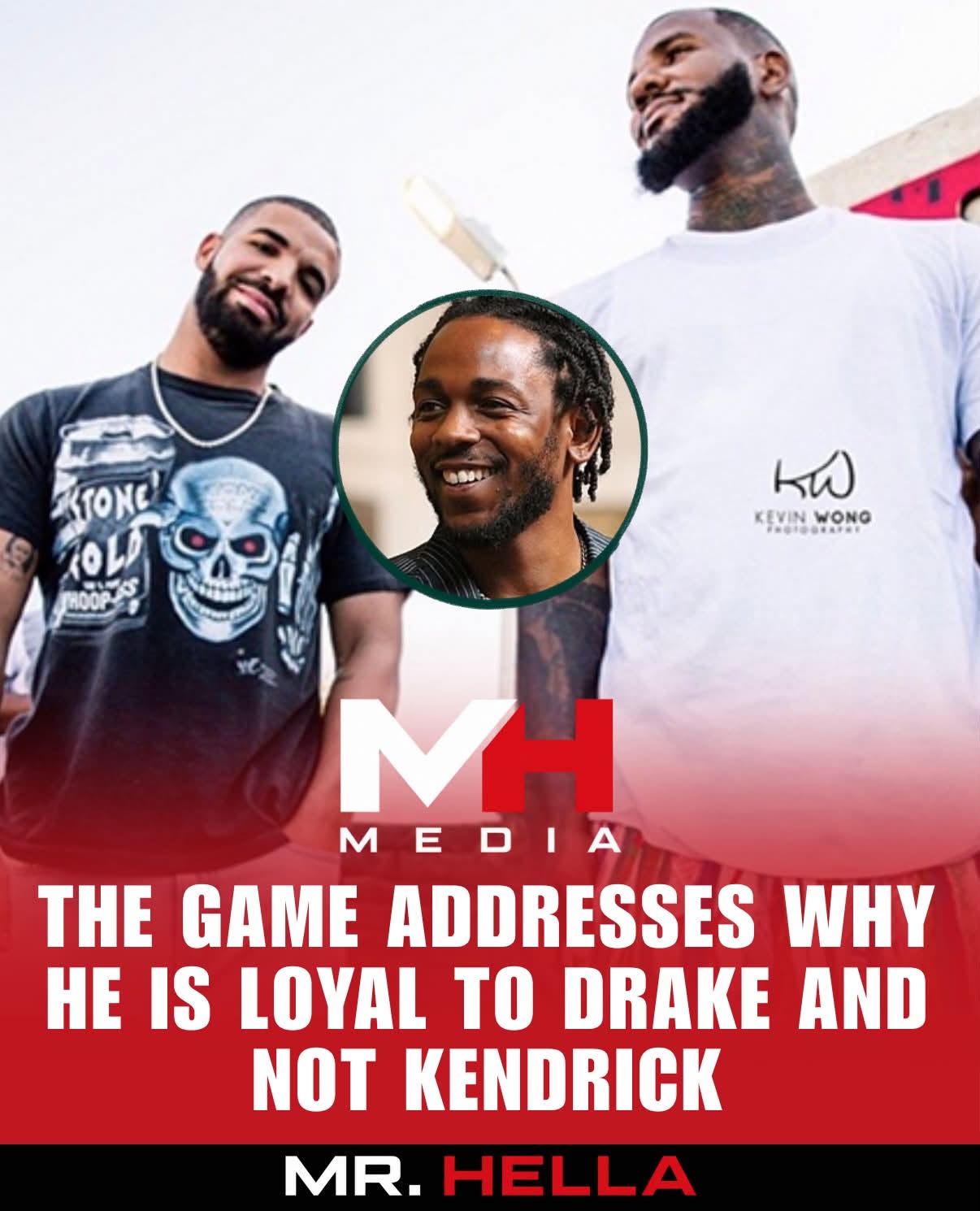
The Game is making it clear that his relationship with Drake isn't about choosing sides in one of hip-hop's biggest rivalries.
Speaking during celebrations surrounding the release of his new album The Documentary III, the Compton rapper addressed growing questions about why he has remained so publicly supportive of Drake despite his own deep history with Kendrick Lamar and Top Dawg Entertainment.
For Game, the explanation is simple:
Loyalty.
He says he supported Kendrick Lamar before Kendrick became one of the biggest rappers in the world, helped put him in positions he personally wished other established artists had created for him, and never expected anything in return.
At the same time, Game says Drake built a genuine relationship with him early in his own career—and Game isn't willing to suddenly abandon a longtime friend because the politics surrounding hip-hop have changed.
During the same emotional speech, Game also made a surprising revelation about just how close he once was to the TDE organization.
According to Game, TDE founder Anthony “Top Dawg” Tiffith once offered him half of Top Dawg Entertainment.
The Game Explains Why He Remains Loyal to Drake
Game's comments arrive amid continued scrutiny over his relationship with Drake following Drake's highly publicized battle with Kendrick Lamar.
Because Game is from Compton and has a long history with Kendrick, some fans expected him to naturally align himself with Kendrick during or after the feud.
Game doesn't see it that way.
He explained that his friendship with Drake existed long before the battle.
“When this n***a Drake came in the game, he adapted to me,” Game said during the release-party speech.
According to Game, the two became genuinely close as Drake's career developed.
“We got close,” he continued. “Drake is on my albums way back then.”
That history matters to Game because he says he doesn't believe friendships should suddenly disappear when industry politics become inconvenient.
“I don't flip-flop on my friends,” he said.
Game Says Drake Has Always Looked Out for His Family
Game went beyond discussing music.
He gave a personal example involving his children to explain why he considers Drake an actual friend rather than simply another famous rapper with whom he has collaborated.
According to Game, if Drake is performing in town and his children want to attend, he can contact Drake directly.
Game said Drake will make sure his children and their friends are taken care of and positioned where they want to be at the show.
That type of relationship, Game argued, isn't something he can simply ignore because public opinion expects him to choose Kendrick's side.
“I can't turn my back on a n***a like that,” he explained.
That statement may be the clearest explanation yet for Game's position.
To him, supporting Drake doesn't automatically mean betraying Kendrick.
He views the relationships separately.
Game Says He Did the Same for Kendrick
What makes the situation complicated is that Game also has an extensive history with Kendrick Lamar.
Long before Kendrick became a Pulitzer Prize-winning rapper, Super Bowl halftime performer and one of hip-hop's most celebrated artists, Game was already one of the biggest rappers representing Compton.
Game says he used that position to help Kendrick.
“I put Kendrick in places that I wanted to be, that I wished n***as would've put me,” Game said.
More importantly, he says he didn't do it expecting a financial reward.
“I didn't ask for nothing in return.”
For Game, that appears to be central to his frustration with the current narrative.
He doesn't want his friendship with Drake interpreted as an attack on Kendrick after spending years supporting Kendrick's career.
Game Says He Put Kendrick on His First Mixtape
Game also reminded the audience of specific ways he supported Kendrick during his earlier years.
“I put Kendrick on his first mixtape,” Game said. “I took Kendrick on tour. I showed Kendrick nothing but love.”
Those comments reflect a period when Kendrick was still establishing himself outside Southern California.
Before good kid, m.A.A.d city transformed Kendrick into a global superstar, artists including Game were already publicly supporting him.
Game's own position at the time was considerably different.
His 2005 debut album The Documentary had turned him into an international rap star.
He had worked with Dr. Dre.
He had recorded with 50 Cent.
He had major records including “Hate It or Love It” and “How We Do.”
Game therefore had something extremely valuable to offer an emerging rapper:
Exposure.
The Game Was Already a Major Compton Star
The timeline is important when understanding why Game talks about his early relationship with Kendrick with such pride.
When The Documentary arrived in January 2005, Kendrick Lamar was nowhere near the mainstream superstar he would eventually become.
Kendrick was still developing his career under the name K.Dot.
Game, meanwhile, had become one of the most visible rappers from the West Coast.
That placed him in a position to help younger Los Angeles-area artists gain visibility.
Game says he deliberately used that position for Kendrick.
He didn't view the younger Compton rapper as someone whose success threatened his own.
Instead, he wanted to provide opportunities he wished established artists had provided him.
Top Dawg Allegedly Offered Game Half of TDE
Then Game dropped one of the biggest revelations of the entire speech.
According to him, Anthony “Top Dawg” Tiffith once offered him half of Top Dawg Entertainment.
“Top Dawg wanted to give me half of TDE,” Game said.
Game presented the alleged offer as evidence of how close his relationship with the TDE organization once was.
However, there is an important distinction.
The claim currently comes from Game.
Top Dawg has not publicly confirmed the details of the alleged offer in the reporting available surrounding Game's comments.
That means the story shouldn't be presented as an independently established business transaction that nearly occurred.
What is confirmed is that Game publicly says the offer was made.
If accurate, the implications are enormous.
Imagine The Game Owning Half of TDE
Top Dawg Entertainment eventually became one of the most respected labels in modern hip-hop and R&B.
Its roster has included Kendrick Lamar, SZA, ScHoolboy Q, Jay Rock, Ab-Soul and numerous other artists.
Kendrick became one of the defining rappers of his generation.
SZA became one of the biggest R&B stars in the world.
ScHoolboy Q developed a successful solo career.
Jay Rock and Ab-Soul helped establish the label's identity.
The idea that Game could have potentially owned a substantial piece of that company creates one of hip-hop's fascinating “what if?” scenarios.
But Game didn't present the story as something he regrets.
Instead, he used it to illustrate how deep his connection with Top Dawg and the TDE family once ran.
Game Says There Is No Beef With Kendrick
Despite all the speculation surrounding The Documentary III, Game has repeatedly resisted the idea that he simply hates Kendrick Lamar.
The album itself plays with that tension.
On “The Pen,” Game directly addresses rumors that the two Compton rappers are beefing.
Other moments on the project, however, have been interpreted by listeners as shots toward Kendrick.
That ambiguity intensified because Drake appears on “No Brakes.”
Given everything that happened between Drake and Kendrick beginning in 2024, any rapper closely associated with one artist can immediately be interpreted as opposing the other.
Game rejects that binary.
He says he has love for Kendrick.
He says he has love for Top Dawg.
And he says Drake is his friend.
In Game's view, all three statements can exist simultaneously.
But Game Admits He Can't Reach Kendrick
There is clearly some distance between the two Compton rappers.
Game openly acknowledged that he has difficulty getting Kendrick on the phone.
“I showed Kendrick nothing but love,” he said. “But I can't get on the phone with him.”
That appears to bother him.
Not necessarily because Game expects Kendrick to speak with him constantly, but because of the history they share.
Game later expanded on the situation during an interview with Big Boy.
“I don't need to talk to Dot every day,” he explained.
But Game contrasted his inability to reach Kendrick with his relationship with Drake.
“I can get Drake on the phone,” he said, while explaining that he couldn't necessarily do the same with people he had known and supported on the West Coast.
That difference appears to explain some of the emotion behind his comments.
Game Doesn't Want His Friendship With Drake Viewed as Betrayal
Game specifically addressed how his decisions could be perceived by Kendrick and Top Dawg.
He doesn't want the people he helped early in their careers to interpret his continued friendship with Drake as disrespect.
“I don't want a n*a that I helped usher into the game, like Kendrick and Top, I don't want them n*as to feel a way about my decisions,” Game explained.
His argument essentially comes down to consistency.
He says he was loyal to Kendrick and Top Dawg when they were building.
He says he remains loyal to them now.
But he also developed a legitimate friendship with Drake.
And he isn't going to abandon Drake simply because Drake later became Kendrick's biggest rap rival.
“I was a real n*a to y'all,” Game said. “I'm a real n*a to him.”
Drake and The Game Go Back More Than a Decade
Game isn't exaggerating when he says his relationship with Drake predates the current controversy.
The two rappers have collaborated for years.
One of their most notable collaborations came in 2015 with “100.”
The record arrived during the rollout for Game's The Documentary 2 era.
Drake's appearance demonstrated that their musical relationship existed nearly a decade before the explosive Kendrick-Drake battle of 2024.
Now Drake has again appeared alongside Game during the Documentary franchise.
The Documentary III, released August 21, 2026, includes their latest collaboration, “No Brakes.”
That song immediately generated discussion because of the political landscape surrounding West Coast hip-hop.
‘No Brakes’ Put Game Directly in the Conversation
Any Drake collaboration following his battle with Kendrick was going to receive scrutiny.
A Drake collaboration with another major Compton rapper was guaranteed to receive even more.
That's exactly what happened with “No Brakes.”
Fans began examining Game's lyrics.
They examined Drake's involvement.
They looked for references to Kendrick.
They debated whether Game had officially chosen Drake's side.
The conversation became even more complicated because The Documentary III contains lyrics that listeners interpreted as Game challenging Kendrick while other lyrics explicitly reject the idea that the two are beefing.
Game's release-party comments were essentially an attempt to explain the contradiction.
He doesn't believe being Drake's friend requires being Kendrick's enemy.
The Kendrick-Drake Battle Changed the Politics of Hip-Hop
The problem is that fans often view rap relationships through alliances.
Once Kendrick and Drake's rivalry exploded into one of the biggest battles in hip-hop history, artists connected to either side were immediately scrutinized.
Who liked which post?
Who attended Kendrick's “Pop Out”?
Who collaborated with Drake?
Who remained silent?
Who played which song?
Every action became evidence for fans attempting to determine allegiances.
Game has repeatedly pushed against that interpretation.
Earlier in 2026, he publicly argued that hip-hop was suffering from Drake's reduced presence and defended Drake's importance to mainstream rap.
That naturally created questions about where he stood with Kendrick.
Now he's answering them more directly.
Game Says Friendship Isn't Industry Politics
Game's explanation essentially separates personal relationships from rap competition.
Drake and Kendrick can have their own issues.
That doesn't mean Game believes he must inherit those issues.
He helped Kendrick because he wanted to help another Compton rapper.
He became friends with Drake because they developed a genuine relationship.
Those events happened independently.
Game doesn't believe one relationship should erase the other.
It's a remarkably simple explanation for a situation fans have turned into an elaborate web of hip-hop alliances.
His Comments Also Reveal Something Deeper
Underneath all the Drake-versus-Kendrick discussion is something more personal.
Game appears to be reflecting on reciprocity.
He helped younger artists.
He brought people on tour.
He created opportunities.
He says he didn't demand money or ownership in return.
Now, decades into his career, he appears to be looking at which relationships remained accessible.
Drake answers.
According to Game, Kendrick often doesn't.
That doesn't necessarily mean Kendrick has done anything wrong.
Kendrick is under no obligation to maintain constant communication with every artist who helped him earlier in his career.
But from Game's perspective, the contrast clearly matters emotionally.
Game Also Brought Up Nipsey Hussle's Brother
The conversation extended beyond Kendrick.
Game also mentioned his relationship with Nipsey Hussle.
He said he once went against people within his own circle in order to bring Nipsey on tour.
“I caught fades with my own homies to take [Nipsey Hussle] on tour,” Game said.
But Game said he now has difficulty getting in contact with Nipsey's brother, Samiel “Blacc Sam” Asghedom.
Again, the theme was access and relationships.
Game wasn't simply listing favors he had done for other artists.
He appeared to be wrestling with how relationships change after years of success, tragedy and industry politics.
The Documentary III Has Become About More Than Music
Game's new album was already generating headlines because of its massive guest list.
The 24-track project includes appearances from Drake, Ye, Lil Wayne, Snoop Dogg, Black Thought, PARTYNEXTDOOR, YG, E-40, Larry June and others.
But the conversations surrounding the project have increasingly become about Game's relationships.
Drake.
Kendrick.
Top Dawg.
Nipsey Hussle.
Blacc Sam.
Dr. Dre.
These aren't simply famous names in Game's orbit.
They represent different periods of his career.
Game Has Been Part of Multiple Generations of West Coast Hip-Hop
That's what makes his perspective unusual.
Game arrived as one of the artists responsible for bringing mainstream attention back toward West Coast gangsta rap during the mid-2000s.
He came through Dr. Dre.
He worked alongside 50 Cent during the height of G-Unit.
He later helped support younger West Coast artists.
Kendrick became a superstar.
Nipsey became an icon.
And Game simultaneously maintained relationships with artists outside Los Angeles, including Drake.
Twenty years later, all of those relationships now intersect.
The result is complicated.
Game Refuses to Pick a Side
For fans, the question is simple:
Drake or Kendrick?
For Game, that question apparently doesn't make sense.
He believes he can respect Kendrick while remaining friends with Drake.
He can acknowledge everything Kendrick accomplished without abandoning someone who has treated him and his family well.
And he can remind people about his early role in supporting TDE without demanding credit for Kendrick's eventual success.
Whether Kendrick or Top Dawg views the situation the same way is another question.
But Game has now made his own position unmistakably clear.
He helped Kendrick because he believed in him.
He says Top Dawg once trusted him enough to offer him half of TDE.
And when Drake entered the industry, Game says Drake connected with him personally and maintained that relationship for years.
Now, after one of the most divisive rap battles in recent memory, Game isn't willing to rewrite that history.
His message is essentially the same one he delivered at The Documentary III celebration:
He doesn't flip-flop on his friends.
Comments