

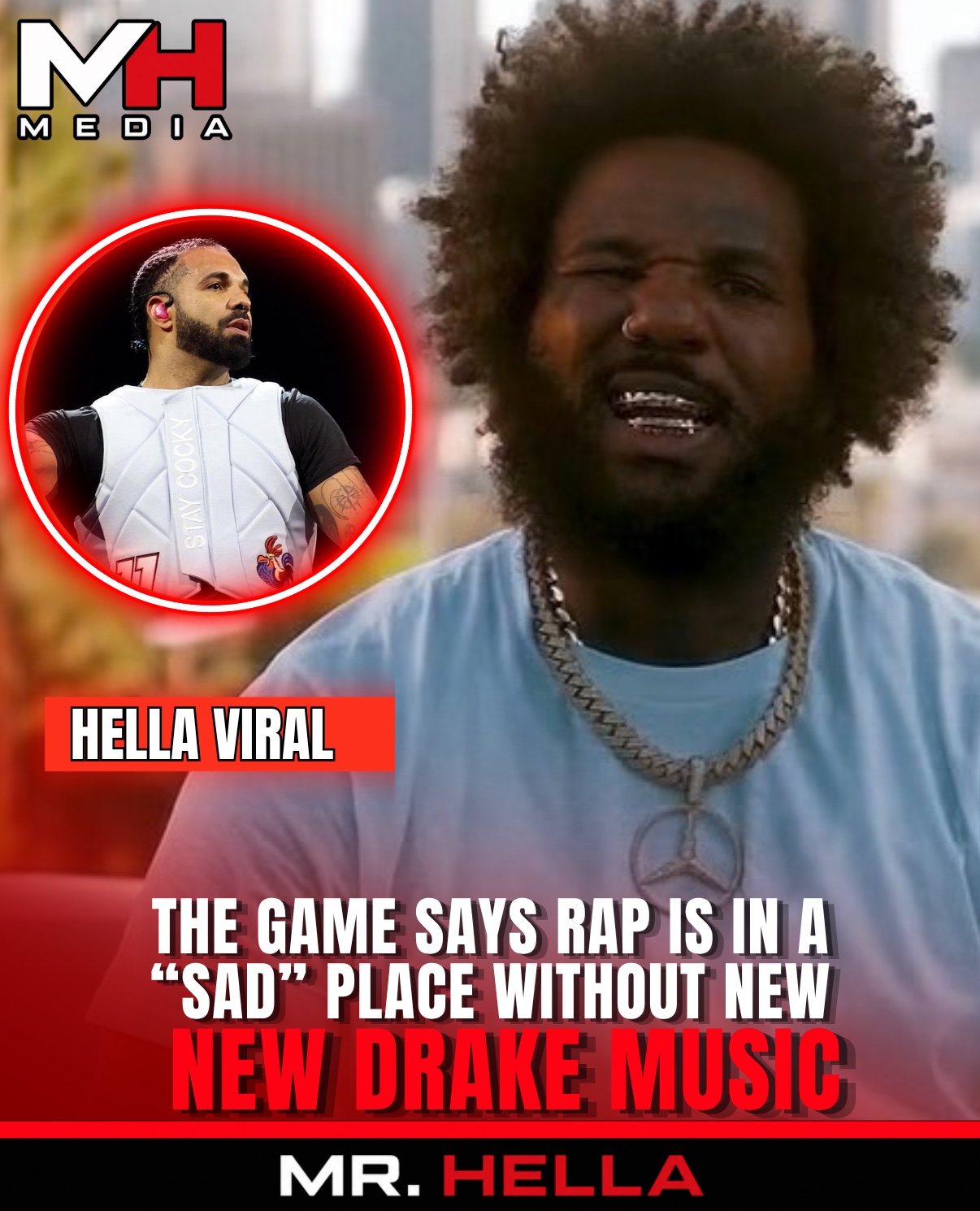
The Game made it clear earlier this year that he believed hip-hop was missing something while Drake remained relatively quiet — and months later, his comments are finding their way back into the conversation.
During an April interview with Complex, the Compton rapper argued that Drake’s reduced presence had created a noticeable void in rap, particularly inside clubs, where he believed the genre was missing the kind of massive records that traditionally brought entire rooms together.
The Game didn’t simply say he wanted another Drake album.
He described the atmosphere without Drake as “sad.”
“You walk in the clubs, everybody on their phone, nobody looks like they’re having a good time no more,” The Game said while discussing Drake’s importance to the genre.
He then questioned what current rap record could create the kind of universal reaction he associated with Drake’s biggest hits, even mentioning Yeat while making his point.
The Game stressed that he wasn’t attacking Yeat. His argument was that hip-hop needed an artist capable of producing records that could reach beyond one particular fan base or section of the club.
“This shit is sad without Drake in the club,” he said. (Complex)
The Game Believed Hip-Hop Had Taken Drake for Granted
The comments were part of a broader position The Game had been taking following Drake’s highly publicized battle with Kendrick Lamar.
Weeks before the Complex interview, Game argued on Instagram that hip-hop had failed to appreciate one of its biggest stars.
“Y’all ain’t appreciate one of the greatest,” he wrote, claiming Drake’s relative absence and silence had left the art form “down 50%.” (Complex)
That wasn’t presented as a statistical measurement of hip-hop’s actual commercial performance. It was The Game’s characterization of what he believed Drake’s reduced presence had done to the culture.
His argument was essentially that people had become so consumed with choosing a winner and loser in the Drake-Kendrick battle that they had overlooked what Drake had contributed to mainstream rap for more than a decade.
The Game believed the consequences could be heard in the music — and felt in the clubs.
“What Song Would Make You Happy About Being There?”
The most interesting part of Game’s comments was that he wasn’t arguing strictly from streaming numbers or Billboard positions.
He was talking about atmosphere.
For years, Drake operated in a rare space between rap superstar and mainstream hitmaker. His catalog includes records designed for traditional rap audiences, melodic R&B songs, pop crossovers, dance records and collaborations with artists from multiple countries and genres.
Game’s argument was that this versatility created something increasingly difficult to reproduce: records capable of crossing different groups inside the same room.
“If you walked in the club today, what song would make you happy about being there right now?” he asked. (Complex)
It was a provocative question because Game wasn’t claiming that talented rappers had disappeared.
He was arguing that rap was missing a particular kind of superstar record.
Drake Hadn’t Actually Disappeared
There was an important qualification even when Game originally made the comments.
Drake wasn’t literally absent from music.
After his 2024 battle with Kendrick Lamar, he released material through his 100 GIGS dump, collaborated with PARTYNEXTDOOR on $ome $exy $ongs 4 U in 2025 and continued appearing on records with other artists.
But Game was referring to something different.
He was talking about the version of Drake that routinely dominated an entire release cycle.
At the time of Game’s April interview, Drake was preparing Iceman, his first solo studio album since For All the Dogs in October 2023. (Complex)
Game believed hip-hop needed that Drake back.
He wouldn’t have to wait much longer.
Then Drake Flooded the Market
On May 15, Drake dramatically ended the conversation about his musical silence.
Instead of releasing only Iceman, he dropped three projects in one night: Iceman, Habibti and Maid of Honour.
The surprise strategy divided different sides of Drake’s musical identity across separate releases, with Iceman leaning heavily into rap while the other projects explored different sounds. (Complex)
That makes Game’s April comments particularly interesting in hindsight.
When he complained about Drake being too quiet, Drake was already preparing one of the largest releases of his career.
The drought Game was talking about was about to end with a flood.
Game Eventually Got Drake on His Own Album
The relationship between the two rappers became even more relevant later in the summer.
The Game released The Documentary III in August, continuing the series that began with his landmark 2005 debut.
Drake appeared on “No Brakes.”
That collaboration immediately attracted attention because Game is one of the most recognizable rappers to emerge from Compton — the same city as Kendrick Lamar — while Drake and Kendrick’s rivalry remained one of hip-hop’s defining storylines.
On the track, Game aligned himself closely with Drake, rapping about the pair as part of the “Three Amigos.” (Complex)
But Game later pushed back against the idea that working with Drake automatically meant he had declared war on Kendrick.
The Game Says Drake Is His Friend
In an August interview with Big Boy, Game explained the situation more directly.
“Drake is the homie,” he said, while adding that Kendrick and Top Dawg Entertainment founder Anthony “Top Dawg” Tiffith were also people he respected.
Game said one practical difference was access: he could call Drake.
He also described Drake as one of the world’s biggest artists and argued that virtually any musician would accept a Drake collaboration if given the opportunity.
For Game, the decision to put Drake on The Documentary III wasn’t supposed to represent a formal declaration of allegiance against Kendrick.
It was music — and Drake was someone he considered a friend. (Complex)
But “No Brakes” Nearly Went Further
There was apparently another layer to the collaboration.
Game later revealed that multiple versions of “No Brakes” existed and suggested some earlier material was significantly more confrontational.
During an appearance on Real 92.3’s The Cruz Show, Game said he removed certain material from the album because he wanted listeners focused on the music rather than another round of rap beef.
“There’s about three versions,” Game said of the song.
He suggested some of the unused versions “weren’t really too kind.”
When asked whether he had made those changes to protect particular people, Game responded that it may have been about protecting the West Coast “as a whole.” (Billboard Canada)
That admission made the Drake collaboration even more interesting.
Game wanted Drake on his album.
But he apparently didn’t want the record to become gasoline for another regional or industry conflict.
His Relationship With Kendrick Is More Complicated Than “Picking Drake”
Game’s position on Kendrick has repeatedly resisted an easy Drake-versus-Kendrick narrative.
Earlier in 2026, he released “Whatever,” where he acknowledged Kendrick as the other obvious candidate for the title of best rapper from Compton.
“If I ain’t the best rapper from Compton, it gotta be Kendrick,” Game rapped. (Complex)
Later, The Documentary III contained lyrics that listeners interpreted as shots at Kendrick, particularly on “LA Monster,” while Game simultaneously questioned why people believed the two Compton rappers were beefing. (Complex)
Game subsequently said he respected what Kendrick accomplished with the Pop Out concert and explained that he didn’t participate partly because he wanted to avoid gang politics interfering with the moment. (Complex)
His position has essentially been that appreciating Kendrick doesn’t require abandoning Drake.
The Bigger Argument Was Never Really About Kendrick
That context matters because Game’s “sad” comments can easily be reduced to another chapter of the Drake-Kendrick feud.
His actual argument was broader.
Game believes Drake performs a function in mainstream hip-hop that is difficult to replace.
He wasn’t saying nobody else could rap.
He wasn’t saying other artists weren’t successful.
And he wasn’t saying the industry had literally stopped functioning.
He was talking about the ability of one artist to repeatedly produce songs that become communal events.
In Game’s telling, you could feel Drake’s absence when you walked into a club.
People weren’t reacting together.
Everybody was looking at their phones.
There wasn’t an obvious record capable of pulling the entire room into the same moment.
And Game believed Drake had spent years providing exactly that.
Drake’s Post-Beef Career Has Become Its Own Debate
The comments also captured a larger question surrounding Drake after the Kendrick battle.
What happens when an artist who has spent more than a decade near the center of mainstream rap experiences the biggest public defeat of his career?
One possibility was that audiences would move on.
Another was that Drake’s enormous catalog, fan base and commercial infrastructure would allow him to continue operating at superstar scale regardless of the battle.
Game clearly believed the latter.
His complaint wasn’t that Drake could no longer make an impact.
It was that hip-hop had made Drake feel unappreciated enough to pull back.
“He should never feel that way,” Game said in April. (Billboard Canada)
Months Later, The Game’s Position Hasn’t Been Hard to Read
Since making those comments, Game hasn’t distanced himself from Drake.
He put Drake on The Documentary III.
He publicly defended the decision.
He described Drake as a friend.
And he argued that having access to one of the biggest artists in music and refusing to collaborate with him because of rap politics wouldn’t make sense. (Complex)
At the same time, Game has continued insisting that his relationship with Drake doesn’t require him to hate Kendrick Lamar.
That nuance can disappear quickly online, where almost every interaction involving either rapper is interpreted as choosing a side.
Game appears comfortable occupying the middle.
He can respect Kendrick.
He can make music with Drake.
And he can still believe mainstream hip-hop isn’t the same when Drake isn’t actively feeding it records.
The Quote Hits Differently After 2026
When Game originally made the statement in April, Drake was preparing his comeback.
Five months later, the circumstances are different.
Drake has released an enormous amount of new music.
Game has released The Documentary III.
The two have collaborated.
And Game has spent much of the year explaining why working with Drake shouldn’t automatically be interpreted as disrespect toward Kendrick.
That gives the resurfaced quote more context than it had when it first appeared.
Game wasn’t merely asking Drake for another album.
He was making an argument about what happens to mainstream rap when one of its most prolific hitmakers stops operating at full speed.
Whether listeners agree is another question.
But The Game’s position was unmistakable:
When Drake isn’t supplying the soundtrack, he believes hip-hop — and especially the club — feels the difference.
Comments