

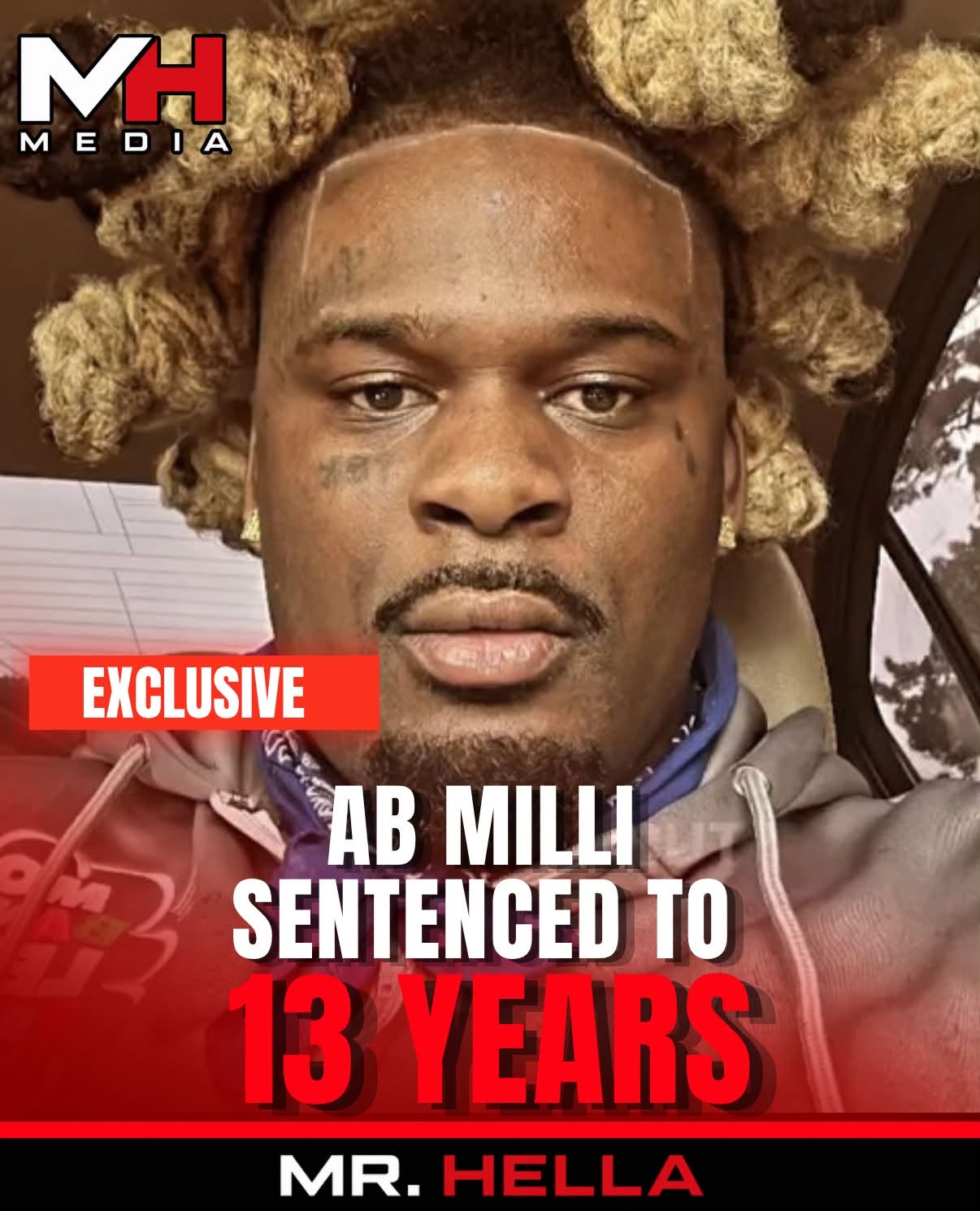
Bay Area rapper AB Milli has been sentenced to 13 years in California state prison after resolving three Alameda County criminal cases involving pimping, robbery, assault and attempting to dissuade a witness.
The 31-year-old rapper, whose legal name is Albert Collins, pleaded no contest to felony charges stemming from an investigation that authorities said involved an armed robbery operation around Oakland. His co-defendant, Maurice Johnson, also received a 13-year sentence.
The sentence closes one major portion of Collins’ legal battle, but it does not mean his problems with the justice system are over. After his state case was resolved, Collins was transferred into federal custody, where he faces proceedings over allegations that his new criminal conduct violated the terms of supervised release imposed in an earlier federal gun case.
Three Alameda County Cases Resolved
Collins’ 13-year sentence resulted from a plea agreement resolving three pending felony cases in Alameda County.
According to reporting on the case, the charges grew out of an investigation into a series of armed robberies around Oakland. Police investigating Collins eventually followed him to Vallejo, where authorities said they observed a suspected 17-year-old human-trafficking victim leave an area described as an open-air sex market and enter his vehicle.
Authorities subsequently alleged that Collins and his girlfriend attempted to prevent the teenager from cooperating with investigators. That allegation resulted in a charge related to dissuading a witness. Collins ultimately entered no-contest pleas resolving charges that included pimping, robbery, assault and witness dissuasion.
A no-contest plea allows a defendant to accept a criminal conviction without formally admitting guilt to the charged conduct in court. For purposes of sentencing, however, it generally carries the same effect as a guilty plea.
Judge Orders AB Milli to Return a PlayStation 5
One of the more unusual details of Collins’ plea agreement involved property taken during one of the robberies.
As part of the resolution, Collins was ordered to return a PlayStation 5 to one of the robbery victims. The order was included as part of the restitution connected to the criminal case.
Although the PS5 detail has attracted attention online because of how unusual it sounds alongside a 13-year prison sentence, it represents only a small piece of a substantially larger prosecution involving multiple felony cases.
Collins’ co-defendant, Maurice Johnson, was also sentenced to 13 years in connection with the investigation.
The 13-Year Sentence May Not Mean 13 Years Behind Bars
Collins received a 13-year state-prison term, but the amount of time he ultimately serves could be shorter depending on the credits he is legally eligible to receive while incarcerated.
Reporting on the sentencing indicated Collins could receive significant conduct credits. However, the precise reduction is governed by California sentencing and prison-credit rules and can depend on factors including the offenses involved and his eligibility. It therefore should not be assumed that his release date will automatically be exactly halfway through the sentence.
Before the state can become the only system Collins has to deal with, however, there is another major issue waiting for him in federal court.
AB Milli Is Now in Federal Custody
Collins was already familiar with the federal system before the Alameda County cases.
In 2021, he was arrested following an encounter with San Francisco police that involved a foot chase and firearms. He later pleaded guilty in federal court to being a felon in possession of a firearm and eventually began serving a period of federal supervised release after leaving custody.
Supervised release is separate from ordinary state parole. It is a period of federal court supervision that follows imprisonment, with defendants required to comply with conditions established by the court.
Collins was still under that federal supervision when Alameda County prosecutors brought the newer criminal cases against him in 2025.
That created a second legal problem: even after resolving the state charges, the conduct underlying those cases could constitute a violation of his federal supervised release.
Collins has consequently been transferred from state custody into federal custody, where he is accused of violating the conditions stemming from his earlier firearm conviction.
The federal supervised-release matter remains separate from his 13-year California sentence. A federal judge will determine what consequences, if any, Collins faces for the alleged violation. The allegation itself does not establish what additional punishment will ultimately be imposed.
A Legal History Dating Back Years
Collins’ latest cases are not his first encounter with law enforcement, and his name has previously surfaced in another Bay Area criminal case under dramatically different circumstances.
In 2016, prosecutors investigating the killing of 25-year-old Shanique Marie examined a diss track recorded by Collins and fellow Bay Area rapper Yatta. According to reporting on that case, the song accused Mario “NastyO” Pitteard of cooperating with police in a burglary investigation.
Authorities alleged that Pitteard retaliated by recruiting three San Francisco gang members to target another man. Marie, who was not the intended target, was instead killed during a Highway 4 shooting in what authorities described as a case of mistaken identity. Pitteard later pleaded no contest to first-degree murder and received a life sentence.
Collins was not the person convicted of Marie’s murder, an important distinction when discussing that history. His connection to that case came through the diss track prosecutors cited as part of the events preceding the retaliation.
Years later, Collins’ own federal firearm case placed him under the supervision that has now brought him back into federal custody.
State Sentence Down, Federal Case Still Ahead
The immediate outcome is clear: AB Milli has received a 13-year California state-prison sentence after pleading no contest in cases involving pimping, robbery, assault and witness dissuasion.
He has also been ordered to return a PlayStation 5 to one of the robbery victims as part of the resolution.
But the 13-year sentence is not necessarily the final word on Collins’ legal situation.
Because the crimes occurred while he was under federal supervised release from his earlier firearm conviction, Collins has now been transferred into federal custody to address the alleged violation.
That leaves the Bay Area rapper dealing with two different systems at once: a lengthy California prison sentence that has already been imposed and a federal supervised-release case that still has to be resolved.



Comments