

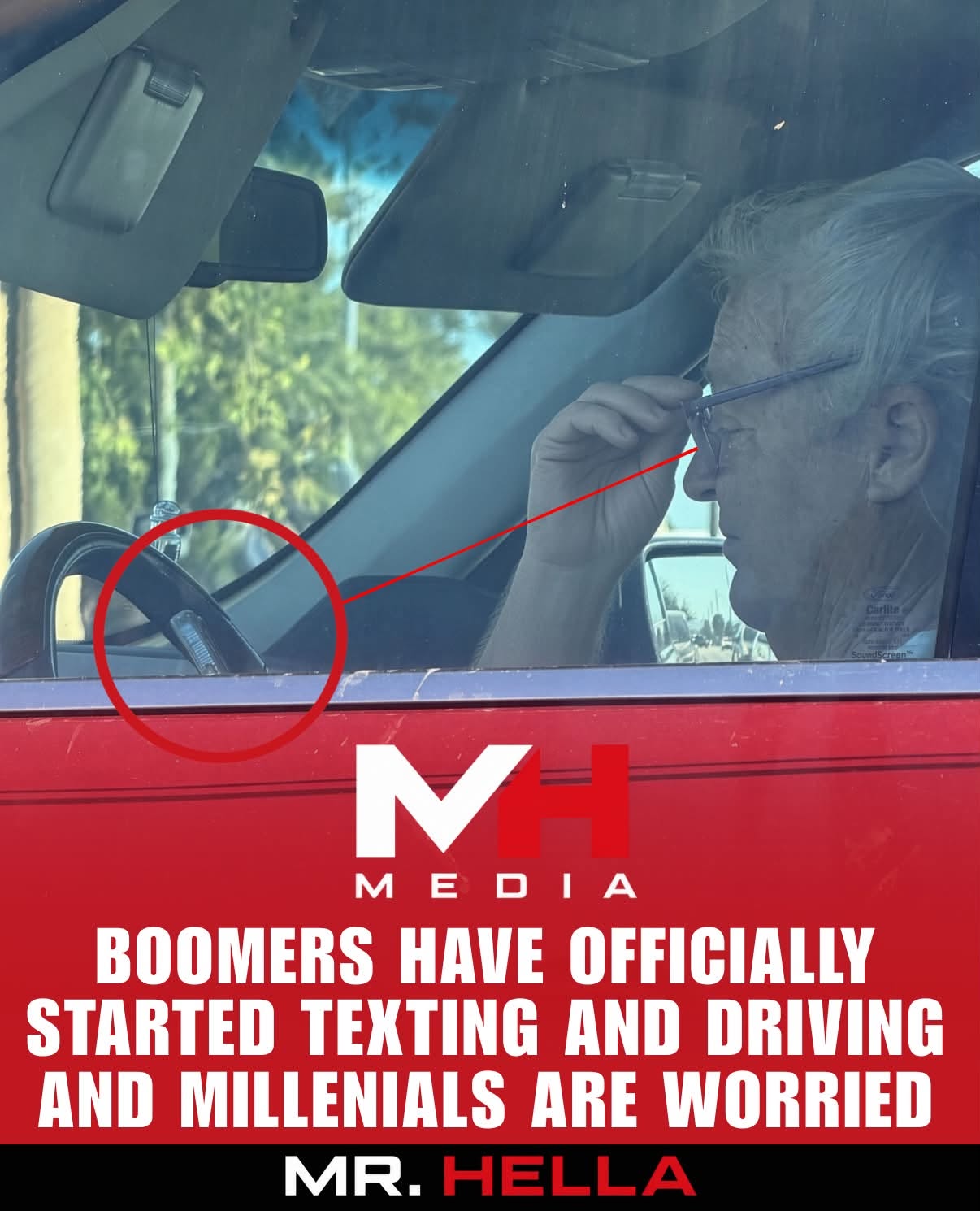
For years, distracted driving and cellphone use behind the wheel have largely been associated with teenagers and young adults.
But America's rapidly changing relationship with technology is complicating that stereotype.
Older Americans have embraced smartphones at an extraordinary rate over the past decade, and research shows that cellphone use behind the wheel isn't limited to younger generations.
That doesn't mean Baby Boomers have suddenly become the most distracted drivers on the road. In fact, younger drivers continue to have particularly high rates of handheld-device use.
Instead, the data reveal something potentially more important:
Distracted driving has become an all-generations problem.
Older Americans Have Rapidly Embraced Smartphones
The technological gap between younger and older Americans has narrowed dramatically.
According to AARP research published in 2026, smartphone ownership among Americans age 50 and older increased from just 55% in 2016 to approximately 90% in 2025.
That represents a dramatic transformation in less than a decade.
Older adults who once primarily used basic cellphones for calling are increasingly using the same smartphones and digital services as younger generations.
Navigation.
Text messaging.
Social media.
Music streaming.
Email.
Video.
Shopping.
Banking.
Those technological changes have brought enormous benefits, but they have also introduced many of the same distractions younger drivers have dealt with for years.
The smartphone doesn't stop demanding attention simply because its owner is 60 or 70 instead of 20.
Research Has Already Found Cellphone Use Among Older Drivers
Research from the AAA Foundation for Traffic Safety and University of California San Diego previously examined cellphone behavior among drivers age 65 and older.
The results challenged the assumption that older drivers largely ignore their phones while driving.
Nearly 60% of the older drivers surveyed reported using their cellphone in some capacity while behind the wheel.
Approximately 58% reported answering calls while driving.
Around 39% reported making calls.
And approximately 9% reported texting.
More than 80% of respondents in the study owned smartphones.
The findings demonstrated that while the specific types and frequency of phone use may differ between generations, older drivers are not immune to cellphone distraction.
But Younger Drivers Still Lead in Some Dangerous Phone Behaviors
This is where the generational conversation needs some perspective.
Current evidence doesn't support portraying older drivers as more phone-obsessed behind the wheel than young people overall.
A 2024 national observational survey cited by the Insurance Institute for Highway Safety found that approximately 4.5% of drivers were observed manipulating handheld devices at intersections.
Among drivers estimated to be between 16 and 24 years old, the rate was considerably higher:
8.7%.
That was the highest rate among the observed age groups.
AAA research similarly notes that drivers between 18 and 24 have an increased likelihood of smartphone use while driving.
So younger drivers remain an important focus of distracted-driving prevention.
What's changing is that the problem can no longer be dismissed as something only young drivers do.
The Smartphone Has Become a Universal Driving Distraction
The modern smartphone is uniquely capable of competing with driving for someone's attention.
A traditional cellphone primarily offered calling and basic texting.
Today's phone can contain virtually someone's entire digital life.
Instagram notifications.
TikTok videos.
Text messages.
Work emails.
Navigation instructions.
Spotify playlists.
YouTube videos.
Group chats.
Breaking news alerts.
Sports scores.
Dating-app notifications.
For drivers of every generation, the temptation is sitting within arm's reach.
The Insurance Institute for Highway Safety says cellphone use while driving increases crash risk, with texting and other forms of physically manipulating a phone consistently associated with increased danger.
Two Seconds Can Matter
One of the most dangerous aspects of distracted driving is how quickly conditions on the road can change.
A driver doesn't need to stare at a phone for 30 seconds to create a dangerous situation.
According to IIHS research, looking away from the roadway for only two seconds can double the risk of a crash or near-crash event.
Think about what can happen in two seconds.
A vehicle ahead can brake.
A pedestrian can enter a crosswalk.
Traffic can suddenly slow.
A motorcycle can move into a driver's blind spot.
A traffic light can change.
An animal can enter the roadway.
A vehicle can drift from its lane.
When a driver finally looks back up, the time available to recognize the danger, decide what to do and physically react has already been reduced.
Aging Can Add Another Layer to the Problem
Cellphone distraction can be dangerous at any age.
For some older adults, however, age-related changes can potentially compound the problem.
The Insurance Institute for Highway Safety notes that advancing age can bring impairments affecting driving ability.
Vision can change.
Physical mobility can decline.
And processing information can become more difficult for some individuals.
This does not mean every older driver is unsafe.
Far from it.
Older adults vary enormously in health and driving ability, and many adapt their driving habits as they age.
Some avoid nighttime driving.
Others drive fewer miles.
Some avoid particularly challenging traffic conditions.
But combining age-related limitations with an additional visual, manual or cognitive distraction can create unnecessary risk.
Older Drivers Aren't Necessarily the Roadway Menace Some Stereotypes Suggest
There is another important piece of context.
Despite concerns surrounding aging and driving, the overall safety picture for older drivers has improved substantially.
IIHS reports that fatal crash involvement rates among drivers 70 and older have declined dramatically compared with previous decades.
Drivers in their 70s actually have lower fatal-crash rates per licensed driver than middle-aged drivers.
That finding challenges another popular stereotype—that simply being older automatically makes someone a dangerous driver.
The picture changes when researchers examine crashes per mile driven, particularly at more advanced ages, partly because older adults generally drive fewer miles.
But the broader point remains:
Age alone isn't enough to determine whether someone is a safe driver.
Behavior matters.
And picking up a phone while driving is one behavior capable of increasing risk regardless of the driver's birth year.
There Are Millions More Older Drivers
The issue is becoming increasingly important simply because America's driving population is getting older.
According to IIHS, there were approximately 36 million licensed drivers age 70 and older in the United States in 2024.
That number has more than doubled since 1997.
Approximately 87% of Americans 70 and older were licensed in 2024, compared with roughly 73% in 1997.
Americans are living longer, maintaining their independence longer and keeping their driver's licenses longer.
At the same time, they are becoming dramatically more technologically connected.
Those two trends are intersecting behind the wheel.
Phone Use Is Also More Difficult to Measure Than It Looks
The distracted-driving problem may be substantially underestimated in official crash statistics.
A 2026 IIHS study compared police crash reports with data collected through smartphone-based telematics.
The difference was enormous.
Researchers found evidence of cellphone use during the 30 seconds before impact in approximately 7% of single-vehicle crashes and 8% of two-vehicle crashes included in the study.
Police reports identified cellphone use in less than 1% of those same crashes.
IIHS concluded that police reports were undercounting cellphone use before crashes by a factor of at least seven.
There are several reasons.
A driver may not admit they were looking at a phone.
A witness may never see it.
And unlike alcohol impairment, evidence of momentary distraction isn't always immediately obvious at a crash scene.
Speeding and Phone Use Can Happen Together
Another 2026 IIHS analysis uncovered an especially concerning relationship.
Drivers were actually more likely to handle their phones as they exceeded the speed limit.
Researchers analyzed nearly 600,000 trips recorded between July and October 2024 through insurance-related safe-driving applications.
On limited-access roads, the proportion of driving time involving phone handling increased approximately 12% for every 5 mph a driver traveled above the speed limit.
That means two risky behaviors can occur simultaneously.
A distracted driver is dangerous.
A speeding driver has less time to react.
Combining the two creates an even more concerning situation.
Modern Cars Can Help, But They Can't Make Distracted Driving Safe
Today's vehicles contain more safety technology than ever before.
Automatic emergency braking can intervene when a collision appears imminent.
Forward-collision warnings can alert drivers.
Lane-departure systems can warn someone drifting out of a lane.
Blind-spot monitoring can identify vehicles that are difficult to see.
Adaptive cruise control can maintain distance from traffic ahead.
Driver-monitoring systems can sometimes detect inattentiveness.
These technologies can prevent crashes or reduce their severity.
But they aren't permission to stop paying attention.
Safety systems have limitations.
Sensors can misinterpret situations.
Road markings can be unclear.
Weather can interfere with cameras.
Some obstacles may not be detected in time.
And a vehicle cannot anticipate every possible traffic scenario.
The person behind the wheel remains responsible for driving.
The Phone Itself Can Also Be Part of the Solution
Interestingly, the same technology creating the distraction can help reduce it.
Most modern smartphones contain driving modes or “Do Not Disturb While Driving” features capable of limiting notifications when someone is on the road.
AAA Foundation research published in 2025 found that activating smartphone-limiting technology resulted in a 41% reduction in the odds of performing a smartphone task while driving.
Drivers were also less likely to physically pick up their phones.
The challenge is getting people to use those features consistently.
Some drivers don't know they exist.
Others forget to activate them.
And some deliberately disable them because they believe they can safely multitask.
Most Drivers Already Know It's Dangerous
Perhaps the most revealing part of America's distracted-driving problem is that drivers don't necessarily need to be convinced that cellphone use is risky.
They already know.
AAA's 2025 Traffic Safety Culture Index found approximately 95% of drivers considered scrolling through social media while driving very or extremely dangerous.
Around 93% said the same about texting or emailing.
About 91% considered reading something on a handheld phone very or extremely dangerous.
Yet drivers still admitted doing those things.
Ten percent reported scrolling through social media while driving.
Twenty-eight percent reported sending a text or email.
Thirty-eight percent reported reading one.
The problem therefore isn't simply education.
It's behavior.
Distracted Driving Isn't a Generation War
Social media discussions about older drivers frequently turn into generational arguments.
Young drivers accuse Boomers of struggling with technology.
Older drivers point toward teenagers constantly staring at their phones.
Neither stereotype captures the entire problem.
Young drivers continue to show particularly high rates of certain forms of cellphone use.
Older drivers are increasingly surrounded by the same technology and can engage in distracted driving as well.
Middle-aged drivers aren't exempt either.
The smartphone has become nearly universal.
So has the temptation to check it.
That makes distracted driving less of a Gen Z problem, Millennial problem or Boomer problem than a modern-driving problem.
America's Drivers Changed Along With Their Phones
Ten years ago, the technological divide between generations was much easier to see.
Today it is disappearing.
AARP's finding that smartphone ownership among adults 50 and older climbed from 55% in 2016 to 90% in 2025 demonstrates just how quickly that transformation occurred.
Older Americans didn't merely acquire smartphones.
They integrated them into everyday life.
And inevitably, some of that use followed them into their vehicles.
The encouraging part is that technology can also reduce the danger.
Drivers can activate automatic driving modes before leaving.
Navigation can be programmed before the vehicle moves.
Messages can wait.
Passengers can handle tasks that require interacting with a screen.
And modern collision-avoidance technology can provide another layer of protection when human attention fails.
But none of those tools changes the fundamental rule of driving:
The road requires attention.
Whether the person holding the steering wheel is 18, 48 or 78, a notification isn't worth finding out what can happen during the two seconds their eyes aren't looking ahead.



Comments