

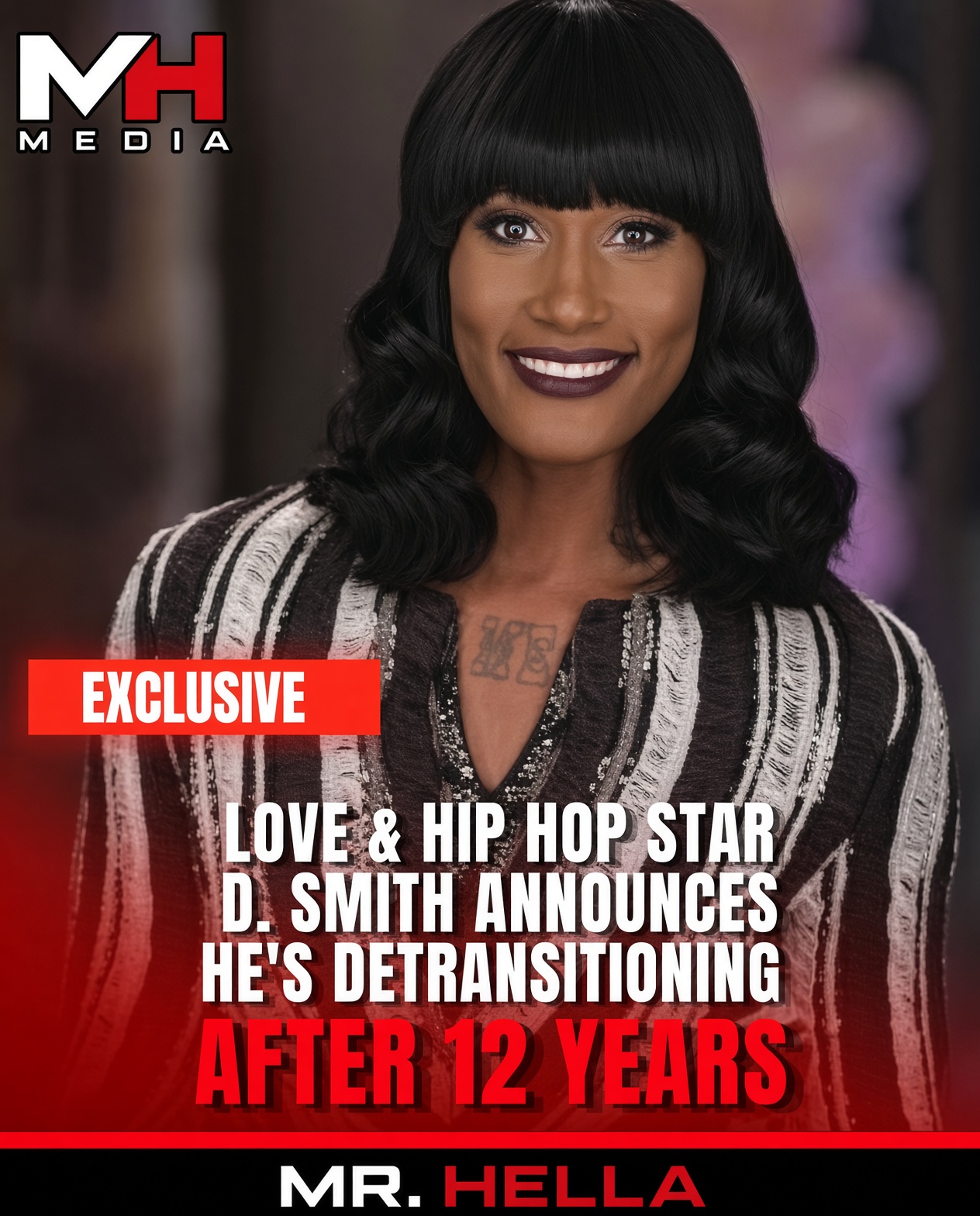
Grammy-nominated producer, filmmaker and former Love & Hip Hop: Atlanta cast member D. Smith has announced a major personal change, revealing that he is detransitioning after spending roughly 12 years living publicly as a transgender woman.
Smith said he will now live and present as a man and use he/him pronouns, describing the decision as a new chapter that has been taking shape privately over the past several months.
“For most of my life, I’ve followed my heart, even when the path wasn’t easy to understand,” Smith wrote in his announcement. He said his years living as a transgender woman were meaningful to him and made clear that he does not view that period of his life as something he needs to disown.
“Those years weren’t a mistake. They were real,” Smith wrote, saying the experience introduced him to people, experiences and lessons that he intends to carry forward.
Smith Says He Will Now Live as a Man
Smith's announcement comes more than a decade after he publicly came out as transgender in 2014.
He said that over the past several months he has entered what he considers a new chapter and has decided to live publicly as a man.
“Going forward, I’ll be living and presenting as a man and using he/him pronouns,” Smith wrote.
Smith also offered a particularly personal explanation for how he views the relationship between his past and where he is now.
“This isn’t about erasing my past,” he said. “Living my life as a woman for 12 years showed me the man that I wanted to become.”
Smith did not provide detailed information about whether his detransition includes medical changes. His public statement focused instead on how he intends to identify, present and live going forward. It would therefore be inaccurate to assume details about medical treatment or procedures that Smith himself has not disclosed.
He Says His Support for the Transgender Community Hasn't Changed
Smith also used the announcement to make clear that his decision should not be interpreted as a rejection of transgender people or of the community he has been closely connected to for years.
“My respect and love for the transgender community remain unchanged,” he wrote.
Smith added that he continues to believe people should be able to live with dignity, safety and compassion and have the freedom to determine who they are.
That part of his statement is significant because Smith's public identity and professional work have been closely connected to transgender representation.
When Smith joined Love & Hip Hop: Atlanta in 2016, he became the franchise's first openly transgender cast member. His appearance brought transgender representation into one of reality television's most prominent hip-hop franchises at a time when that representation was considerably less common on mainstream television.
Smith's time on the program was relatively brief, but his appearance attracted significant attention and introduced him to a much larger reality-television audience.
Smith Had an Established Music Career Before Reality TV
Long before Love & Hip Hop, Smith had already built a résumé behind the scenes in the music business.
The producer, songwriter and singer earned Grammy recognition through his work with Lil Wayne and contributed to Wayne's blockbuster 2008 album Tha Carter III. Smith produced, co-wrote and performed on “Shoot Me Down,” one of the tracks on the Grammy-winning project.
Smith has also worked with artists including Ciara, Fantasia, Estelle and Monica, among others, giving him an established career in R&B and hip-hop before his personal life became part of reality television.
His career took another turn when he moved into filmmaking.
Smith directed the 2023 documentary Kokomo City, which centered on the lives and experiences of four Black transgender sex workers in Atlanta and New York.
The film premiered at the Sundance Film Festival, where it received both the NEXT Innovator Award and an Audience Award. Lena Waithe served as one of the project's executive producers.
The documentary further established Smith as a prominent creative voice connected to transgender storytelling, making his latest announcement particularly notable given how much of his public work over the previous decade intersected with gender identity.
Smith Isn't Calling His Past a Regret
Perhaps the clearest point in Smith's announcement is one that could easily become lost as the story spreads online: he did not characterize his transition as a mistake.
Instead, Smith framed his detransition as another stage of the same personal journey.
His statement repeatedly emphasized that the 12 years he spent living publicly as a transgender woman remain part of his life and helped shape the person he is today.
That distinction matters when reporting the announcement.
Smith is saying that he is detransitioning and will now present as a man. He is not saying that his previous identity was fraudulent, that transgender people generally should detransition, or that he regrets the entire period.
In fact, his statement explicitly communicates the opposite on several of those points.
Smith described his past as real and meaningful while simultaneously saying that living through it ultimately helped him understand the man he now wants to become.
More of the Story Could Be Coming
Smith indicated that his initial statement does not contain everything behind the decision.
“There is much more to this journey” than can fit into one announcement, he said, adding that he intends to share the fuller story when he feels the time is right.
For now, he is asking for room to continue growing while beginning the next phase of his life publicly.
The announcement represents another major evolution for someone whose career has moved through several different worlds — from producing records for major artists, to reality television, to becoming an openly transgender figure in hip-hop culture, and later to directing an acclaimed documentary centered on Black transgender lives.
Now, roughly 12 years after publicly beginning that chapter, Smith says he is entering another.
D. Smith will live and present publicly as a man and use he/him pronouns going forward. But in his own telling, the years that came before are not something he intends to erase.
They remain part of the story that brought him here.


Comments