

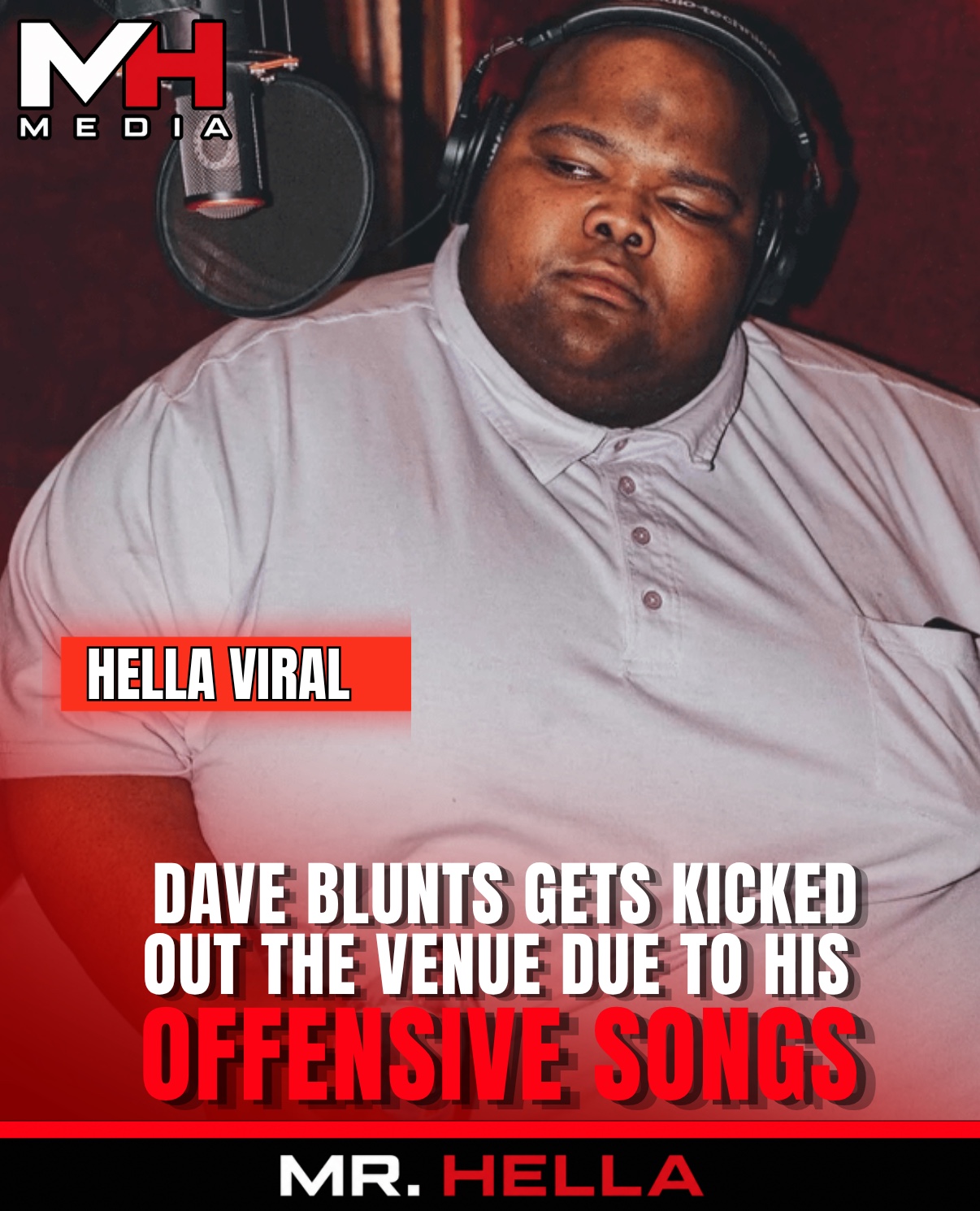
Dave Blunts is once again drawing attention for the provocative material that has become inseparable from his rise in rap, this time following a reported incident surrounding his scheduled appearance in San Luis Obispo, California.
Blunts was officially scheduled to perform at the Fremont Theater in San Luis Obispo on September 26 as part of his Still Standing Tour. Archived event listings from both AXS and local concert calendars confirm the rapper was on the venue’s schedule for Saturday night.
Social-media posts circulating around the appearance have since fueled claims that Blunts encountered problems at or around the venue, with the situation being characterized online as another instance of the rapper’s explicit material creating friction.
Exactly what happened, however, requires some caution.
Mr. Hella Media has been able to independently confirm that Blunts was booked at the Fremont Theater, but has not found an official statement from the venue establishing that he was removed specifically because of his lyrics. The Fremont Theater’s current event calendar has already moved on to subsequent shows, and no public explanation for the reported incident appears on its website.
That leaves the San Luis Obispo episode, as currently described on social media, as a reported incident rather than a fully documented venue enforcement action.
Still, the controversy fits into a much larger conversation that has followed Blunts throughout his increasingly high-profile career: the rapper has made it clear that sanitizing his music for people who find it offensive isn’t part of his plan.
Dave Blunts Has Never Tried to Make His Music Clean
Provocation isn’t something accidentally attached to Dave Blunts’ music.
It is embedded in it.
Blunts, born Davion Blessing, built much of his audience through emotionally direct records that can jump from heartbreak and health problems to drugs, sex, threats, insults and intentionally offensive punchlines with little warning.
His lyrics can be vulnerable one moment and deliberately outrageous the next.
That combination has helped distinguish him from a generation of internet rappers competing for attention, but it has also made him a difficult artist to separate from controversy.
Blunts addressed criticism of his writing directly around the release of his 2025 album You Can’t Say That. In announcing the project, he pushed back against people who believed his material had become too vulgar, arguing that the songs reflected the difficult realities of his life and saying he wasn’t going to “Kidzbopify” those experiences to make them more comfortable for listeners.
That position has effectively become part of the Dave Blunts brand.
He isn’t presenting the explicitness as something that slipped through.
He is defending it as part of the point.
His 2026 Material Has Continued Pushing That Line
Blunts hasn’t noticeably softened his approach as his profile has grown.
His February 2026 single “Unnecessary,” for example, contains explicit sexual language and slurs almost immediately, demonstrating how little interest the rapper has shown in adjusting his writing for a broader or more family-friendly audience.
That creates an obvious tension as an artist moves from internet notoriety into traditional concert venues.
Online, listeners can decide whether they want to press play.
A live venue operates differently.
Promoters, venue operators and touring teams can have their own contractual requirements, age restrictions and expectations surrounding performances. The exact terms governing Blunts’ San Luis Obispo appearance have not been made public, so it would be premature to say that his lyrics violated a particular Fremont Theater rule.
But Blunts’ catalog was hardly a secret before the booking.
By September 2026, the provocative nature of his music had been established for years.
The Fremont Theater Show Was Part of a Larger California Run
The San Luis Obispo appearance wasn’t an isolated booking.
It came during Blunts’ Still Standing Tour, which has taken him through multiple venues around the country.
Concert records show Blunts performing at the Nile Theater in Mesa, Arizona, on August 26, followed by California dates including House of Blues in San Diego, Ventura Music Hall in Ventura and Cornerstone in Berkeley.
Live Nation also listed another Still Standing Tour performance at the Parish at House of Blues Anaheim for September 27, one day after the scheduled San Luis Obispo show.
That context matters because there is currently no evidence that Blunts has been broadly unable to find venues willing to host his performances.
The more accurate picture is an artist with an intentionally provocative catalog touring conventional venues while occasionally generating controversy around the content and atmosphere surrounding those shows.
Controversy Has Followed His Live Performances Before
Dave Blunts concerts have already produced unpredictable moments.
A documented setlist from his August 2025 performance at Los Angeles’ El Rey Theatre notes that an audience member was removed after displaying a swastika during the show. The same concert reportedly included a fight in the crowd later in the set.
Those incidents shouldn’t be conflated with Blunts himself being removed from a venue.
But they illustrate the chaotic atmosphere that can surround his live performances.
His song titles alone provide some indication of the material audiences encounter. The documented El Rey set included records such as “Diddy Games,” “Sex Crimes,” “Tired of Being A Simp,” “10 PERCS” and “Check On My N****s,” alongside more emotionally driven songs including “Hospital Bed” and “Balcony.”
It is a catalog that intentionally refuses to fit comfortably into a sanitized mainstream package.
His Music Is More Complicated Than Shock Lyrics
Reducing Blunts entirely to vulgarity would also miss why his career has developed as quickly as it has.
Behind the shock value is an artist whose music has frequently dealt with serious personal problems.
Blunts has rapped openly about hospitalization, his weight, romantic rejection, substance use and the psychological effects of sudden fame.
“Balcony,” released in 2025, is built around the fallout from a failed relationship and references Blunts being hospitalized while struggling with the breakdown of that relationship.
In an extended interview on RawTalk, Blunts went into considerably greater detail about that period, describing arguments, hospitalization and the messy deterioration of his relationship with a woman he identified as Solar.
That willingness to turn uncomfortable personal experiences into songs has been central to his appeal.
The controversy comes from how he tells those stories.
Blunts doesn’t filter them through conventional pop songwriting.
He exaggerates, insults, jokes, threatens and says things that many artists with mainstream ambitions would avoid entirely.
His Rise Has Been Unconventional From the Beginning
Dave Blunts didn’t arrive through the traditional major-label artist-development system.
His rise was driven heavily by the internet, where his unusual vocal delivery, highly quotable lyrics, physical appearance and intensely personal songs made him nearly impossible to ignore.
Part of the initial fascination centered on the contrast between Blunts’ voice and appearance.
But the memes eventually gave way to a genuine audience.
His songwriting became recognizable enough that major artists began paying attention, and his connection with Ye became one of the most notable developments in his career.
Blunts’ visibility grew rapidly from there.
With that growth came a question that follows many artists who become famous by refusing to conform: what happens when the thing that made an artist compelling online collides with the expectations of larger stages and mainstream institutions?
Blunts appears unwilling to solve that problem by changing the music.
Blunts Has Already Answered the Censorship Question
That is perhaps the most important context surrounding the latest controversy.
Blunts has effectively told listeners what they should expect.
When critics objected to his explicit material, his response wasn’t that people had misunderstood him.
He defended his right to make it.
His argument around You Can’t Say That was that his music reflected experiences that weren’t clean, pleasant or easily marketable.
That doesn’t mean venues are obligated to accept anything an artist chooses to perform.
Nor does artistic expression eliminate contractual obligations or venue policies.
But it does mean anyone booking Dave Blunts in 2026 is booking an artist whose refusal to sanitize himself is already well documented.
Past Associations Have Added Another Layer of Scrutiny
Blunts’ associations have also helped keep him near controversy.
His relationship with Ye brought him considerably more attention while simultaneously connecting him to one of music’s most polarizing figures.
Reports surrounding their collaboration indicated that the two artists became close creatively, with Blunts becoming heavily involved in writing material connected to Ye’s unreleased work.
For Blunts, that relationship made a certain amount of artistic sense.
Both artists have demonstrated an appetite for provocation and a willingness to say things that create backlash rather than avoiding controversy altogether.
But as Blunts’ audience expands beyond the internet spaces where his career first exploded, the consequences of that approach can become more complicated.
The San Luis Obispo Story Still Needs an Official Explanation
For now, the biggest unanswered question is exactly what happened surrounding the September 26 Fremont Theater appearance.
The booking itself is confirmed.
AXS listed Dave Blunts at the Fremont Theater for September 26 at 8 p.m., and San Luis Obispo concert listings separately advertised “Dave Blunts Presents: Still Standing Tour” for the same date.
What remains unconfirmed is the precise reason behind the reported venue-removal incident circulating online.
There is not enough publicly documented evidence at this stage to state as fact that Fremont Theater officials removed Blunts because he refused to censor vulgar lyrics.
There is similarly not enough evidence to attribute the situation to his past associations without an on-record explanation from the venue, promoter or Blunts’ team.
Those details matter.
A viral clip can show that an incident occurred without necessarily establishing everything that happened before the camera started recording.
But the Larger Conflict Isn’t Going Away
Whatever ultimately emerges about San Luis Obispo, Dave Blunts’ larger relationship with controversy is unlikely to disappear.
The same characteristics creating problems for him are also part of what made him famous.
His songs are explicit.
His humor is deliberately uncomfortable.
His personal life becomes material.
His concerts can be unpredictable.
And when critics tell him the music goes too far, his public response has essentially been that he isn’t interested in rewriting his life into something cleaner for them.
That attitude has helped turn Dave Blunts from an internet curiosity into a touring rapper with a rapidly expanding audience.
It may also ensure that incidents like the one being discussed around San Luis Obispo continue following him as he moves into bigger venues.
For now, the September 26 booking is documented.
The social-media controversy is real.
But the claim that Dave Blunts was specifically removed because he refused to censor his lyrics still needs confirmation from someone directly involved.
Until that arrives, the strongest part of the story isn’t speculation about why one venue may have had a problem with Dave Blunts.
It’s that an artist who has repeatedly promised not to sanitize his music is now confronting the complications that can come when that philosophy moves from the internet to the stage.

Comments