

Ed Sheeran has spent much of his career trying to keep politics away from his concerts. After one of the most turbulent weeks of his career, he acknowledged that was no longer possible.
Standing before tens of thousands of fans at Lincoln Financial Field in Philadelphia on Saturday, September 19, Sheeran directly addressed the war in Israel and Gaza, the humanitarian crisis facing Palestinians and the growing debate over freedom of expression that has engulfed his Loop Tour.
Sheeran told the audience that he has deliberately avoided becoming a political commentator because he wants his music to bring people together rather than divide them. But after controversy surrounding his tour exploded into an international debate over Gaza, Israel and what performers should be allowed to say onstage, the British singer said he could no longer avoid discussing what he believes is fundamentally a humanitarian issue.
“What is happening in Gaza is catastrophic and unjustifiable and disproportionate,” Sheeran told the Philadelphia crowd. He also said his heart had been broken by the scale of civilian deaths, including the deaths of children.
It was one of Sheeran’s clearest public statements on the conflict and represented a significant departure from the position he had tried to maintain only days earlier.
Sheeran Says His Shows Are Supposed to Be About Unity
Sheeran began his remarks by explaining why he has generally resisted bringing politics onto his stage.
“I’ve tried in my career not to be a political commentator of any kind because I want my music and shows to be about unity not division, about humanity not politics,” he said.
For Sheeran, that philosophy has been central to the type of live experience he says he wants to create.
His concerts draw enormous audiences across countries, cultures, religions and political viewpoints. Rather than asking those audiences to agree with him politically, Sheeran said he has wanted his music to provide a place where those differences can temporarily coexist.
That philosophy became considerably harder to maintain after events surrounding his U.S. Loop Tour forced questions about politics directly into the production.
Sheeran acknowledged that he had suddenly found himself in the middle of an argument he never expected his tour to become part of.
“I’ve never wanted to be an activist musician,” he told the crowd, saying recent events had placed him in the center of an “important and passionate argument” involving freedom of speech and an extraordinarily complicated political conflict.
He also acknowledged that he had made difficult decisions during the controversy and apologized for mistakes.
His Comments Went Beyond Gaza
Although Sheeran strongly condemned the destruction and civilian deaths in Gaza, his remarks were broader than a single statement about Palestinians.
He also addressed the October 7, 2023 Hamas-led attack in Israel, calling what happened at the music festival “horrific” and placing it in the context of what he described as centuries of Jewish suffering.
At the same time, he said the suffering of Palestinians could not be ignored.
His comments therefore did not frame concern for Israelis and Palestinians as mutually exclusive positions. Instead, Sheeran focused his remarks on civilian suffering and the human consequences of the conflict.
He also indicated that speaking publicly was not the end of what he intended to do.
Sheeran told the audience that he was already speaking with people representing different perspectives to determine how he could make a contribution to victims of the conflict. He acknowledged that he does not know enough about the extraordinarily complicated situation and said he intended to continue listening and learning.
That admission was consistent with the cautious approach Sheeran has taken throughout the controversy. Rather than presenting himself as an authority on Middle Eastern politics, he framed his intervention around humanitarian concerns.
But the fact that he intervened at all marked a major change.
The Loop Tour Forced the Conversation
Only days earlier, Sheeran had publicly explained why he generally avoided political commentary at his shows.
“I have my personal views on this devastating conflict,” he said in a statement Tuesday. “Just because I choose not to speak publicly, it doesn’t mean I don’t have them.”
He added that people attending his concerts “do not expect a political forum.”
By Saturday, the circumstances surrounding his tour had made maintaining that separation increasingly difficult.
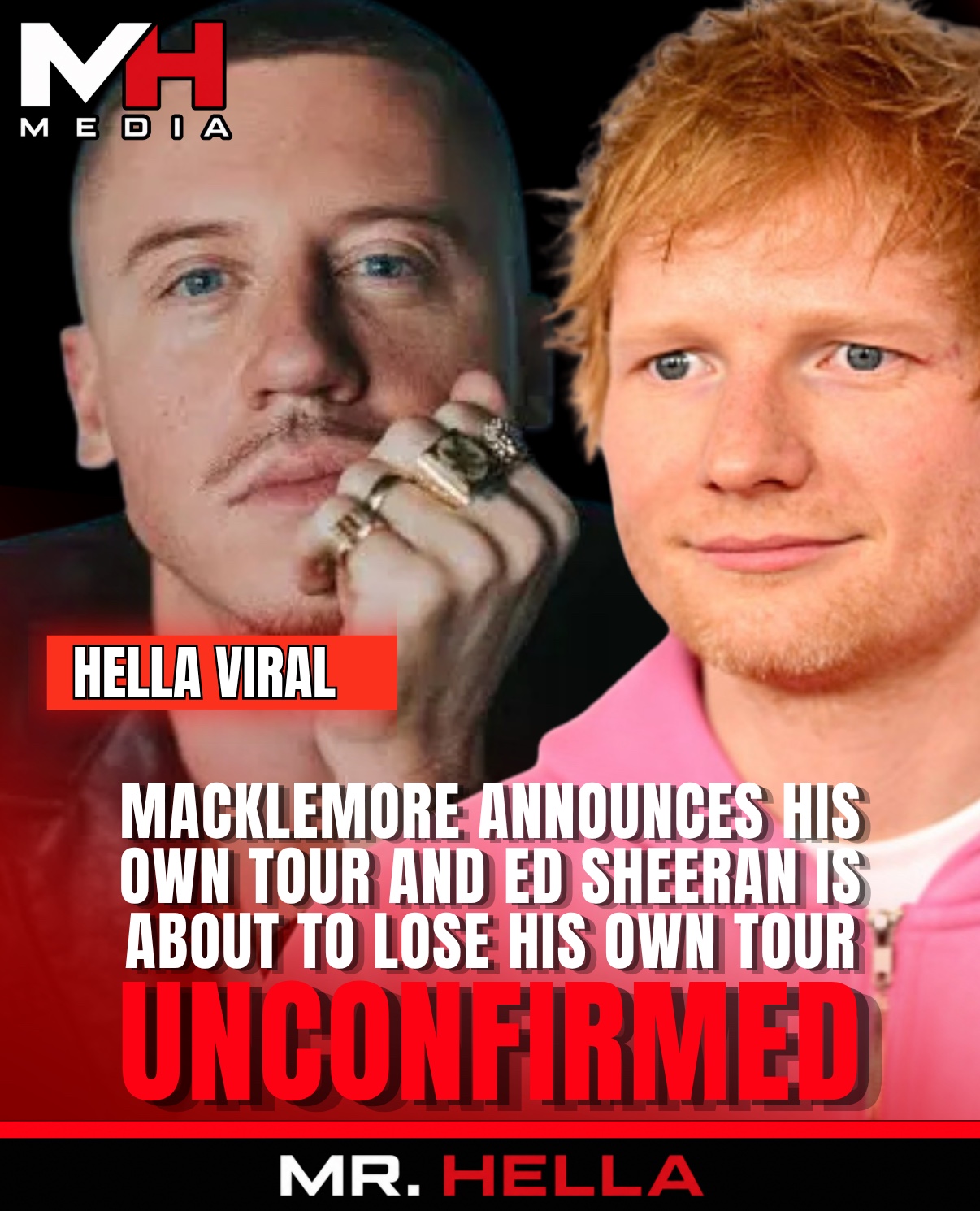
The controversy began after Macklemore, one of the Loop Tour’s opening acts, used his performances at MetLife Stadium in New Jersey to express support for Palestinians. During his set, Macklemore shouted “Free Palestine” and incorporated imagery from Gaza into his performance.
The political message generated immediate controversy.
Owners of upcoming stadiums objected to Macklemore’s participation, and he was subsequently removed from the remaining dates of the tour. Sheeran has maintained that he did not personally make the decision to remove Macklemore, saying the decision was made by the tour promoter after objections from venues.
The removal did not calm the situation.
Instead, it triggered an even larger debate about whether venue owners and other powerful figures should be able to influence what performers say from the stage.
Sheeran Raises His Own Free-Speech Concerns
During his Philadelphia remarks, Sheeran made clear that he was troubled by that question.
Without identifying individual venue owners by name, he said he was deeply concerned about the prospect of venues requiring performers’ material to be approved in advance.
“This happens in so many places I perform around the world,” Sheeran said, adding that he does not believe it should happen “in the free world.”
That statement added another dimension to his response.
Sheeran was not simply offering his views about Gaza. He was also publicly questioning how much authority venues should have over artists’ speech.
The distinction matters because Sheeran has repeatedly said he did not make the ultimate decision to remove Macklemore.
His position now appears to contain two separate ideas: Sheeran still wants his own concerts to emphasize music and unity rather than political advocacy, but he is also uncomfortable with outside institutions deciding what performers are permitted to say.
Those positions are not necessarily the same as endorsing Macklemore’s exact statements or presentation. They instead reflect Sheeran’s concern about who controls speech inside a live-performance environment.
Other Artists Walked Away
The controversy became even more difficult for Sheeran after other musicians scheduled to participate in the Loop Tour began withdrawing.
Beoga, Lukas Graham, Aaron Rowe and Finneas were among the artists who pulled out following Macklemore’s removal, with the departures tied to objections over what happened and expressions of support for Palestinians.
The withdrawals transformed what had begun as a dispute involving one opening act into a crisis surrounding the broader tour.
By the time Sheeran arrived in Philadelphia, the lineup around him had dramatically changed.
The singer performed largely on his own, leaning on the looping approach that has long allowed him to build full arrangements live from his guitar and voice.
For an artist who has spent years performing stadium shows with remarkably minimal equipment, Sheeran was uniquely equipped to continue despite losing much of the supporting lineup.
But the circumstances surrounding the stripped-down performance were impossible to separate from the controversy that preceded it.
Protesters Were Waiting Outside
The political debate also followed Sheeran directly to Lincoln Financial Field.
A small group of pro-Palestinian demonstrators gathered outside the Philadelphia stadium before the concert, waving Palestinian flags and urging people to reconsider attending.
Some ticket holders reportedly struggled with that decision.
There were fans who attended while making clear they simply wanted to hear Sheeran’s music and did not see the concert as an endorsement of either side of a political dispute. Others decided not to enter and instead joined demonstrations outside.
That division illustrated the exact problem Sheeran had been trying to avoid.
He wanted the stadium to be a place where thousands of people with different beliefs could share the same music.
Instead, people were now debating whether simply entering the stadium carried political meaning.
Sheeran Says He Made Mistakes
Sheeran did not portray his handling of the situation as flawless.
“I’ve had to take and make difficult decisions, and I am making mistakes and I’m so, so sorry for them,” he told the Philadelphia audience.
That acknowledgment was notable after days of criticism from multiple directions.
Some supporters of Macklemore argued that Sheeran should have done more to keep him on the tour and protect his ability to express pro-Palestinian views. Others believed political statements about the conflict should never have become part of the concerts in the first place.
Sheeran attempted to navigate between those positions without pretending the controversy could simply disappear.
By the end of the night, he became even more personal about what the previous week had done to him.
Sheeran told the audience it had been one of the worst weeks of his life and said he had questioned whether the tour would continue — and even whether he still wanted to be an artist.
He said he felt people close to him had abandoned him during the controversy, but looked out at the approximately 50,000 people in Philadelphia and thanked them for showing up.
From Avoiding Politics to Speaking Directly
The significance of Sheeran’s Philadelphia speech is not that he suddenly reinvented himself as a political activist.
In fact, he explicitly said he does not want that role.
What changed is that Sheeran acknowledged there are circumstances where attempting to remain outside a political debate becomes difficult when the debate has already arrived at your own stage.
For years, his approach has been to make concerts about songs, relationships and shared emotions rather than ideological arguments.
The Loop Tour controversy challenged that model.
Macklemore’s removal raised questions about Palestine, Israel, venue ownership, artistic control and freedom of expression. Supporting artists walked away. Protesters gathered outside the stadium. Fans debated whether they should attend.
Eventually, Sheeran decided silence was no longer sufficient.
He condemned the October 7 attack in Israel and acknowledged Jewish suffering. He described the devastation and civilian deaths in Gaza as catastrophic, unjustifiable and disproportionate. He raised concerns about conditions affecting Palestinians and questioned whether venues should be pre-approving what artists say.
But he also returned to the principle he says he wants his concerts to represent.
Unity rather than division.
Humanity rather than politics.
The irony is that it took one of the most politically charged weeks of Sheeran’s career for him to explain that philosophy more publicly than ever before.
Ed Sheeran still says he does not want his concerts to become political forums.
On Saturday night in Philadelphia, however, he acknowledged that the humanitarian suffering in Gaza — and the freedom-of-speech controversy surrounding his own tour — had reached a point where he felt he could no longer avoid the conversation.

Comments