

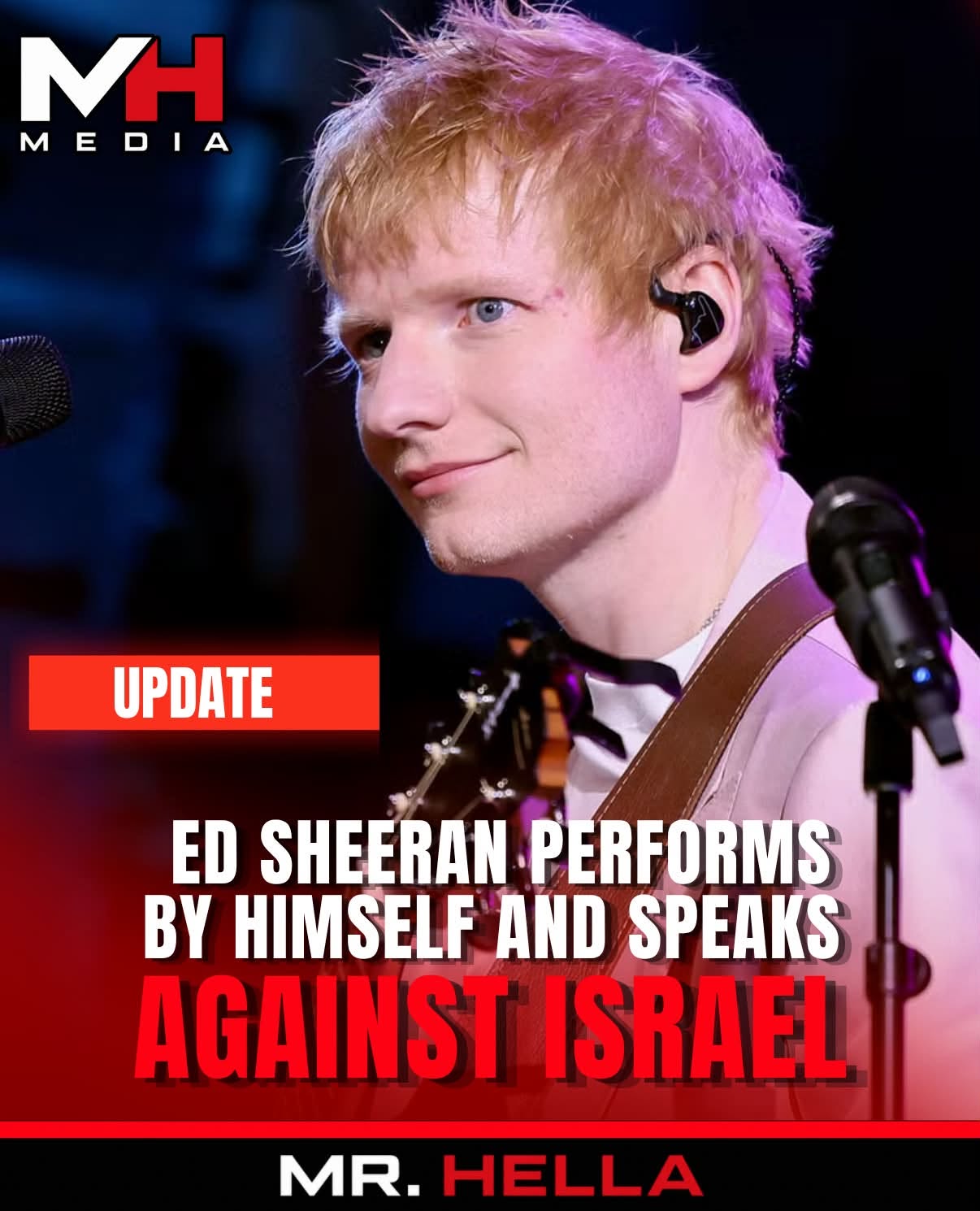
Ed Sheeran directly addressed the war in Gaza from the stage Saturday night, breaking from his typically apolitical approach as controversy surrounding Macklemore’s removal and the departure of multiple supporting acts continued to engulf his Loop Tour.
Performing at Philadelphia’s Lincoln Financial Field on September 19, Sheeran opened his concert with an unusually lengthy statement about Israel and Gaza. He described the devastation and civilian death toll in Gaza as “catastrophic and unjustifiable,” while also condemning the October 7 attacks in Israel and acknowledging what he described as centuries of Jewish suffering.
“My heart has been broken by the scale of devastation and loss of civilians’ lives, of children’s lives,” Sheeran told the crowd. He said he wants his music and concerts to represent humanity and unity rather than become political forums.
The remarks represented a notable shift for the 35-year-old singer, who only days earlier had explained that while he had personal views on the conflict, he generally kept them away from his performances because fans attending an Ed Sheeran concert did not expect a political forum.
But after a turbulent week in which Macklemore was removed from the tour and multiple artists subsequently withdrew, Sheeran acknowledged that circumstances had pushed him directly into a political debate he never intended to lead.
“I’ve never wanted to be an activist musician,” Sheeran told the Philadelphia audience, explaining that the situation had placed him in the middle of a heated argument involving politics and freedom of expression. He also acknowledged mistakes in how the controversy had unfolded and apologized.
Sheeran Addresses Both Israel and Gaza
Sheeran’s remarks went beyond the brief statement he had previously issued online.
According to accounts of his Philadelphia address, the singer acknowledged the October 7 attacks in Israel and Jewish suffering while also speaking directly about Palestinian civilians, the destruction in Gaza and conditions in the West Bank. He characterized what was happening in Gaza as not only catastrophic and unjustifiable but also disproportionate, and criticized what he called systemic injustice in the West Bank.
The comments matter because Sheeran had faced pressure from people on opposing sides of the controversy to state more clearly where he stood.
His position Saturday was not presented as an endorsement of one population’s suffering over another. Instead, Sheeran attempted to frame his remarks around civilian life, humanity and his opposition to violence and injustice while recognizing both Jewish and Palestinian suffering.
That approach was consistent with the broader message Sheeran has repeatedly said he wants attached to his concerts: people with different backgrounds and political beliefs should be able to occupy the same space and share an experience through music.
The difficulty is that his Loop Tour had already become part of the political debate whether Sheeran wanted it to or not.
The Controversy Started With Macklemore
The extraordinary scene in Philadelphia followed nearly two weeks of fallout stemming from Macklemore’s appearances as an opening act for Sheeran at MetLife Stadium in New Jersey earlier in September.
Macklemore, who has become one of the music industry’s most outspoken supporters of Palestinians, used his performances to discuss Gaza and declare “Free Palestine.” His set also incorporated political imagery connected to his song “Hind’s Hall.”
The performances generated both support and backlash.
Several Jewish and pro-Israel organizations criticized Macklemore’s presentation, while Macklemore maintained that criticism of the Israeli government and support for Palestinian rights should not be equated with hostility toward Jewish people.
The situation escalated when stadium operators objected to Macklemore appearing at upcoming dates.
Macklemore was ultimately removed from the remaining Loop Tour shows. Sheeran has repeatedly maintained that he did not personally make that decision, saying Macklemore’s contractual relationship was with tour promoter Messina Touring Group and that the promoter made the final call.
Sheeran said he spent days speaking with venues and attempting to “build bridges” before the decision was announced.
Macklemore, meanwhile, stood by his comments and pledged the money he expected to make from the tour — which he put at $1 million — to organizations providing assistance to Palestinians.
The Rest of the Tour Lineup Began Falling Apart
Removing Macklemore did not end the controversy.
Instead, other artists began leaving.
Irish singer Aaron Rowe and folk group Beoga withdrew from their appearances, as did Danish band Lukas Graham. Finneas, who had been scheduled to participate in later dates, also pulled out. Their departures were publicly tied to the controversy surrounding Macklemore and support for Palestinians.
The result was a dramatically different Philadelphia concert from the one originally planned.
Sheeran went forward with the September 19 date without the lineup of supporting artists that had been expected before the dispute erupted. No replacement opening acts had been announced ahead of the performance, and Sheeran took the stage for a show centered on his own performance.
For an artist whose looping technology has long allowed him to command stadiums largely by himself, performing without a conventional backing lineup was musically possible.
Symbolically, however, it was difficult to ignore why he was suddenly standing there without the artists who had been scheduled around him.
Protesters Gathered Outside the Stadium
The controversy followed Sheeran all the way to Lincoln Financial Field.
Pro-Palestinian demonstrators gathered outside the stadium before Saturday’s show, waving Palestinian flags and calling on concertgoers to boycott the performance.
Some fans told reporters they had reconsidered attending because of the controversy. Others said they ultimately decided to go because they wanted to see Sheeran perform and did not view attendance as an endorsement of any political position.
The Palestinian Campaign for the Academic and Cultural Boycott of Israel also called for a broader boycott of Sheeran’s tour, extending its appeal beyond Philadelphia to future dates.
That left Sheeran confronting exactly the situation he had said he hoped to avoid: a concert where the political controversy surrounding the event threatened to become as significant as the music itself.
“I Am Making Mistakes”
Sheeran did not present himself Saturday as having perfectly handled the crisis.
Instead, he acknowledged that he had been forced to make difficult choices and that some of those choices may have been mistakes.
“I am making mistakes and I’m so, so sorry,” he told the crowd.
The apology was significant because criticism of Sheeran had increasingly focused not only on what happened to Macklemore but on whether Sheeran should have done more to prevent it.
Macklemore’s supporters argued that removing an artist following his political comments amounted to suppressing pro-Palestinian speech. Critics of Macklemore, meanwhile, argued that a stadium concert should not have been transformed into a platform for political messaging that some attendees considered inflammatory.
Sheeran has attempted to position himself between those arguments.
He has maintained that the decision to remove Macklemore was not his while acknowledging that, as the headlining artist whose name is attached to the tour, he became inseparable from the fallout.
Saturday’s speech appeared to recognize that distinction.
Sheeran may not have wanted his concerts to become political forums, but by the time he reached Philadelphia, avoiding the subject entirely had become increasingly difficult.
The Tour Continues
Despite the withdrawals, protests and boycott calls, Sheeran has not abandoned the Loop Tour.
His Philadelphia performance demonstrated that he is prepared to continue even after the lineup surrounding him changed dramatically.
It also marked a new stage in the controversy.
Earlier in the week, Sheeran's public position centered largely on explaining what he said he didn't do: he said he did not personally remove Macklemore and did not want his concerts transformed into political forums.
In Philadelphia, he went further and told the audience what he actually believes about the humanitarian situation.
He condemned the October 7 attacks and recognized Jewish suffering while describing the devastation and civilian deaths in Gaza as catastrophic and unjustifiable. He expressed concern over Palestinians in the West Bank and acknowledged that his effort to stay outside political activism had become increasingly difficult amid the crisis surrounding his own tour.
The speech did not erase the disagreement over Macklemore’s removal, and it is unlikely to satisfy every critic on either side of the broader Israel-Palestine debate.
But it did answer one question that had followed Sheeran throughout the week.
He has personal views on what is happening in Israel and Gaza.
And on Saturday night in Philadelphia, despite previously saying his concerts were not intended to be political forums, Ed Sheeran finally decided to share some of them from the stage.


Comments