

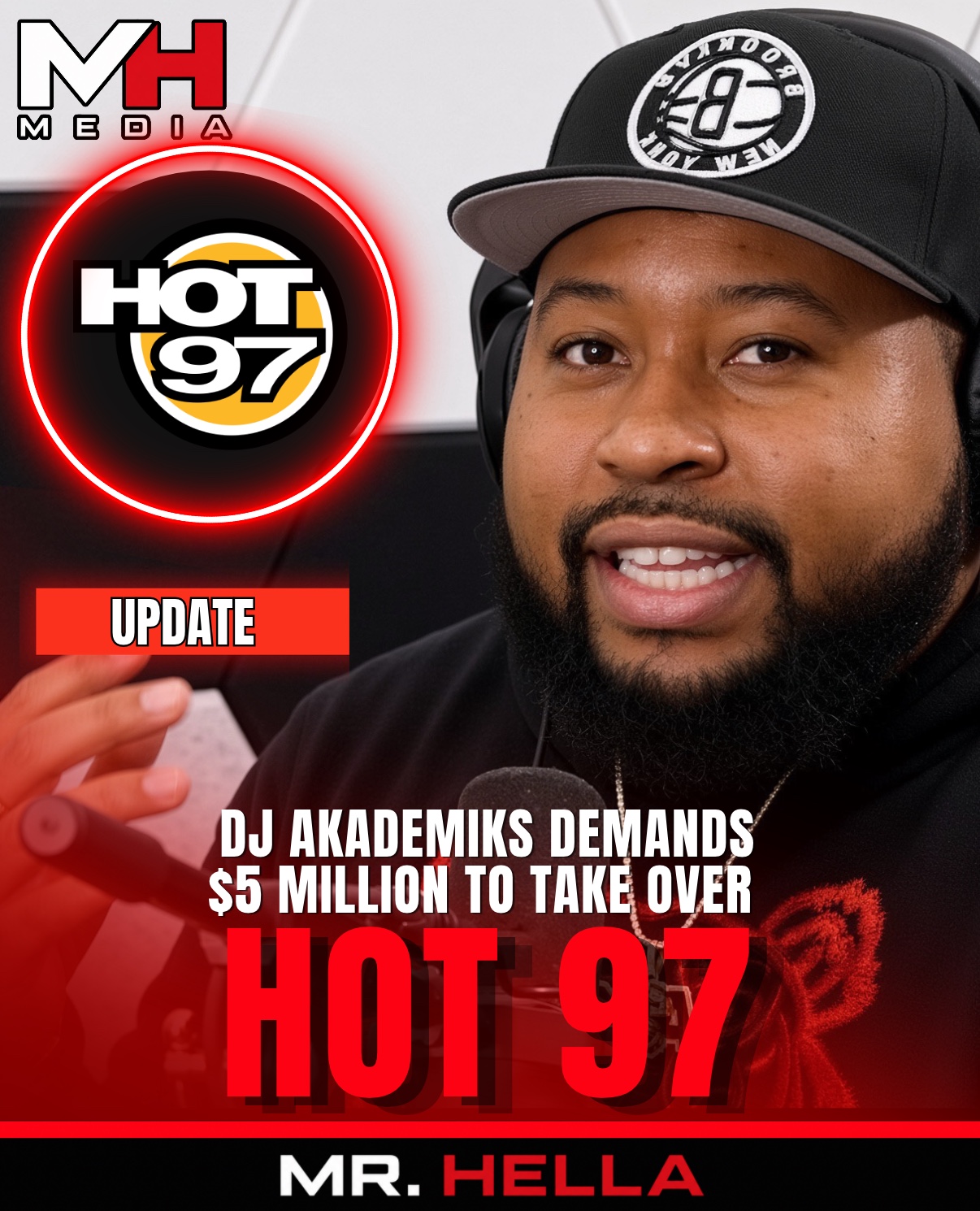
DJ Akademiks Demands $5 Million to Replace The Kid Mero at Hot 97 as Joe Budden Defends Morning Show Host
October 19, 2026 | Mr. Hella Media
The growing controversy surrounding New York’s legendary hip-hop radio station Hot 97 has taken another dramatic turn, with DJ Akademiks publicly offering to replace The Kid Mero for $5 million a year while Joe Budden has thrown his support behind the embattled morning show host.
The dispute has quickly expanded beyond complaints about workplace conditions into a larger conversation about the future of traditional hip-hop radio, corporate management and the growing influence of independent media personalities. What began as criticism from Hot 97 employees has now drawn some of the biggest names in hip-hop commentary into a public disagreement over the station’s leadership and direction.
DJ Akademiks Offers to Take Over Hot 97’s Morning Show
DJ Akademiks entered the controversy during an October 15 livestream, suggesting that Hot 97 should consider replacing The Kid Mero with him as the station attempts to navigate mounting criticism and reported staffing reductions.
Akademiks, who has previously exchanged criticism with Mero, presented himself as someone capable of attracting a younger audience and bringing greater digital relevance to the historic radio brand.
However, his proposed services would come at a substantial price.
“Listen, non-negotiable, I want $5 million for the first year,” Akademiks declared.
He also suggested that he would be available to begin working after Thanksgiving if the station removed its current morning show personalities.
His remarks appeared to be a public challenge rather than evidence of any formal negotiations with Hot 97. There has been no confirmed indication that the station has approached Akademiks about replacing Mero or agreed to consider his proposed salary.
Nevertheless, the comments immediately added another dimension to an already contentious situation, particularly given Akademiks’ established rivalry with several personalities associated with the station.
Joe Budden Calls The Kid Mero and Offers His Support
While Akademiks used the controversy to promote his own potential involvement, Joe Budden took a different approach.
During a recent episode of The Joe Budden Podcast, Budden contacted The Kid Mero directly to discuss the criticism he and co-host Kazeem “Kaz” Famuyide had directed toward Hot 97 management.
Mero explained that his frustrations centered on corporate leadership and the challenges of producing successful programming when executives fail to provide adequate support.
He argued that even talented personalities can struggle when the people making decisions behind the scenes do not understand the business or the needs of their employees.
Budden expressed solidarity with Mero but also warned that publicly confronting an employer could have serious professional consequences.
“You absolutely have my support,” Budden told him.
Budden also suggested that Mero’s decision to criticize station leadership so openly could put his position at risk, noting that employees rarely maintain comfortable relationships with management after publicly challenging their decisions.
Despite that warning, Budden encouraged Mero to continue speaking out as long as the station allowed him to remain on the air.
Mero, meanwhile, indicated that his criticism was not motivated by a personal salary reduction. Instead, he emphasized his concerns about management, resources and the broader working environment.
Hot 97 Employees Publicly Criticize Station Management
The controversy began gaining significant attention following an October 14 livestream involving Mero and Kaz, during which the two personalities openly questioned the leadership of Hot 97 and its parent company, MediaCo.
Kaz delivered one of the strongest criticisms, describing Hot 97 as the worst workplace of his professional career.
He claimed that the morning show had achieved competitive ratings despite limited resources and ongoing difficulties behind the scenes.
Mero similarly questioned the value of highly compensated executives who, in his view, were failing to provide the leadership necessary for the station to succeed.
The comments were particularly striking because they came from personalities currently representing the station, rather than former employees discussing their experiences after leaving.
The original October 14 livestream was subsequently unavailable on Hot 97’s YouTube channel, although clips of the discussion continued circulating online.
The complaints also followed significant programming changes at the station, including the previous departure of Ebro Darden, Peter Rosenberg and Laura Stylez from the morning lineup.
Former Employees Raise Additional Allegations About Layoffs and Payments
The situation became more complicated when former Hot 97 producer Scottie Beam publicly raised additional concerns about the station’s financial and staffing situation.
Beam alleged that numerous DJs had been furloughed and that employees were experiencing payment issues. She also made claims involving unpaid rent and broader financial difficulties affecting Hot 97 and sister station WBLS.
Those allegations have not been independently verified, and they should not be treated as established findings about MediaCo’s finances.
Former morning show personality Peter Rosenberg also weighed in, identifying several longtime DJs who were no longer working at the station, including DJ Drewski, Bobby Konders and Jabba.
The comments have fueled concerns about the future of one of New York City’s most influential hip-hop radio institutions.
MediaCo had not publicly addressed the hosts’ allegations at the time of the initial reporting, leaving several important questions about the station’s staffing decisions and financial condition unanswered.
The Controversy Highlights a Larger Shift in Hip-Hop Media
Beyond the public disagreements, the situation reflects a growing divide between traditional radio companies and independent digital personalities.
For decades, Hot 97 played a major role in shaping hip-hop culture, introducing emerging artists, hosting influential interviews and helping establish New York as a central force in the music industry.
However, the rise of podcasts, livestreaming platforms and independent media networks has created new competition for the attention of hip-hop audiences.
Personalities such as Akademiks and Budden have built substantial audiences outside the traditional radio system, giving them greater control over their content, distribution and business relationships.
Mero’s comments about corporate leadership reflect similar concerns about whether traditional media organizations can adapt quickly enough to compete in a rapidly changing entertainment landscape.
Akademiks’ $5 million proposal also raises an interesting business question: Would an established radio company be willing to invest that amount in a personality whose audience and influence were largely built outside conventional broadcasting?
There is currently no indication that Hot 97 intends to pursue such an arrangement.
What Happens Next for Hot 97?
As of October 19, The Kid Mero remains listed as the host of Mornings with Mero on Hot 97’s official website, with the program scheduled for weekday mornings from 6 a.m. to 10 a.m. Eastern.
No confirmed announcement has been made regarding his dismissal, a replacement morning show or negotiations with DJ Akademiks.
The station also faces unanswered questions surrounding reported layoffs, employee compensation concerns and the criticism directed toward its leadership.
For now, Akademiks’ proposal remains a public offer, while Budden’s support has added another prominent voice to the growing conversation about the station’s management.
What makes the controversy particularly significant is that it involves more than a disagreement between competing media personalities. It has exposed a public conflict between on-air talent and corporate leadership at one of hip-hop’s most recognizable radio brands.
Whether Hot 97 can resolve those tensions without further departures or programming changes remains uncertain.


Comments