

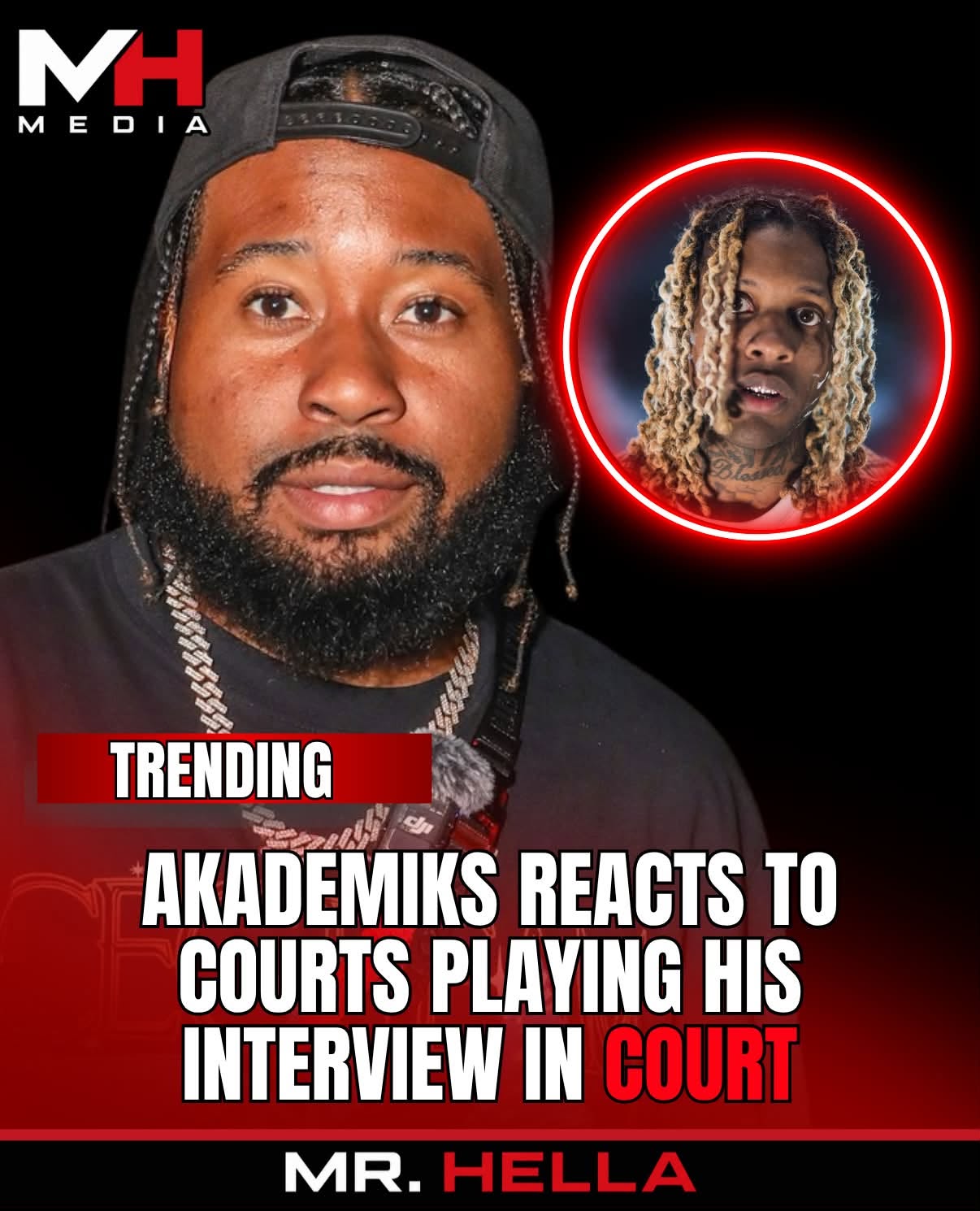
DJ Akademiks found himself unexpectedly pulled into Lil Durk’s federal murder-for-hire trial after prosecutors played a portion of his 2023 interview with the Chicago rapper during closing arguments—and then pointed to Akademiks’ own reaction as part of their presentation to the jury.
Akademiks reacted to the courtroom development during his livestream, expressing disbelief that an interview originally recorded for entertainment and album promotion had become part of the government's effort to establish its case against Durk.
The disputed footage came from Durk’s 2023 appearance on Akademiks’ “Off the Record” podcast.
During the interview, Akademiks brought up online comments pressuring Durk to “slide for Von,” a phrase referring to calls for retaliation following the November 2020 killing of Durk’s close friend King Von.
“For some odd reason, I don’t see those comments anymore,” Durk responded.
Akademiks reacted visibly to the statement during the original interview.
Three years later, federal prosecutors showed that moment to jurors.
Prosecutors Point to Akademiks’ Reaction
The government did not focus exclusively on what Durk said.
Prosecutors also drew attention to how Akademiks reacted when Durk made the statement.
During closing arguments, the government used the clip as part of its broader theory that Durk had faced public pressure to retaliate for Von’s death and that his comment about no longer seeing people demanding retaliation carried significance when viewed alongside the other evidence presented at trial.
That interpretation immediately became controversial.
Akademiks pushed back after learning how his reaction had been characterized in court.
He argued that prosecutors were assigning meaning to a facial expression from a podcast interview without ever calling him as a witness to explain what he actually understood Durk to mean.
Akademiks also said the interview had been produced as entertainment and promotion surrounding Durk’s music rather than as an interrogation about a criminal case. He objected to prosecutors using his reaction in a way he believed suggested he understood Durk to be discussing deadly retaliation.
Akademiks was not a witness in the trial.
That distinction became central to his criticism.
From his perspective, prosecutors were effectively asking jurors to interpret what his facial expression meant without giving him an opportunity in court to explain it himself.
Durk’s Defense Says the Clip Lacked Context
Durk’s attorneys raised their own objections to how the interview was presented.
The defense argued that prosecutors had shown jurors a selective portion of a much longer conversation while leaving out additional comments that could change how Durk’s remarks were understood.
In other portions of the interview, Durk discussed Tekashi 6ix9ine publicly trolling him over King Von’s death.
Durk said he did not take 6ix9ine’s comments seriously and discussed moving away from feuds and turning “hate into love.”
His attorneys wanted jurors to hear that additional material.
They argued it provided important context for Durk’s statement about no longer seeing “slide for Von” comments and undermined the prosecution’s suggestion that the exchange could be interpreted as evidence of retaliation.
The defense had already attempted to introduce additional footage from the interview before closing arguments.
After prosecutors returned to the 56-second portion during their rebuttal closing, Durk’s attorneys renewed the fight and sought an emergency hearing while the jury was deliberating.
U.S. District Judge Michael Fitzgerald denied the request.
Akademiks Says Interview Was Being Misrepresented
Akademiks’ response added another layer to the dispute.
The media personality has extensively covered Durk’s trial on his own livestreams, discussing testimony, court filings and evidence throughout the proceedings.
But seeing his own content used inside the courtroom put him in a very different position.
Akademiks argued that prosecutors were treating an entertainment interview—and particularly his reaction during that interview—as though it carried a meaning he never intended.
He also said portions of the conversation were scripted or structured around promoting Durk’s album, challenging the idea that every exchange should be interpreted literally as an unguarded conversation about real-world events.
Akademiks went further by saying the government's presentation potentially put his own safety at risk.
His concern was that people could interpret the prosecution's argument as suggesting Akademiks personally understood Durk to be admitting involvement in retaliation connected to Von.
Akademiks disputes that interpretation.
A Podcast Interview Becomes Federal Evidence
The episode illustrates how years-old hip-hop interviews, livestreams and social-media content have become increasingly important in criminal cases involving prominent rappers.
A conversation that initially existed as entertainment content can later be examined line by line by investigators, attorneys and jurors.
That is precisely what happened with Durk’s appearance on “Off the Record.”
The interview was recorded in 2023.
The Los Angeles shooting at the center of Durk’s trial occurred in August 2022.
Prosecutors allege Durk orchestrated a murder-for-hire plot targeting Quando Rondo in retaliation for King Von’s death, resulting in the killing of Rondo’s cousin, Saviay’a “Lul Pab” Robinson.
Durk has pleaded not guilty and denies ordering or financing the attack.
His attorneys maintain that prosecutors have attempted to transform ambiguous statements, music, internet commentary and the actions of other people into evidence against him.
Now an interview with DJ Akademiks has become part of that battle.
Prosecutors say the exchange helped support their interpretation of the evidence.
Durk’s attorneys say the government presented it without crucial context.
And Akademiks himself says prosecutors assigned a meaning to his reaction that he never intended.
What began as a hip-hop podcast conversation in 2023 ultimately ended up being replayed three years later inside a federal courtroom—with Durk’s future hanging in the balance.

Comments