

Drake Faces Copyright Lawsuit Over Alleged Theft of “Janice STFU” Chorus
Drake is facing a new copyright infringement lawsuit after producer and songwriter Aviel Calev Hirschfield, professionally known as Avi, accused the Toronto rapper of using protected musical material without authorization in his song “Janice STFU.”
The lawsuit, reportedly filed Friday, October 16, adds another legal controversy to Drake’s career, with the dispute centering on the song’s chorus. Hirschfield alleges that material he created was incorporated into the recording without the necessary permission or compensation.
The case raises questions about the ownership of musical compositions, the process of clearing material used in commercial recordings and the extent to which one artist can claim legal protection over elements of a song.
The allegations remain unproven. A lawsuit represents the plaintiff’s claims, not a judicial determination that copyright infringement occurred.
Songwriter Claims He Created the Chorus Months Before Drake Released It
According to the complaint, obtained and first reported by Billboard, Hirschfield developed the disputed chorus between December 2025 and January 2026. He says he was working with instrumental material supplied by production duo FNZ, consisting of Michael “Finatik” Mulé and Isaac “Zac” De Boni, both of whom have worked with Drake.
Hirschfield alleges that he created an eight-line chorus after drawing inspiration from Swedish singer Lykke Li’s 2011 song “I Follow Rivers.” He says he wrote new lyrics and developed a vocal melody and cadence over the instrumental, intending the recording to reach Drake.
The songwriter claims he completed his demo around January 25, 2026, and distributed it to FNZ and other producers associated with the rapper. According to the lawsuit, he received no response indicating whether the material would be used.
Months later, when Drake released ICEMAN in May, Hirschfield says he discovered that the chorus of “Janice STFU” matched the recording he had submitted.
The lawsuit describes the two choruses as “literally identical,” alleging that the finished song reproduced the same lyrics, melody and vocal rhythm.
Hirschfield maintains that his contribution was incorporated into the commercial release without his name appearing in the songwriting credits.
Avi Previously Worked on Beyoncé’s “Heated” With Drake
Hirschfield is not an unknown songwriter approaching Drake’s professional circle for the first time.
The Grammy-winning producer previously shared songwriting credits with Drake on “Heated,” a track from Beyoncé’s critically acclaimed 2022 album Renaissance.
That previous connection is significant because Hirschfield says he developed the disputed chorus specifically with Drake in mind and submitted it through producers who already had professional relationships with the rapper.
According to the complaint, his earlier work with Drake and the surrounding production network made it reasonable for him to believe his demo could reach the artist.
The lawsuit does not allege that Drake personally received the recording directly from Hirschfield. Instead, the songwriter argues that his work was circulated among collaborators involved in Drake’s music-making process.
Establishing who received the demo, when they received it and whether the disputed material reached the people responsible for the finished song could become central questions in the litigation.
Lawsuit Points to Audio Files and Metadata as Evidence
Hirschfield claims he possesses original recording files that document when the disputed chorus was created.
According to the lawsuit, those materials include individual audio tracks, commonly called stems, and associated metadata that he says establish the recording’s existence before the commercial release of “Janice STFU.”
He alleges that his manager supplied the materials to Drake’s representatives after the song became available.
Rather than receiving songwriting credit or a negotiated royalty arrangement, Hirschfield says his claim was rejected.
The complaint alleges that Drake’s representatives maintained the rapper wrote the chorus himself and questioned the authenticity of the recording evidence.
Hirschfield further claims that Drake’s legal representatives suggested the file metadata may have been manipulated to make his demo appear older than it actually was.
His attorneys reject that suggestion, arguing that deliberately fabricating evidence in a dispute involving a major recording artist would create extraordinary professional and legal risks for their client.
The complaint also alleges that Drake’s legal team sent Hirschfield a cease-and-desist letter demanding that he stop publicly asserting authorship of the chorus.
Those are allegations contained in the lawsuit. The underlying audio files, correspondence and metadata have not been independently authenticated in the reporting reviewed by Mr. Hella Media.
Drake’s Team Strongly Denies the Allegations
Drake’s representatives have publicly rejected the lawsuit, making clear that the rapper disputes Hirschfield’s account.
In a statement provided to TMZ on October 16, a representative said:
“These allegations are categorically, unequivocally, and completely denied. There is not one iota of truth to these accusations.”
The representative characterized the lawsuit as a baseless attempt to exploit Drake’s commercial success for money and publicity.
Drake’s team also insisted that the rapper wrote the song and does not know Hirschfield.
The denial establishes that the two sides have sharply conflicting accounts of how the chorus was created.
Hirschfield says he recorded and circulated the material months before the release. Drake’s representatives maintain that the rapper wrote the song himself and that the allegations are false.
No court has determined which account is correct.
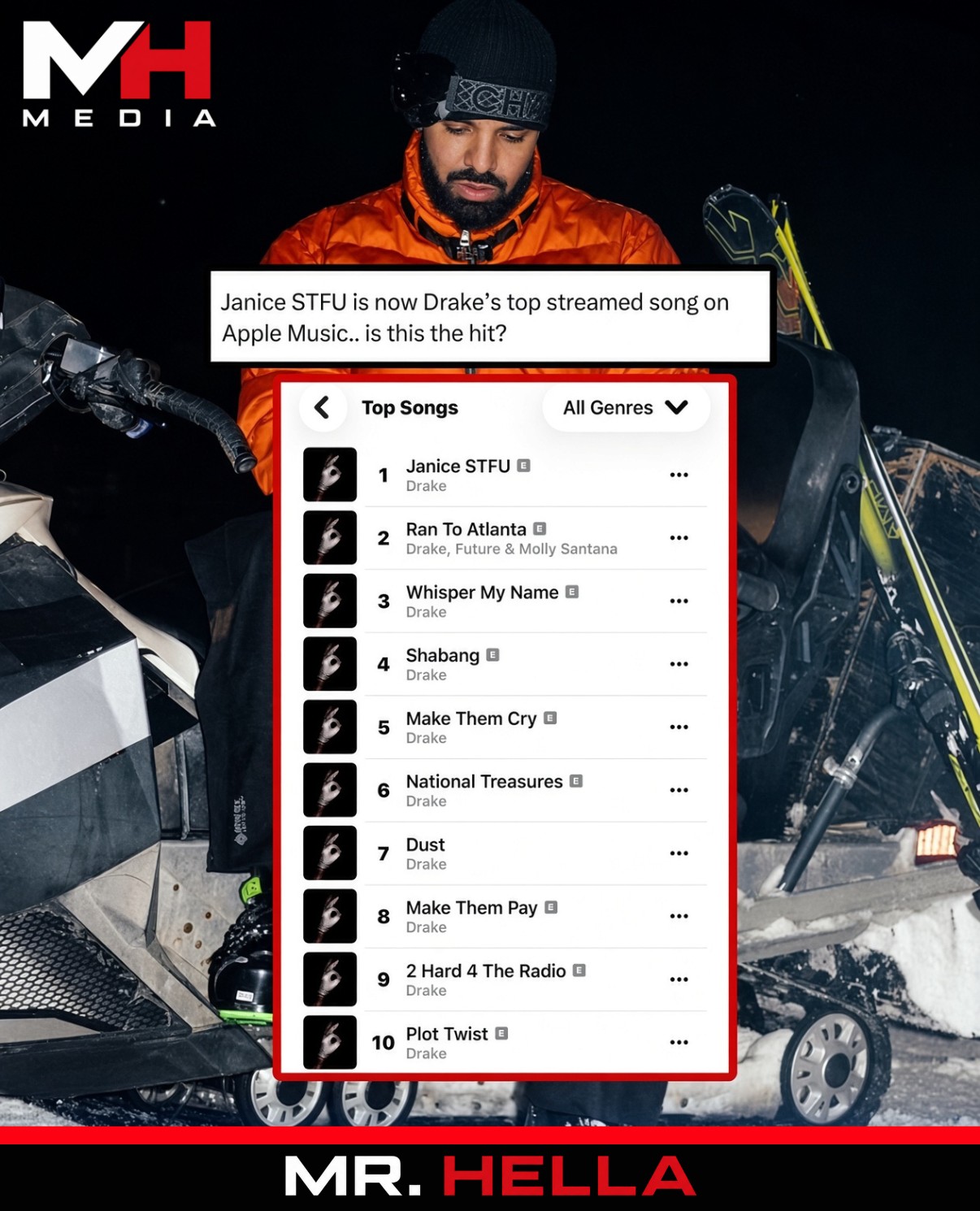
“Janice STFU” Became One of Drake’s Biggest Hits of 2026
The financial stakes are substantial because “Janice STFU” has become one of Drake’s most commercially successful recent releases.
The song debuted at No. 1 on the Billboard Hot 100 and remained at the top for two weeks.
It also spent 20 weeks at No. 1 on Billboard’s Hot Rap Songs chart, marking Drake’s longest-running leader on that particular ranking.
According to the lawsuit’s account of the song’s commercial performance, “Janice STFU” has accumulated more than 300 million streams on Spotify.
Those numbers help explain why a dispute over the chorus could involve significant publishing revenue.
Successful recordings can generate income from streaming, digital downloads, radio performances, licensing agreements and other uses. Songwriters who own a share of the underlying composition may be entitled to royalties separate from the income generated by the sound recording.
If Hirschfield ultimately establishes that he owns a protected contribution used without authorization, the court could consider whether he is entitled to compensation or other remedies.
However, the song’s commercial success alone does not prove infringement or determine the value of any potential claim.
The Lykke Li Connection Adds Another Layer to the Dispute
One particularly interesting aspect of the case involves the song “I Follow Rivers,” originally released by Swedish artist Lykke Li in 2011.
Hirschfield acknowledges drawing inspiration from that recording while developing his demo.
The lawsuit therefore raises a more specific authorship question than whether Drake’s song resembles an older recording.
The issue is whether Hirschfield created original, protectable musical material beyond any elements derived from “I Follow Rivers,” and whether that material was subsequently used in Drake’s release without authorization.
An interpolation involves recreating elements of an existing composition rather than directly sampling its original sound recording. Depending on the circumstances, permission may be required from the owners of the underlying musical work.
But permission to interpolate an existing song does not automatically settle a separate dispute about who wrote additional lyrics or other original material.
Hirschfield’s argument focuses on his claimed contribution to the finished chorus, not ownership of Lykke Li’s original composition.
That distinction could become important if the case proceeds into a detailed examination of the two recordings and their respective songwriting histories.
Lawsuit Names Drake, OVO Sound and Universal Music Companies
The lawsuit, filed October 16 in the U.S. District Court for the Central District of California, names Drake, OVO Sound and Universal Music entities among the defendants.
Hirschfield is seeking financial compensation related to the alleged unauthorized use of his work.
The requested relief includes damages, profits allegedly attributable to the infringement, legal fees and other remedies available under copyright law.
The complaint also seeks recognition of his alleged contribution to the song.
The exact amount of money at stake has not been established by a court, and no judgment has been entered against Drake or the other defendants.
Copyright lawsuits involving music often require extensive examination of original recordings, studio sessions, communications between collaborators, songwriting registrations and the timeline of a song’s development.
The fact that a songwriter possesses an earlier recording can be important evidence, but it does not automatically establish that another artist copied the material. Courts may also consider access, originality, substantial similarity and the credibility of competing evidence.
Those issues remain unresolved in this case.
What Happens Next?
The October 16 filing begins a new legal dispute over one of Drake’s biggest records of the year.
Hirschfield alleges that he wrote and recorded the chorus months before the song’s release, submitted it to producers in Drake’s professional circle and was later denied credit and compensation.
Drake’s team categorically rejects those claims, insisting that the rapper wrote the song and that the lawsuit has no factual basis.
The next significant developments could involve formal responses from the defendants, the production of studio records and communications, and possible examination of the audio files Hirschfield says support his allegations.
For now, there is no ruling that Drake stole the chorus, and the allegations should not be treated as established fact.
The dispute nevertheless raises a consequential question about one of 2026’s biggest hip-hop records: who actually created the hook that helped make “Janice STFU” a chart-topping hit?
That is the question Hirschfield is asking a federal court to resolve.
Comments