

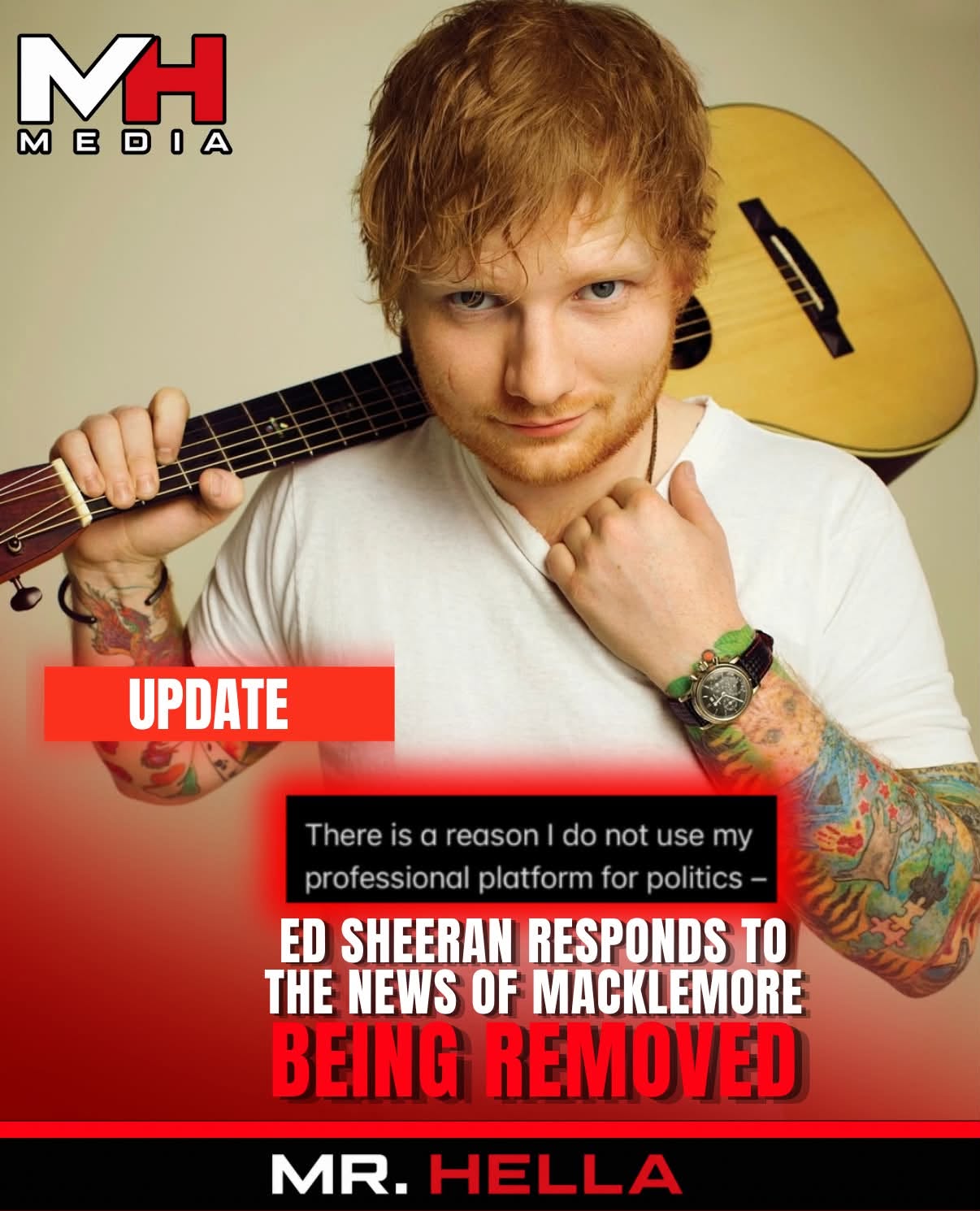
Ed Sheeran is breaking his silence after Macklemore was dropped from the remaining U.S. dates of the Loop Tour, saying he did not personally make the decision and spent the previous week unsuccessfully trying to keep the situation from escalating.
In a lengthy statement Tuesday, Sept. 15, Sheeran said several venues scheduled to host upcoming Loop Tour concerts warned that they would pull the shows if Macklemore remained on the lineup following his pro-Palestinian remarks at MetLife Stadium.
Sheeran said the final decision belonged to tour promoter Messina Touring Group and the venues—not him.
“Macklemore coming off tour was the promoter’s decision, it was not mine,” Sheeran wrote. “Macklemore’s contract for the tour was with the promoter, not me.”
The statement represents Sheeran’s first extensive public explanation of the controversy, which erupted after Macklemore used his opening performances in New Jersey to speak about Palestinians in Gaza and the West Bank and declare “Free Palestine” before performing his protest song “Hind’s Hall.”
Sheeran Says Venues Threatened to Pull Shows
According to Sheeran, the problem moved beyond social-media backlash after Macklemore’s New Jersey performances.
“Venues on my upcoming tour dates communicated that they would pull the shows if he was still supporting,” Sheeran wrote.
Sheeran said he was told the objections centered on how Macklemore delivered part of his message rather than everything the rapper said during the performance.
One of the people Sheeran acknowledged speaking with was New England Patriots owner Robert Kraft, whose Kraft Group operates Gillette Stadium in Massachusetts.
Kraft had publicly objected to Macklemore performing at the stadium, citing what he described as the rapper’s history of antisemitic rhetoric and imagery. Macklemore has denied that his advocacy for Palestinians is antisemitic and has said his criticism is directed at Israel’s government and its treatment of Palestinians.
Sheeran said he spent days talking with venue representatives, promoters and activists in an effort to find a compromise.
“I spoke with the venues at length all week to try and build a bridge,” Sheeran said.
He said those discussions ultimately failed to change the outcome.
“The venue’s and promoter’s decision was final.”
Sheeran Says His Opening Acts Control Their Own Sets
Sheeran also addressed questions about how much control he exercises over what supporting artists say and perform during his concerts.
According to Sheeran, Macklemore asked to join the Loop Tour the previous year and Sheeran agreed because he respected him as an artist.
“As with all my support acts, I agree that they play a setlist of their choosing,” Sheeran wrote.
That clarification is significant because Macklemore’s political statements were delivered during his own opening set rather than during Sheeran’s performance.
Sheeran’s account suggests Macklemore was not given a predetermined setlist or instructed by Sheeran to avoid particular songs or subjects before the MetLife shows.
The disagreement instead emerged after the performances, when venue operators began objecting to Macklemore remaining on the tour.
Ms. Rachel Accused Sheeran of ‘Caving’
Before Sheeran released his explanation, children’s entertainer and YouTube personality Ms. Rachel publicly criticized him over the controversy.
Ms. Rachel, whose real name is Rachel Griffin Accurso, argued that Sheeran had an opportunity to resist pressure surrounding Macklemore’s pro-Palestinian statements but failed to do so.
“Instead he caved,” she wrote while urging public figures to speak about Gaza.
Her criticism was based on the initial perception that Sheeran himself had decided to remove Macklemore.
Sheeran’s statement directly challenged that characterization.
He maintained that he tried to negotiate a solution but did not have final authority over Macklemore’s contract or the decisions made by stadium operators.
“I have spent this week trying to build bridges, to find a solution and unfortunately, was unable to do so,” Sheeran wrote.
Sheeran Defends Staying Out of Politics Onstage
Sheeran also addressed criticism of his longstanding reluctance to turn his concerts into political platforms.
The singer said he has personal views about the Israel-Palestine conflict and cares deeply about the suffering involved, but generally chooses not to use his professional platform to promote political positions.
He said audiences come to his concerts expecting music rather than a political forum and described his shows as spaces centered around unity, joy, escapism and love.
At the same time, Sheeran said he respects Macklemore’s willingness to publicly advocate for his beliefs.
“I respect Macklemore’s strength of purpose to stand up and shout for what he believes,” Sheeran wrote.
That leaves Sheeran attempting to draw a distinction between supporting Macklemore’s ability to express himself and personally adopting the same approach during his own performances.
Macklemore’s Removal Stands
Sheeran’s explanation does not change the immediate outcome.
Messina Touring Group confirmed Monday that Macklemore would no longer appear on the remaining U.S. dates he had been scheduled to support after venues indicated they would not host the concerts with him on the lineup.
Macklemore has maintained that he does not regret using the MetLife Stadium stage to speak about Palestinians. He has also expressed hope that the dispute will not destroy his longtime friendship with Sheeran.
The two artists therefore appear to agree on at least one point: neither wants the controversy reduced to a personal feud between them.
Where they differ is over the larger question of what artists should do when political expression collides with the demands of venues, promoters and a stadium tour involving hundreds of thousands of ticket holders.
For Sheeran, the answer Tuesday was that he tried to find a compromise and failed.
And after days of being blamed for Macklemore’s removal, he wanted one point made clear.
The final call, he says, was not his.

Comments