

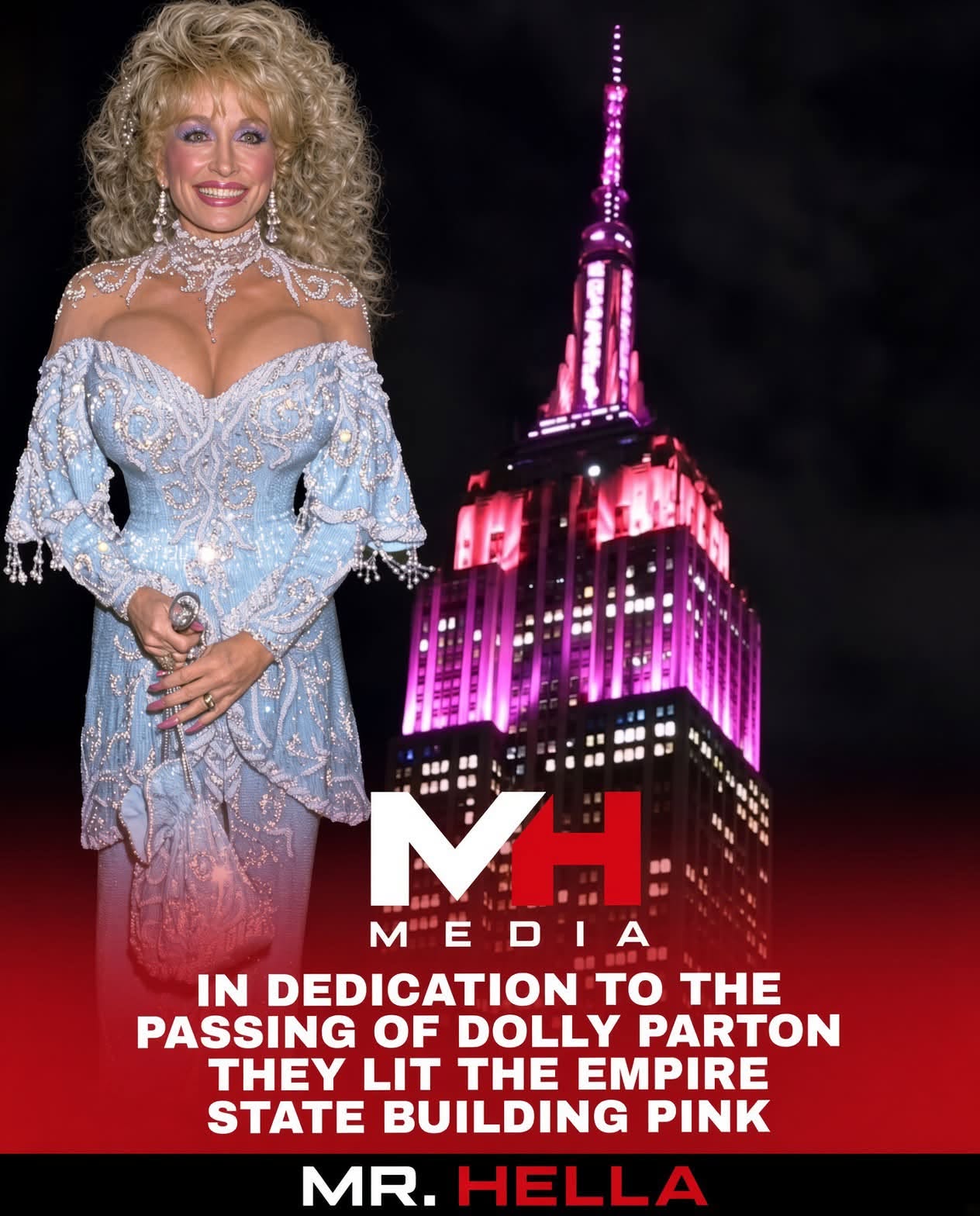
New York City’s skyline turned pink Tuesday night as the Empire State Building paid tribute to Dolly Parton, illuminating its famous tower in a sparkling display just hours after the country music legend’s death at 80.
The tribute was carefully designed around one of the most recognizable songs of Parton’s career. At exactly 9:25 p.m. on August 25, the Empire State Building’s tower lights transitioned into a pink sparkle, remaining illuminated for one hour until 10:25 p.m. The unusual starting time was intentional: 9:25 served as a visual play on “9 to 5,” Parton’s 1980 hit and the title song from the film in which she starred alongside Jane Fonda and Lily Tomlin.
The tribute transformed one of America’s most recognizable landmarks into a memorial visible across Manhattan and beyond, with photographs and videos of the pink tower quickly spreading online. It was among the first major public tributes to Parton following the announcement that she had died earlier Tuesday in Nashville after a brief battle with cancer.
New York Found a Dolly Parton Way to Say Goodbye
The choice of pink carried an unmistakable connection to Parton, whose larger-than-life image became nearly as recognizable as her voice during a career spanning more than six decades. Rhinestones, elaborate costumes, towering blonde hair and bright colors were never incidental pieces of her public persona; Parton embraced glamour as part of the character she presented to the world, frequently joking about her appearance while remaining firmly in control of the image she created.
Against the dark New York skyline, the Empire State Building’s pink sparkle provided a fittingly theatrical farewell. Rather than simply illuminating the building in a static color, the sparkling effect gave the tower the kind of visual flamboyance that had long been associated with Parton herself.
The Empire State Building confirmed that the display was intended to honor Parton’s “life and legacy,” with the illumination running from 9:25 to 10:25 p.m. The tribute also recognized the charitable work associated with the Dollywood Foundation and Dolly Parton’s Imagination Library, the children’s literacy initiative that became one of the defining accomplishments of her life outside entertainment.
The precision of the timing made the tribute particularly distinctive. Instead of merely referencing “9 to 5” through graphics or accompanying music, New York incorporated the song directly into the clock.
At 9:25, the city went pink for Dolly.
‘9 to 5’ Became Much Bigger Than a Movie Song
The reference carried particular significance because “9 to 5” represented one of the moments when Parton’s career expanded decisively beyond country music.
Released in 1980 as the theme to the comedy of the same name, the song accompanied Parton’s major film debut alongside Fonda and Tomlin. The movie followed three working women dealing with an overbearing and sexist boss, while Parton’s title track turned the frustrations of everyday office life into an upbeat anthem about working people trying to get ahead.
Parton wrote the song herself, famously creating its distinctive percussive sound by clicking her acrylic fingernails together while developing the rhythm. The record became one of her biggest crossover successes and helped establish her as a mainstream entertainer capable of reaching audiences far beyond Nashville.
The film did the same thing for her acting career. Parton went on to appear in movies including The Best Little Whorehouse in Texas and Steel Magnolias, building a screen career alongside the music that had originally made her famous.
Decades later, “9 to 5” remained so closely associated with Parton that the Empire State Building needed only a time on a clock to reference it.
The Tribute Came Hours After Her Family Announced Her Death
Parton’s death had been announced earlier Tuesday by her family, bringing an end to one of the longest and most influential careers in American entertainment. She was 80.
Her death followed a period of increasing concern about her health, during which Parton had publicly discussed medical issues while continuing to reassure fans that she intended to keep working. Her representatives later confirmed that she died following a brief battle with cancer.
The news prompted an immediate wave of tributes from musicians, actors, public figures and fans around the world. The reaction reflected the unusual breadth of Parton’s cultural reach. She was unquestionably a country music icon, but by the end of her life, describing her solely as a country singer failed to capture the scale of what she had become.
Parton was also a songwriter whose compositions crossed generations, an actress, entrepreneur and philanthropist whose Imagination Library distributed books to children on an enormous scale. Her songs, including “Jolene,” “Coat of Many Colors,” “9 to 5” and “I Will Always Love You,” had become cultural standards long before her death.
That broad influence could be seen almost immediately in the geography of the tributes.
Parton’s roots remained firmly in Tennessee, but the mourning was international.
Tributes Quickly Spread Around the World
New York’s pink skyline was only one part of a rapidly growing global response to Parton’s death.
At Buckingham Palace, the King’s Guard performed “9 to 5,” bringing one of Parton’s most famous songs into the ceremonial surroundings of the British monarchy. Fans and performers across multiple countries shared memories and musical tributes, while flowers and messages accumulated at locations closely connected to Parton’s life and career.
In Tennessee, where Parton was born and where she built much of her business and philanthropic legacy, tributes carried an especially personal meaning. Fans gathered around places associated with her childhood and career, including her statue in Sevierville and sites connected to Dollywood. Elsewhere, tributes appeared at the Hollywood Walk of Fame and Nashville’s Music City Walk of Fame.
The range of those memorials demonstrated something that had become increasingly apparent during the later decades of Parton’s career: her cultural identity had grown far beyond the genre that made her famous.
She belonged to country music, but she had also become part of a much larger American cultural vocabulary.
The Pink Lights Also Honored a Philanthropic Legacy
Behind the music references, the Empire State Building tribute also acknowledged another major part of Parton’s legacy: her work on behalf of children and literacy.
Parton founded the Imagination Library in 1995, initially creating the program to provide free books to young children in her home region of East Tennessee. Inspired in part by her father, who could not read or write, the initiative expanded dramatically over the following three decades and eventually distributed hundreds of millions of books to children.
The program became so closely identified with Parton that her family asked those wishing to honor her after her death to support the Imagination Library.
That charitable legacy gave the Empire State Building’s tribute another dimension. The lights weren't simply commemorating the performer behind “9 to 5.” They were recognizing a woman whose influence extended into the homes of millions of families who may never have attended one of her concerts.
Parton had turned the wealth and visibility created by entertainment into something designed to continue long after her own career ended.
One Hour Above New York
At 10:25 p.m., the pink tribute ended.
For exactly one hour, one of the most recognizable structures in the world had become a memorial to a woman whose own image was similarly unmistakable.
The simplicity of the tribute made it effective. There was no need to display Parton’s name across the building or explain the significance of the unusual starting time to people familiar with her career. Pink provided the visual connection. The clock supplied the musical reference.
And New York provided the stage.
Parton spent much of her life thousands of miles from Manhattan, building her career from the Tennessee mountains to Nashville and eventually onto stages around the world. Yet within hours of her death, her influence was visible hundreds of feet above one of the largest cities in America.
At 9:25 p.m., the Empire State Building began sparkling pink.
At 10:25, the lights changed.
For the hour in between, the New York skyline belonged to Dolly Parton.

Comments