

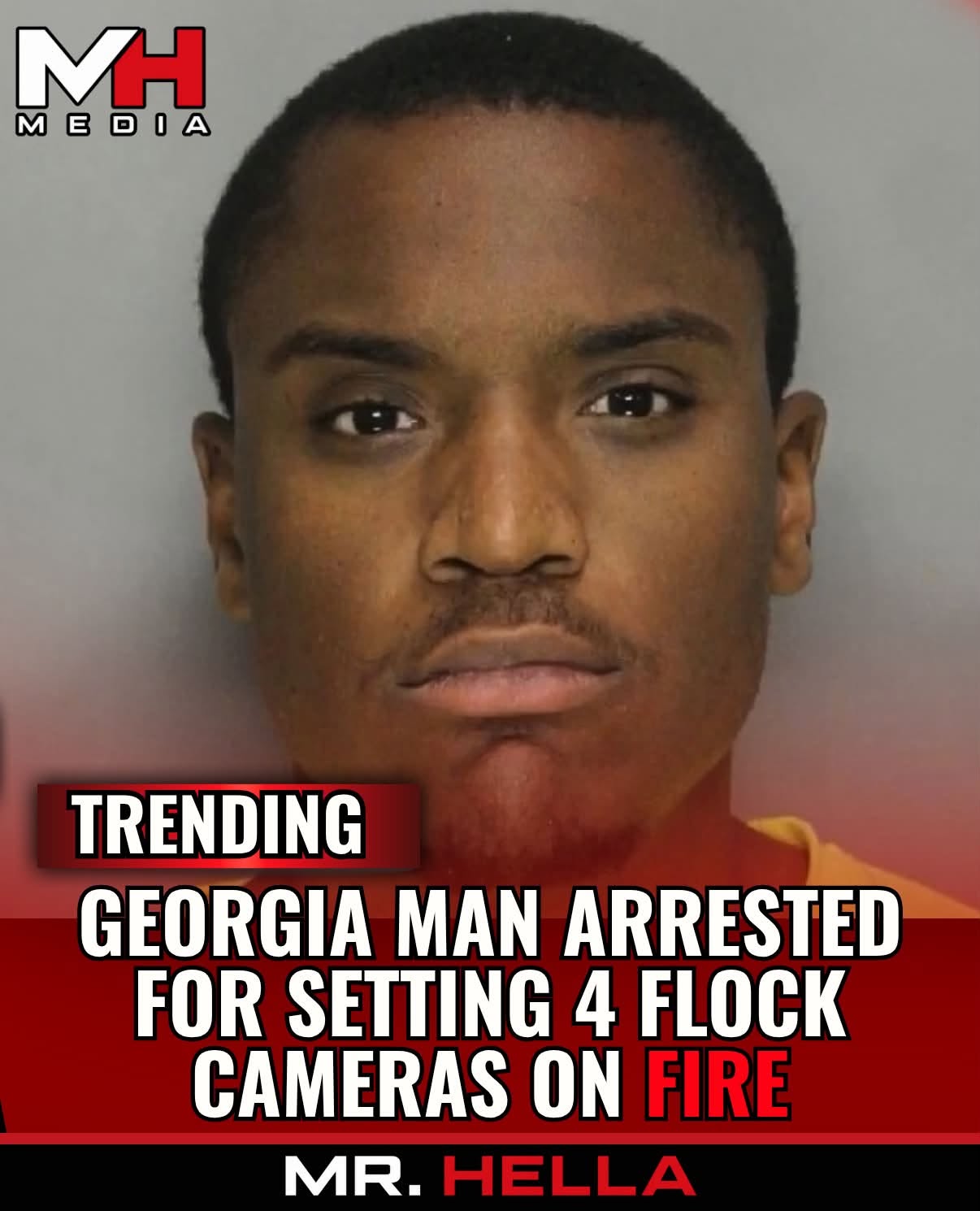
A Georgia man accused of attacking automated license plate readers across Cobb County was ultimately tracked down using the same surveillance network he allegedly tried to destroy, according to police and court records.
Colby Williams, 25, of McDonough, was arrested Sept. 3 after investigators accused him of firing projectiles at four Flock Safety cameras in East Cobb, damaging the devices and setting at least two of them on fire.
Williams now faces 10 criminal charges: four counts of third-degree arson, four counts of second-degree criminal damage to property, one count of interference with government property and one misdemeanor count of reckless conduct.
But the most unusual part of the case is how investigators say they found him.
The Flock camera network Williams allegedly targeted captured information about his vehicle, allowing investigators to trace the car back to him and take him into custody.
Police Say Cameras Were Targeted at Multiple Locations
According to an arrest warrant, the attacks began around East Cobb Park off Roswell Road.
Investigators allege Williams fired a projectile at a Flock camera there, leaving what the warrant described as two large melted areas on the device. Police also discovered a sticker attached to the camera pole reading “deflock,” accompanied by a QR code directing people to a website that maps automated license plate readers across the country.
Williams then allegedly traveled roughly two miles to a Home Depot near the Providence Square Shopping Center, where three additional Flock cameras were targeted.
Two of those cameras caught fire, while another was left with two holes consistent with being struck by projectiles, according to local reporting based on the warrant. Flames from the damaged equipment also threatened nearby vegetation.
A woman who was sitting in her vehicle at the Home Depot told WSB-TV she suddenly heard a loud pop before seeing flames coming from one of the cameras.
“I looked up and this camera over here was just shooting fire,” she told the station, adding that she became concerned the flames could spread to a nearby tree and called 911.
Authorities said some of the cameras involved belonged to Cobb County government or the Cobb County Police Department, while others were privately owned.
The Cameras Allegedly Recorded Their Own Suspect
As detectives began piecing together what happened, the technology at the center of the attacks became part of the investigation.
Investigators identified a gray 2013 Volkswagen captured by the Flock network and used license plate recognition data to trace the vehicle, according to FOX 5 Atlanta. Police said the system ultimately helped them locate Williams.
Cobb County Police Sgt. Eric Smith confirmed that “Flock cameras were used to locate Williams.”
In other words, authorities say the automated license plate readers continued doing exactly what they were designed to do while some of the cameras were allegedly being targeted: recording identifying information from vehicles passing through the area.
Williams was arrested Thursday morning and booked into the Cobb County Adult Detention Center. He was being held without bond following his arrest, according to local reports.
Police Investigating Whether Other Incidents Are Connected
The Cobb County incidents may not be the only cases investigators are examining.
Police said Williams was also considered a suspect in similar incidents involving Flock cameras in Marietta and Henry County. Authorities had not established publicly at the time of his arrest that he was responsible for those additional cases.
Marietta police said they were working with Cobb County investigators to determine whether the incidents were connected.
Williams has been charged in connection with the Cobb County incidents, but the allegations have not been proven in court.
Flock Cameras Have Become Increasingly Controversial
The case comes as automated license plate readers are facing growing scrutiny across Georgia and elsewhere in the country.
Flock Safety's cameras photograph passing vehicles and record information including license plates and vehicle characteristics, creating data that participating law-enforcement agencies can search during investigations.
Police departments have credited the technology with helping identify suspects and locate stolen vehicles, while privacy advocates have raised concerns about the scale of the network, how information is shared and the possibility that the systems could be misused.
Those concerns have become particularly visible in Georgia, where allegations that some law-enforcement officers improperly used Flock systems for personal purposes have fueled additional scrutiny.
Cobb County Police Chief Dan Ferrell recently acknowledged the tension surrounding the technology, saying law enforcement has to balance public safety with constitutional protections.
The allegations against Williams add an unusual chapter to that broader debate.
Authorities have not publicly established a motive for the attacks, and the presence of the “deflock” sticker does not by itself establish why the cameras were allegedly targeted.
What investigators say happened afterward, however, is considerably clearer.
Four license plate readers were allegedly attacked. Police began searching for the person responsible. And according to investigators, the trail that led them to their suspect came from the very surveillance system that had been targeted.



Comments