

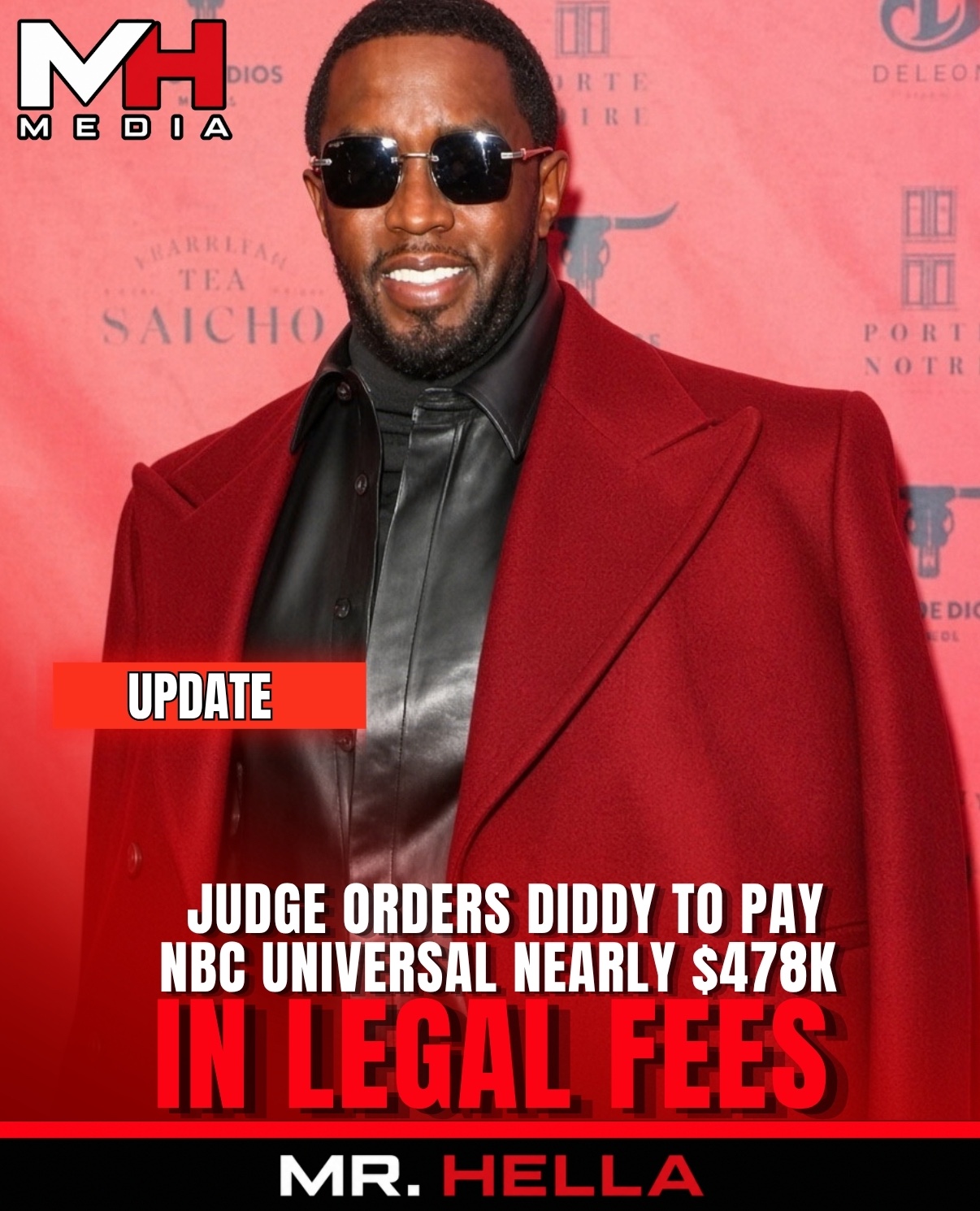
Sean “Diddy” Combs has been ordered to pay nearly $478,000 in attorneys’ fees to NBCUniversal, Peacock and the production company behind Diddy: The Making of a Bad Boy, the latest financial consequence from his failed $100 million defamation lawsuit over the 2025 documentary.
New York Supreme Court Justice Phaedra F. Perry-Bond ordered Combs to pay the defendants $477,700.50 in legal fees Tuesday, Oct. 6, after previously dismissing his lawsuit under New York’s anti-SLAPP law. NBCUniversal, Peacock TV and Ample Entertainment had sought $990,292, meaning the judge ultimately awarded them less than half of what they requested.
The ruling is an important distinction from a damages judgment against Combs over the allegations discussed in the documentary. The nearly $478,000 isn’t compensation for something the film accused him of doing. It represents attorneys’ fees generated by NBCUniversal and the other defendants while successfully defending themselves against Combs’s defamation lawsuit.
Combs’s spokesperson Juda Engelmayer emphasized that point after the decision while also highlighting how much the court cut NBCUniversal’s request.
“Yes, Sean was ordered to pay approximately $478,000 in attorneys’ fees, but that is only half the story,” Engelmayer told TMZ, arguing that the court rejected more than $512,000 of the amount defendants originally sought after finding portions of the billing excessive.
The ruling gives both sides something to point toward, but the bottom line remains straightforward: Combs sued NBCUniversal and its partners for $100 million, the lawsuit was dismissed, and he has now been ordered to pay a substantial portion of the companies’ cost of defeating it.
The Fight Started With a Peacock Documentary
The dispute centers on Diddy: The Making of a Bad Boy, a documentary that began streaming on Peacock on Jan. 14, 2025.
The film examined Combs’s rise in entertainment as well as the serious allegations that had accumulated against him. Peacock described the documentary as featuring exclusive interviews with people who had been close to Combs, including a former bodyguard and childhood friend, along with previously unseen footage.
Combs fiercely objected to portions of the film.
On Feb. 12, 2025, while awaiting his federal criminal trial, he sued NBCUniversal Media, Peacock TV and Ample Entertainment for defamation, seeking at least $100 million in damages.
His lawsuit argued that the defendants had published false and defamatory allegations while capitalizing on the intense public interest surrounding his criminal case.
The companies fought back.
And eventually, they won dismissal.
The Judge Threw Out Diddy’s Lawsuit in April
Justice Perry-Bond dismissed Combs’s amended complaint on April 20, 2026.
The court analyzed the case under New York’s anti-SLAPP protections, which are designed to protect speech concerning issues of public interest from certain lawsuits that cannot meet the law’s heightened requirements.
The judge concluded that the documentary’s reporting of the allegations was “substantially accurate” and rejected Combs’s request for discovery. The court found that the documentary presented a range of perspectives and that Combs had not met the heightened burden required to keep the lawsuit alive.
The ruling did not amount to a judicial finding that every underlying accusation discussed in the documentary was true.
That distinction is especially important.
The court was deciding whether Combs had a viable defamation claim against the documentary’s producers and distributors — not conducting a trial to independently determine every allegation raised by every interview subject featured in the film.
But once the court dismissed Combs’s complaint under the applicable anti-SLAPP provisions, another problem emerged for him.
The defendants wanted their legal bills paid.
NBCUniversal Wanted Nearly $1 Million
NBCUniversal, Peacock and Ample came back to court seeking $990,292 in attorneys’ fees.
The request reflected hundreds of hours of work by attorneys at Gibson, Dunn & Crutcher, the high-profile law firm representing the defendants.
The initial application sought $927,448 for 777.5 hours of legal work performed through May 20, 2026. The amount later increased after the defendants added fees associated with preparing their reply to Combs’s opposition.
Combs fought the request.
His attorneys argued that the court should wait while his appeal of the underlying dismissal moved forward. If the judge decided to award fees immediately, Combs argued that the amount should be no more than $166,769.25.
The judge rejected both extremes.
NBCUniversal didn’t get its requested $990,292.
Combs didn’t get the bill reduced to roughly $167,000.
Instead, the court landed at $477,700.50.
The Judge Cut the Requested Hours
One of the most interesting portions of Tuesday’s ruling concerns the difference between the attorneys’ hourly rates and the number of hours they billed.
The court declined to reduce the hourly rates charged by NBCUniversal’s attorneys, even while acknowledging that those rates were higher than customary rates.
According to the decision, attorney Theodore Boutrous’s rate reached $1,980 per hour, while other lawyers involved in the case billed at rates down to $915 per hour.
The judge concluded those rates were justified by the unusual nature of the litigation, the amount Combs was demanding, the case’s enormous publicity, the lawyers’ experience and the quality of the work they performed. The court described the partners involved as among the country’s leading First Amendment litigators.
Where the defendants lost money was in the hours.
The court reduced what it considered excessive billing, ultimately cutting the requested award by more than half.
That is the basis for Combs’s spokesperson emphasizing that NBCUniversal sought nearly $1 million but received approximately $478,000.
Diddy’s Team Says That Context Matters
Engelmayer pushed back against portraying Tuesday’s ruling as an unqualified victory for NBCUniversal.
His statement pointed out that the court rejected more than $512,000 of the requested fees.
That is significant.
NBCUniversal and the other defendants asked for almost $1 million and didn’t receive it.
But Combs had argued the award should be dramatically lower still — approximately $166,769 if the court decided to rule before his appeal was resolved. The final award is nearly three times that figure.
So while Combs’s side can accurately say NBCUniversal’s original request was substantially reduced, the defendants can accurately say Combs has been ordered to pay them almost half a million dollars after his lawsuit failed.
Both facts can be true.
Why Diddy Has to Pay the Other Side’s Lawyers
In ordinary American litigation, each side frequently pays its own attorneys regardless of who wins.
Anti-SLAPP laws can change that equation.
New York’s statute contains a fee-shifting mechanism that can require a plaintiff to pay the defendant’s attorneys’ fees after an unsuccessful lawsuit covered by the law.
When Perry-Bond dismissed Combs’s amended complaint in April, she specifically ordered the defendants to submit a fee application under New York Civil Rights Law § 70-a.
Tuesday’s decision determines how much of that application Combs must pay.
That makes the $477,700.50 award a direct consequence of losing the anti-SLAPP fight.
Diddy Originally Wanted at Least $100 Million
The size of Combs’s original lawsuit also influenced the fee dispute.
He wasn’t seeking a symbolic correction or a relatively small amount in damages.
He sought at least $100 million.
The judge specifically considered the size and complexity of the litigation when deciding whether the rates charged by NBCUniversal’s attorneys were reasonable.
That creates a striking contrast.
Combs entered the case seeking nine figures from the companies responsible for the documentary.
Less than two years later, his complaint has been dismissed and he is the one being ordered to write a check.
What Diddy Claimed Was Defamatory
Combs’s lawsuit objected to a series of allegations and implications contained in the documentary.
The film explored allegations involving sexual assault, abuse and other misconduct while examining Combs’s career and personal history.
His legal team argued that the documentary presented false claims as fact and accused its creators of exploiting the public appetite for stories about Combs ahead of his criminal trial.
NBCUniversal and its co-defendants defended the documentary and argued that the lawsuit should be dismissed.
Perry-Bond ultimately agreed that the amended complaint could not proceed.
Again, that ruling shouldn’t be transformed into a blanket statement that a court independently verified every allegation appearing in the documentary.
The legal question was defamation.
The judge ruled against Combs on that question.
The Documentary Arrived During the Most Intense Period of Diddy Coverage
Timing was central to Combs’s complaint.
Diddy: The Making of a Bad Boy premiered while he was detained awaiting the federal criminal trial that would become one of the biggest celebrity court cases in years.
At the time, Combs faced racketeering-conspiracy and sex-trafficking charges along with transportation-to-engage-in-prostitution counts.
His 2025 trial produced a mixed verdict.
Jurors acquitted Combs of racketeering conspiracy and sex trafficking while convicting him on two federal counts involving transportation to engage in prostitution.
He was later sentenced to 50 months in federal prison.
That outcome is relevant because some of the most serious criminal allegations surrounding Combs when the documentary was released did not ultimately produce convictions.
But the criminal case and the NBCUniversal defamation case are separate proceedings governed by different legal standards.
The Lawsuit Was Filed Before the Criminal Verdict
When Combs sued NBCUniversal in February 2025, his federal criminal trial hadn’t happened yet.
He was still fighting the government’s case and denying the allegations against him.
That context was part of his argument that the documentary had gone too far by airing inflammatory allegations before a jury had heard his criminal case.
NBCUniversal argued that the film addressed matters of obvious public concern and was legally protected.
By April 2026, Perry-Bond had sided with the defendants and dismissed Combs’s amended complaint.
Tuesday’s fee order is essentially the financial aftermath of that decision.
Diddy’s Appeal Is Still Important
Combs has challenged the dismissal.
His lawyers had asked Perry-Bond to delay deciding the fee issue until the Appellate Division, First Department, resolves his appeal.
The judge chose not to wait.
That means the fee award arrives while Combs is still contesting the underlying loss.
An appellate ruling could therefore remain important to the long-term status of the case.
For now, however, the operative trial-court rulings are that Combs’s defamation complaint has been dismissed and that he owes the defendants $477,700.50 in attorneys’ fees.
Another Legal Bill During an Already Expensive Period
The award comes as Combs continues dealing with extensive legal exposure on multiple fronts.
His federal criminal case produced a prison sentence and an appeal.
He has also faced numerous civil lawsuits containing allegations ranging from sexual assault to other forms of misconduct, many of which he has denied.
Not every lawsuit against Combs has been proven, and the claims in separate civil cases should not be treated as established simply because multiple lawsuits exist.
But defending that volume of litigation is expensive regardless of the outcome.
Tuesday’s ruling is different because it places a specific number on money Combs has been ordered to pay to an opposing party after one of his own lawsuits failed.
$477,700.50.
NBCUniversal Got Less Than Half — But Still Won the Fee Fight
The cleanest way to understand Tuesday’s decision is to separate the two numbers.
NBCUniversal, Peacock and Ample wanted $990,292.
The court awarded $477,700.50.
Combs wanted the judge either to postpone the issue or, if ruling immediately, to award no more than approximately $166,769.
The judge rejected that proposed ceiling.
That means NBCUniversal’s lawyers didn’t receive everything they requested, but Combs still ended up with a legal bill hundreds of thousands of dollars larger than the amount his side argued was reasonable.
It’s Another Loss From a Lawsuit Diddy Chose to File
That is what separates this case from the many lawsuits filed against Combs.
He initiated this one.
Combs sued NBCUniversal, Peacock and Ample.
He sought at least $100 million.
The defendants moved to dismiss.
They succeeded.
New York’s anti-SLAPP provisions entitled them to recover attorneys’ fees.
And now a judge has determined the amount.
Nearly $478,000.
The documentary remains available on Peacock, where the platform describes the 99-minute film as examining Combs’s journey through interviews and exclusive footage.
Combs continues to challenge the underlying dismissal, meaning the legal fight isn’t necessarily finished.
But Tuesday’s order creates an immediate and expensive consequence from the case.
Diddy went to court demanding $100 million from NBCUniversal and its partners over Diddy: The Making of a Bad Boy.
For now, he’s the one who has been ordered to pay.
Comments