

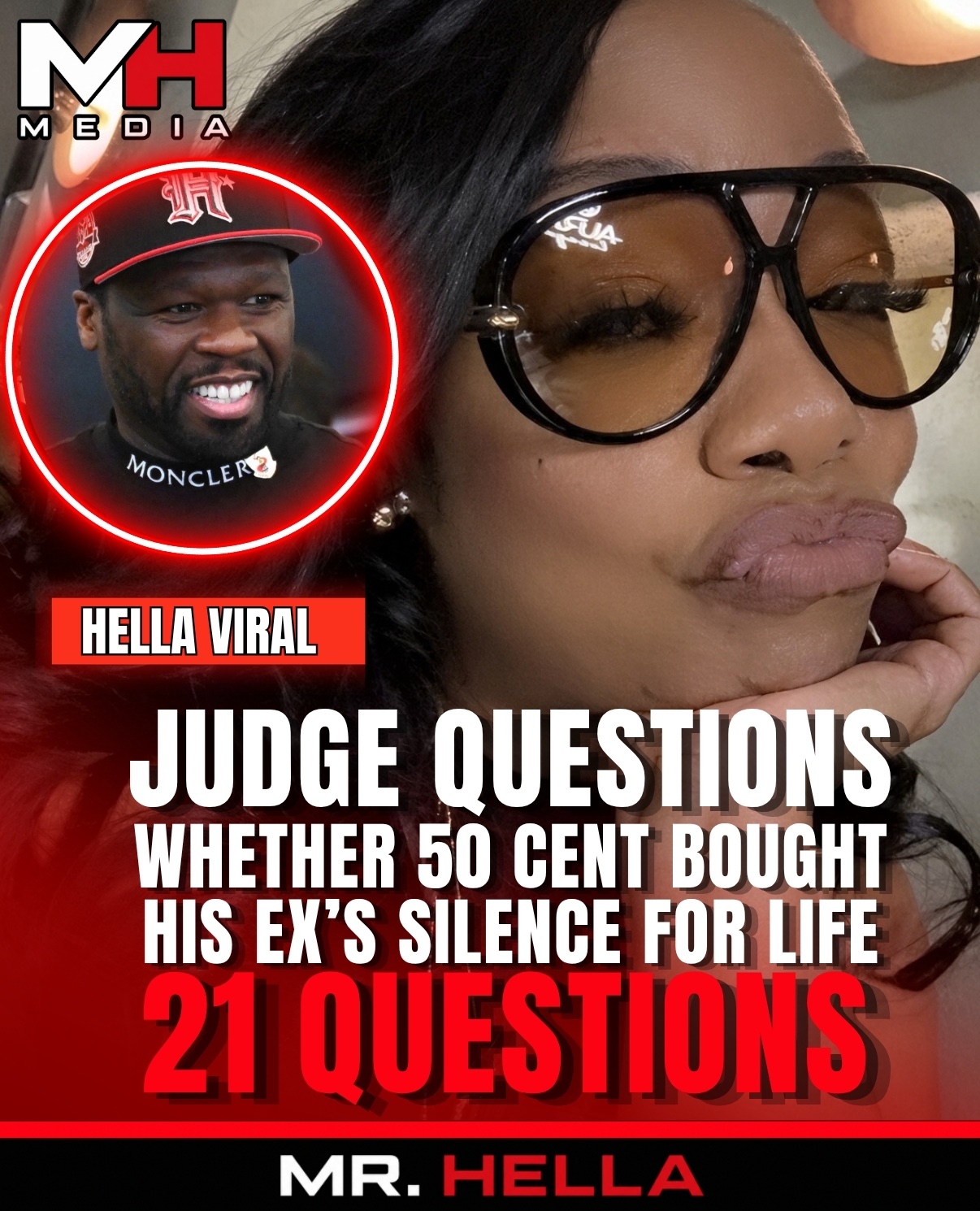
Judge Questions Whether 50 Cent Bought His Ex Shaniqua Tompkins’ Silence for Life in $1 Million Legal Battle
A New York judge is raising serious questions about a nearly 20-year-old agreement between 50 Cent’s publishing company and his former partner, Shaniqua Tompkins, suggesting the arrangement may have been designed to keep her from publicly discussing their relationship indefinitely.
During a September 22 court hearing in Manhattan, New York Supreme Court Justice Robert Reed questioned whether G-Unit Books, a company associated with the rap mogul, had effectively purchased Tompkins’ silence through a book agreement that gave the company exclusive rights to her personal story without requiring it to publish anything.
The judge’s remarks, detailed in an October 7 report by AllHipHop, introduced a striking comparison: the controversial practice known as catch and kill, in which a publisher purchases exclusive rights to a potentially damaging story and then deliberately prevents it from becoming public.
The questions emerged in an ongoing lawsuit in which G-Unit Books is seeking at least $1 million from Tompkins, the mother of 50 Cent’s eldest son, Marquise Jackson, over allegations that she violated a 2007 agreement by discussing their relationship and making abuse allegations in interviews and social-media videos.
Tompkins is challenging the agreement’s validity, alleging that she signed it under threats and intimidation. The rapper’s legal representatives dispute her allegations and maintain that the contract is enforceable.
No final ruling on the enforceability of the agreement has been issued. But the judge’s comments suggest the court is examining a fundamental question: Can someone permanently sell the exclusive rights to their own life story, even when the buyer never publishes it? <Cite refs={[“turn947283search0”,“turn947283search4”]}/>
Judge Compares the Deal to a ‘Catch and Kill’ Arrangement
One of the most consequential moments of the September hearing came when Justice Reed questioned why G-Unit Books would purchase Tompkins’ life story without an obligation to publish it.
According to the hearing account obtained by AllHipHop, Reed compared the arrangement to tactics historically associated with the National Enquirer, the supermarket tabloid that became notorious for acquiring exclusive rights to sensitive stories and keeping them from publication.
The judge described the arrangement as resembling a catch-and-kill scheme, questioning whether the actual purpose of the agreement was to produce a memoir or prevent Tompkins from publicly discussing her relationship with Curtis Jackson, better known as 50 Cent.
Reed went further, suggesting the promised second payment, which depended on publication, might never have been realistically expected to occur.
His concern was not simply that the deal favored G-Unit Books financially. It was that the agreement appeared to give the company permanent control over a woman’s account of her own life while allowing the company to avoid publishing that account.
“This is a payment to make sure that her story, her relationship to Mr. Jackson was never told publicly,” Reed said, according to AllHipHop’s reporting on the hearing.
That observation could become central to how the court evaluates the contract, although it was a question raised during oral arguments rather than a final judicial finding.
Could the Contract Keep Tompkins Silent Until She Dies?
The most striking exchange concerned the agreement’s duration.
According to the reported terms, G-Unit Books received exclusive rights to Tompkins’ story, name and likeness on a perpetual basis. The contract reportedly did not include a provision returning those rights to Tompkins if the company failed to publish the proposed book.
That meant the company could potentially hold the rights indefinitely, even if the memoir never appeared.
Reed questioned whether such an arrangement could prevent someone from telling their own story decades after signing.
He presented a hypothetical involving a person who signs a nondisclosure agreement at 20 years old and later wants to speak publicly at 60.
Could the agreement still prevent that person from telling their story for the remainder of their life?
The question goes directly to the dispute’s central issue. G-Unit Books maintains that Tompkins knowingly granted exclusive rights that were intended to last indefinitely. Tompkins argues that the circumstances surrounding the agreement, combined with the company’s alleged failure to fulfill its obligations, make continued enforcement improper.
The judge has not ruled that the agreement is invalid. Nor has he determined that 50 Cent personally intended to suppress abuse allegations through the publishing arrangement.
But the hearing demonstrates that the court is scrutinizing whether the contract’s structure served a legitimate publishing purpose or functioned primarily as a means of controlling what Tompkins could say.
The $80,000 Book Deal at the Center of the Dispute
The conflict traces back to 2007, when Tompkins entered into an agreement with G-Unit Books concerning a proposed memoir about her life and relationship with 50 Cent.
Under the reported terms, the company would pay $80,000 in two installments.
The first $40,000 was payable when the agreement was signed. The remaining $40,000 was contingent on the book being published. Tompkins could also potentially receive royalties if the project generated sales.
But the memoir was never published.
G-Unit Books argues that the second installment never became payable because the publication condition was not satisfied.
Tompkins disputes the fairness and enforceability of that arrangement. She says $5,000 was deducted from the initial payment for an attorney, leaving her with approximately $35,000.
From her perspective, the company received sweeping control over her life story while she received less than half of the agreement’s stated maximum advance.
G-Unit’s position is that the payment structure was explicit and that the company retained discretion over whether the book would ever be released.
The disagreement raises a broader contractual question: Does a publisher’s decision not to publish a work justify retaining exclusive rights indefinitely when the agreement expressly permits that outcome?
The answer will depend on the contract’s language, the applicable law and the defenses Tompkins has raised. <Cite refs={[“turn947283search0”,“turn947283search1”]}/>
50 Cent’s Lawyer Defends the Agreement
G-Unit Books attorney Lisa Coyle defended the contract during the September hearing, arguing that its terms clearly gave the company discretion over publication.
According to AllHipHop, Coyle told the court that the agreement did not guarantee the book would be released and that Tompkins was not entitled to the second payment if publication never occurred.
The attorney also offered a possible explanation for why the company might have purchased the rights.
She suggested that 50 Cent could have wanted to collaborate with Tompkins on a book about their relationship and the years before his rise to international fame.
That explanation presented the agreement as a legitimate business transaction rather than an attempt to suppress damaging information.
Coyle also argued that the contract’s perpetual duration was not concealed from Tompkins.
Her broader position was that a contract does not automatically become unenforceable simply because one party later regrets accepting its terms.
The argument highlights the difference between an unfavorable bargain and a legally invalid one.
Courts generally do not rewrite agreements solely because one side negotiated better terms. However, claims involving duress, coercion, unconscionability or other legal defects can create separate questions about whether an agreement should be enforced.
Those are among the issues now surrounding the G-Unit Books dispute.
Tompkins Says She Was Threatened Into Signing
Tompkins’ challenge extends beyond the amount of money she received.
In a sworn affidavit previously obtained by AllHipHop, she alleged that the agreement was presented during a period when she was emotionally and financially dependent on 50 Cent and felt unable to resist pressure from people associated with his business operations.
She specifically accused the rapper’s late manager, Chris Lighty, of pressuring her to sign.
According to Tompkins, Lighty repeatedly contacted her about the agreement and later confronted her at a Las Vegas hotel with another man she believed was a security guard.
She alleged that Lighty warned her of serious consequences if she refused to sign.
Tompkins further claimed that she was not given a meaningful opportunity to review the complete document or negotiate its terms with independent legal representation.
She described signing because she feared retaliation and believed she had no practical alternative.
Those allegations remain disputed.
G-Unit Books has defended the agreement and argued that Tompkins’ previous statements and conduct demonstrated that she had accepted the contract.
No court finding has established that Lighty threatened Tompkins or that the agreement was obtained through unlawful coercion.
Nevertheless, the allegations are significant because a contract signed under legally recognized duress may be challenged even when its written terms appear clear.
Why G-Unit Books Is Seeking $1 Million
The current lawsuit was filed in July 2025 after Tompkins began publicly discussing her history with 50 Cent through interviews and social-media content.
Among the material at issue were videos associated with her online series The Unspoken, in which she discussed their former relationship, family disputes and allegations of abuse.
G-Unit Books contends that Tompkins violated the 2007 agreement by disclosing and promoting information over which the company had purchased exclusive rights.
The company argues that the disclosures damaged the commercial value of the rights because the information was no longer exclusive.
Its lawsuit seeks at least $1 million in damages, along with an order restricting further publication of material it claims falls within the agreement.
That demand is particularly striking given the original contract’s $80,000 payment structure.
The company is not simply asking Tompkins to return the money she received. It is seeking substantially greater damages based on its allegation that her public statements diminished the value of the rights it acquired.
Whether the company can establish those losses, and whether the agreement can be enforced against the particular statements Tompkins made, remain unresolved questions.
Abuse Allegations Are Part of the Dispute
The litigation has become especially contentious because some of the statements G-Unit Books wants restricted involve Tompkins’ allegations of physical abuse during her relationship with 50 Cent.
Tompkins has alleged that the rapper physically assaulted her while she was pregnant with their son and on other occasions during their relationship.
She has also described an alleged incident in which she says he struck her in front of her daughter.
In separate court filings, Tompkins alleged that 50 Cent physically attacked her during a confrontation involving paperwork for the 2005 film Get Rich or Die Tryin’ at the offices of Violator Management.
According to her account, he grabbed her by the hair, dragged her across the office and choked her after becoming angry about how she signed a document.
50 Cent’s legal representatives have denied the allegations.
His attorney previously described the accusations involving the film-related agreement as false and argued that they concerned a separate transaction rather than the 2007 book agreement currently being litigated.
The allegations have not been established as facts in the present case.
That distinction is important because the judge’s questions about the publishing contract should not be interpreted as a determination that Tompkins’ abuse allegations are true.
The current dispute concerns contractual rights and defenses, not a criminal prosecution of 50 Cent for the alleged conduct. <Cite refs={[“turn947283search1”,“turn947283search4”]}/>
The Case Has Already Produced a Setback for G-Unit Books
The September hearing followed an earlier procedural dispute over whether Tompkins had been properly notified of the lawsuit.
G-Unit Books initially sought a default judgment after Tompkins did not respond within the required period.
But in March 2026, Justice Reed declined to grant the company the automatic victory it sought and allowed Tompkins to defend the case.
G-Unit Books challenged that outcome.
In July, a New York appellate court upheld the decision allowing Tompkins to contest the lawsuit.
The appellate judges concluded that G-Unit Books had not adequately established that Tompkins was properly served at the addresses used during its attempts to deliver the legal papers.
The ruling was procedural. It did not determine whether the book agreement was enforceable or whether Tompkins had breached it.
But it prevented the company from obtaining a victory without fully litigating the underlying dispute.
That decision cleared the way for Tompkins’ defenses to receive further consideration.
The Legal Fight Has Reached Into Free-Speech Arguments
Tompkins has also raised defenses related to her ability to speak publicly about her own experiences.
G-Unit Books has challenged those arguments, maintaining that enforcement of a voluntarily signed commercial agreement is different from an unlawful attempt to suppress protected expression.
In earlier filings, the company’s attorneys cited litigation involving Donald Trump and his niece, Mary Trump, to support their position that contractual confidentiality obligations can remain enforceable even when a person invokes free-speech protections.
The company also challenged several of Tompkins’ affirmative defenses and counterclaims, including arguments involving New York’s anti-SLAPP law, which addresses certain lawsuits targeting protected public participation.
Those arguments introduce another complicated dimension.
The First Amendment generally protects individuals against government restrictions on speech, but private contracts can create enforceable obligations concerning confidentiality and intellectual-property rights.
The question in this case is not whether Tompkins has any right to free expression. It is whether this particular agreement validly restricts the statements at issue, and whether her defenses prevent G-Unit Books from enforcing it.
The September hearing did not settle those questions.
Why the Judge’s Comments Matter
Justice Reed’s remarks are noteworthy because they focus on the purpose and practical consequences of the agreement rather than simply its wording.
The contract reportedly grants rights indefinitely.
The book was never published.
The second payment was never triggered.
And G-Unit Books is now seeking at least $1 million because Tompkins discussed her own life publicly.
Viewed together, those circumstances prompted the judge to question whether the agreement was functioning as a publishing contract or a permanent restriction on Tompkins’ ability to tell her story.
That does not mean the judge has already decided the case.
Judges frequently use pointed questions during oral arguments to test competing legal positions, and those questions do not necessarily predict the final outcome.
Still, the exchange identifies a potential weakness that Tompkins’ attorneys may continue emphasizing: the absence of any deadline requiring G-Unit Books to publish the memoir or return her rights.
If a company can indefinitely prevent someone from publishing their life story while having no obligation to publish it itself, the agreement creates a potentially extraordinary degree of control over personal expression.
Whether that control is legally permissible under these circumstances is precisely what remains at issue.
What Happens Next?
Justice Reed reserved his decision on the pending defenses and counterclaims following the September hearing.
According to AllHipHop, the judge indicated that he would issue a written ruling after considering the parties’ arguments.
The next scheduled court date is December 15, 2026.
Until a ruling is issued, the underlying dispute remains unresolved.
G-Unit Books continues to maintain that it purchased exclusive rights through a valid agreement and that Tompkins violated those rights by discussing her relationship publicly.
Tompkins maintains that she was pressured into signing the agreement, did not receive the full amount described in its payment terms and should not be permanently prevented from telling her own story.
The court must determine which legal defenses and claims can proceed before the broader dispute can be resolved.
A Nearly 20-Year-Old Agreement Is Now Under a Microscope
For much of his career, 50 Cent has been known for maintaining extraordinary control over his public image, business ventures and entertainment projects.
But the dispute involving Tompkins raises a different question about control: whether a contract can give one party exclusive authority over another person’s personal history indefinitely.
The original agreement was signed in 2007, when 50 Cent was among hip-hop’s biggest commercial stars and G-Unit was expanding beyond recorded music into publishing, film and other ventures.
Nearly two decades later, the proposed memoir has never appeared.
Instead, the agreement has become the foundation of a seven-figure lawsuit between the rapper’s publishing company and the mother of his eldest son.
And now a New York judge is asking whether the deal was ever genuinely intended to produce a book.
That is a consequential question, particularly because the company is seeking to enforce the agreement against Tompkins’ public discussion of her own experiences.
For now, there has been no ruling that 50 Cent bought Tompkins’ silence, and no judicial finding that the agreement was designed to conceal wrongdoing.
But Justice Reed’s questions have shifted attention to the contract’s most controversial feature: the possibility that G-Unit Books could control Tompkins’ life story forever without ever publishing a single page of it.
With the next court date scheduled for December 15, the battle over who has the legal right to tell Shaniqua Tompkins’ story is far from over.


Comments