

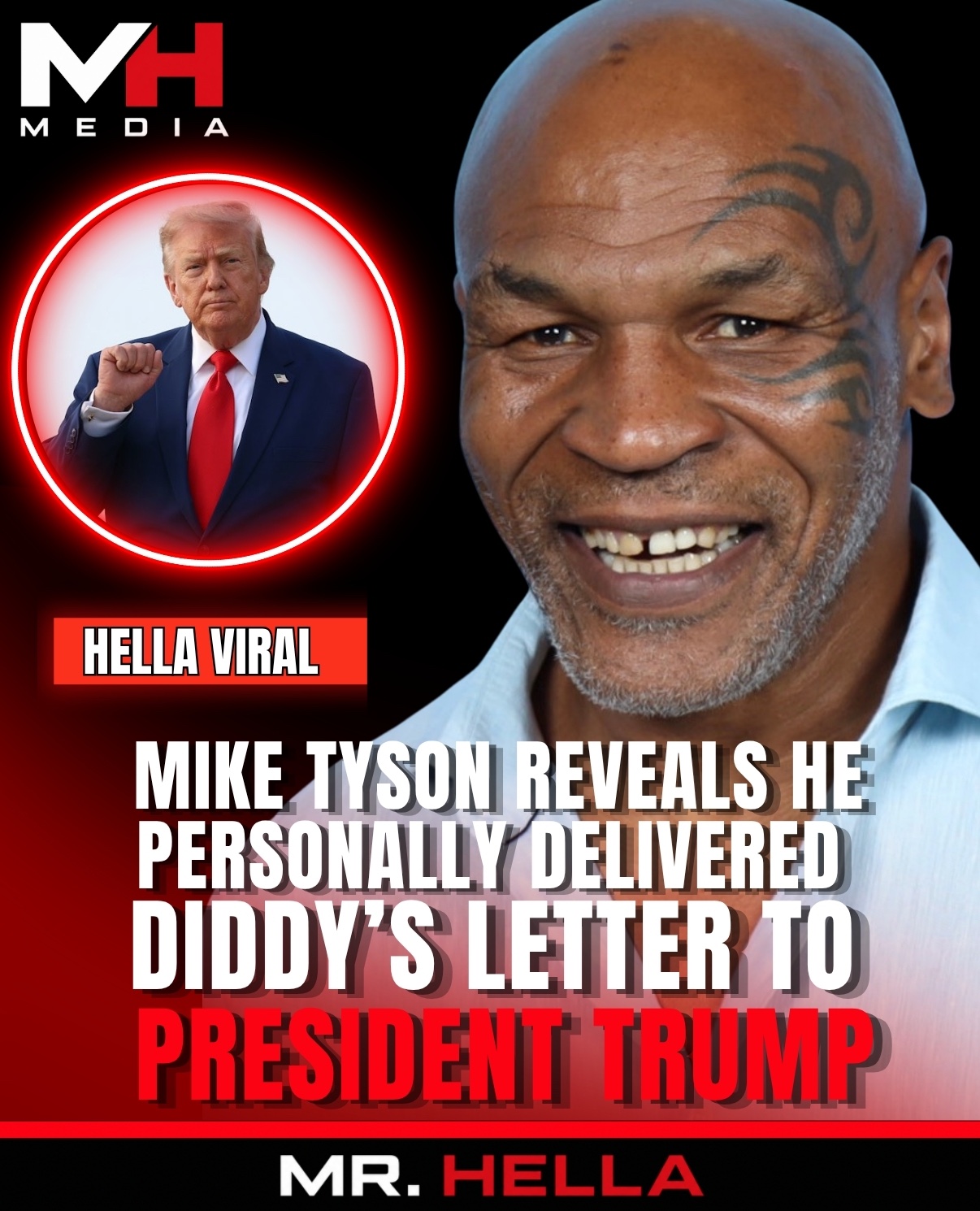
Mike Tyson Says He Personally Delivered Diddy’s Letter to President Trump After Receiving Request From Prison
Mike Tyson has revealed that he personally delivered a letter from Sean “Diddy” Combs to President Donald Trump, confirming that the incarcerated music mogul reached out to him for help getting a message directly to the White House.
The former heavyweight boxing champion discussed the unusual request during an October 8 appearance on Andy Cohen’s SiriusXM program, Andy Cohen Live. Tyson said Combs contacted him while incarcerated and asked whether he could pass a letter along to Trump.
Tyson confirmed that he followed through.
The revelation adds another high-profile name to the ongoing discussion surrounding Combs’ attempts to seek presidential intervention following his federal criminal conviction. It also raises questions about what Combs communicated to Trump, whether the president personally reviewed the letter and whether any request for clemency is receiving serious consideration.
Tyson did not publicly disclose the full contents of the letter during the interview, and his account of delivering it does not establish that Trump agreed to take any action on Combs’ behalf.
Nevertheless, the disclosure is significant. Rather than relying exclusively on attorneys or formal legal channels, Combs reportedly enlisted one of boxing’s most recognizable figures to deliver a personal communication to the president.
Tyson Confirms Diddy Contacted Him From Prison
During his conversation with Cohen, Tyson acknowledged that Combs had contacted him from behind bars and asked him to deliver a letter to Trump.
The request placed Tyson in an unusual position between two prominent figures he has known within overlapping celebrity and business circles.
Tyson’s relationship with Trump dates back decades, particularly to the period when the future president was heavily involved in Atlantic City’s casino and entertainment industry.
Trump promoted several major boxing events during Tyson’s career, including fights associated with his rise to international superstardom in the late 1980s.
That history helps explain why Combs might have believed Tyson could reach the president in a way that most people could not.
The former champion has maintained a public relationship with Trump over the years and has spoken favorably about him on multiple occasions.
Combs, meanwhile, has known Trump through New York’s entertainment and business circles, although their relationship and public political positions have evolved over time.
By approaching Tyson, Combs was turning to someone with connections to both men.
What Was in Diddy’s Letter?
The central unanswered question is what Combs actually wrote.
Tyson confirmed the delivery but did not provide a complete account of the letter’s contents during the interview.
Given Combs’ incarceration and the continuing attention surrounding potential presidential clemency, the disclosure immediately invites questions about whether the letter requested a pardon, a commutation or some other form of assistance.
Those possibilities should not be confused with verified details of the document.
Without the letter itself or a direct account of its contents, it would be premature to state definitively what Combs requested in writing.
A presidential pardon generally addresses a federal offense and its legal consequences, while a commutation reduces a sentence without overturning the conviction.
Both fall within the president’s federal clemency authority, but they serve different purposes.
Tyson’s confirmation establishes that he delivered a communication from Combs to Trump. It does not, by itself, establish that any particular form of clemency was requested or promised.
Trump Has Already Acknowledged Receiving a Letter
Tyson’s revelation helps explain how a communication from Combs may have reached the president.
Trump had previously acknowledged receiving a letter from the incarcerated music executive, although he did not publicly identify Tyson as the person who delivered it.
According to reporting by The New York Times, Trump indicated that he was not inclined to grant Combs a pardon. The president reportedly cited Combs’ past criticism of him as one factor influencing his attitude toward the request.
Tyson’s interview therefore connects two previously separate pieces of the story: Combs’ attempt to reach Trump and the president’s acknowledgment that a letter had arrived.
It does not establish that Tyson’s delivery changed Trump’s position.
Reports about Combs’ potential release have also circulated periodically, prompting the White House to push back against suggestions that a pardon was imminent. The administration has emphasized that clemency decisions belong to the president.
As of October 9, no pardon or commutation for Combs has been announced.
Diddy Is Serving a 50-Month Federal Prison Sentence
Combs is serving a 50-month federal prison sentence following his 2025 criminal trial in New York.
In July 2025, a federal jury convicted him on two counts of transportation to engage in prostitution under the Mann Act, a federal law originally enacted in 1910.
The jury acquitted him of the more serious racketeering-conspiracy and sex-trafficking charges.
Those distinctions remain important. Although Combs was convicted of federal prostitution-related transportation offenses, he was not convicted of the racketeering and sex-trafficking charges that carried the possibility of substantially longer imprisonment.
He was sentenced in October 2025 and is incarcerated at the Federal Correctional Institution at Fort Dix, New Jersey.
Combs continues to challenge his conviction and sentence through the federal appeals process.
A presidential pardon would represent a separate legal avenue from that appeal.
Tyson Questions the Government’s Use of an Old Federal Law
Tyson did more than discuss the letter during his conversation with Cohen.
He also expressed surprise at the government’s use of the Mann Act in prosecuting Combs.
“I was surprised that they went through so many lengths to get him,” Tyson said.
He referred to the law’s age, describing it as a rule dating back approximately 110 years.
The comments reflected Tyson’s skepticism about the prosecution, although the Mann Act remains an enforceable federal statute and has been amended repeatedly since its original passage.
The law’s age does not make a prosecution improper.
Tyson’s remarks nevertheless illustrate his willingness to publicly defend Combs at a time when many prominent entertainers have avoided discussing their relationships with the Bad Boy Records founder.
Tyson made his position clear when Cohen asked whether they remained friendly.
“I’m friendly with Puff,” he said.
Tyson’s Own Prison Experience Adds Context
Tyson also discussed his personal experience with incarceration during the interview.
The former heavyweight champion was convicted of rape in 1992 and served approximately three years in an Indiana prison before his release in 1995.
Tyson has maintained that he was wrongly convicted.
During his conversation with Cohen, he reflected on his time behind bars and described the support he believed he received from prison staff.
He even characterized those years as among the best of his life, an unusual reflection on a period that significantly interrupted his boxing career.
Tyson’s personal history does not establish why he agreed to assist Combs, but it provides context for his familiarity with the criminal justice system and his public discussion of incarceration.
The boxer was appearing on Andy Cohen Live to promote his four-part Netflix documentary, TYSON, scheduled to premiere October 13.
The documentary examines his rise in boxing, personal struggles, addiction, family tragedies and criminal conviction.
A Pardon Would Not Resolve Diddy’s Civil Lawsuits
Even if Trump eventually granted Combs presidential clemency, the consequences would have important limits.
A presidential pardon applies to federal offenses. It would not automatically dismiss private civil lawsuits or eliminate allegations raised by plaintiffs seeking damages.
Combs continues to face numerous civil claims involving alleged sexual misconduct and other wrongdoing.
He has denied the allegations in those proceedings.
The federal criminal trial and the civil cases are legally separate matters, with different standards of proof and potential consequences.
A pardon would also not establish that Combs was factually innocent of the offenses for which he was convicted.
Likewise, a commutation could reduce or end his remaining prison sentence without erasing the underlying conviction.
Those distinctions are especially important given the considerable public confusion surrounding Combs’ criminal verdict, sentence and possible clemency.
Why Tyson’s Involvement Matters
Tyson’s role is notable because it demonstrates how Combs has attempted to use longstanding personal relationships to reach people with political influence.
For decades, Combs occupied a prominent position in entertainment, fashion and business, building connections with musicians, athletes, executives and politicians.
Tyson’s disclosure shows that at least one major celebrity was willing to help him communicate directly with the president despite the reputational controversy surrounding his conviction.
It also illustrates the difference between having access to powerful people and obtaining a favorable decision from them.
Tyson says he carried out the request.
Trump reportedly received a letter.
But there is no verified indication that the communication persuaded the president to grant clemency.
What Happens Next?
For now, Combs remains incarcerated at Fort Dix while his legal team pursues available avenues for relief.
Tyson has not disclosed the letter’s complete contents, and no authenticated copy has been made public through his interview.
It also remains unclear precisely when Tyson delivered the communication or whether he discussed Combs’ case with Trump beyond passing along the letter.
The White House has not announced a change in its position regarding Combs’ potential clemency.
Those unanswered questions leave the situation largely where it stood before Tyson spoke publicly: Combs wants presidential intervention, but there is no confirmed decision to grant it.
What has changed is the public understanding of how Combs attempted to get his message to the president.
One of the most recognizable figures in boxing has now acknowledged serving as the messenger.
Tyson’s account turns what had previously been a reported effort to reach Trump into a firsthand admission of his own involvement.
And his explanation was remarkably simple.
“I did what he told me to do.”
Comments