

MR. HELLA MEDIA | HELLA VIRAL | NOVEMBER 3, 2026
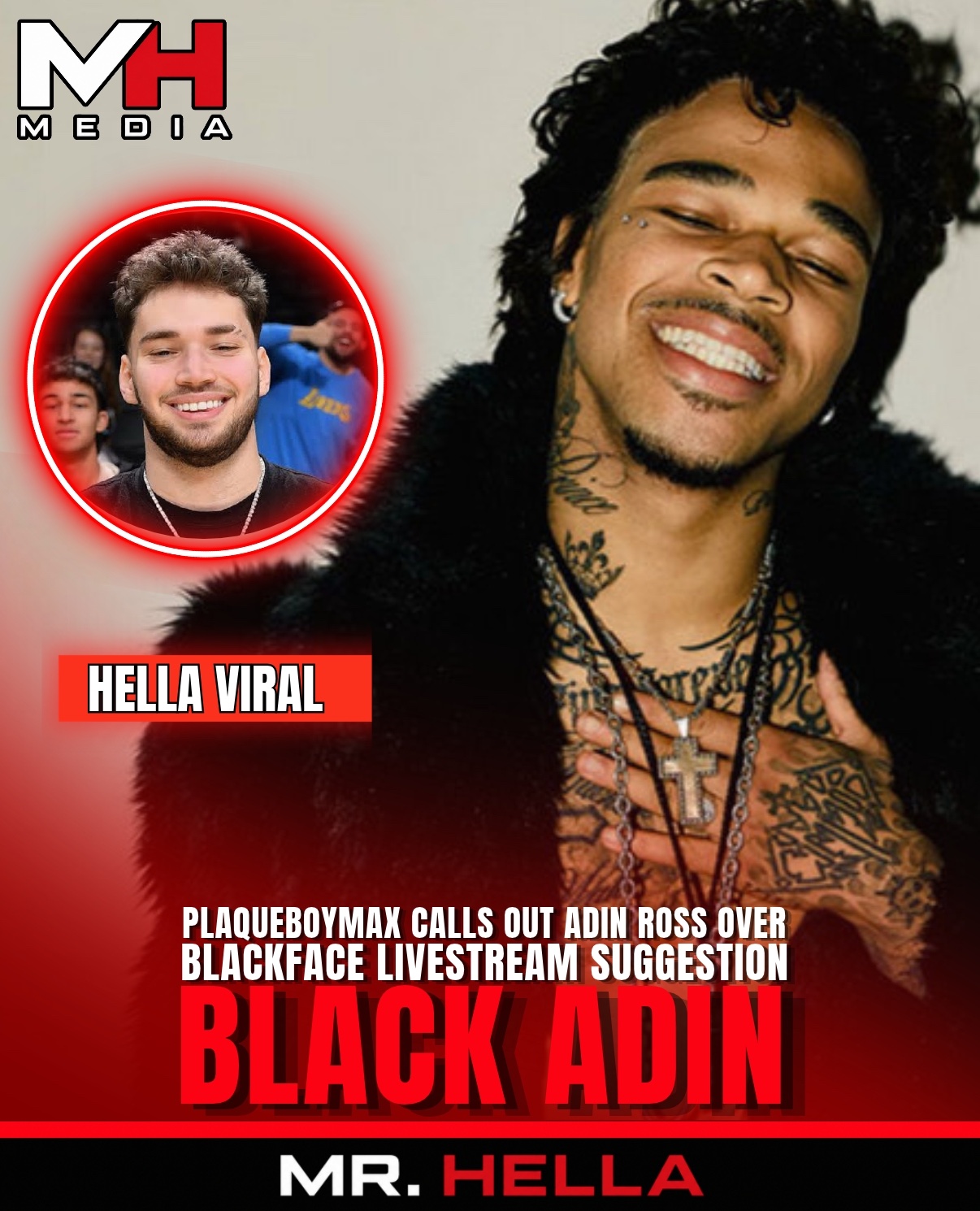
PlaqueBoyMax Calls Out Adin Ross Over Blackface Livestream Suggestion, Questions His Respect for Black Culture
By Mr. Hella Media
A controversy involving two of the internet’s most recognizable livestream personalities has erupted across the streaming and hip-hop communities after Adin Ross suggested that he and several fellow creators participate in a blackface livestream. The remarks prompted a direct response from PlaqueBoyMax, who questioned why Ross would propose something he considered disrespectful to the same Black culture that helped shape his streaming career.
The disagreement began during a Halloween broadcast on October 31, when Ross watched footage of PlaqueBoyMax and his friends dressed as white men for a comedic livestream. Ross appeared amused by the costumes before suggesting that he and fellow streamers Cheesur and Konvy could create their own version by wearing blackface.
The suggestion immediately raised questions about the racial implications of the proposed content. Ross also asked his audience whether the idea would generate backlash, indicating that he understood the concept could be controversial.
PlaqueBoyMax addressed the remarks during a November 1 livestream, explaining that his criticism was not rooted in personal hostility toward Ross. Instead, he challenged what he viewed as a lack of respect for Black culture from someone whose career has been closely connected to hip-hop artists, Black entertainers and predominantly Black cultural spaces.
The exchange has since circulated across social media, raising a broader discussion about racial humor, the historical meaning of blackface and the responsibilities of influential creators whose audiences extend across different communities.
Adin Ross Suggests Blackface Livestream While Watching Halloween Costumes
The controversy originated when Ross reacted to footage from PlaqueBoyMax’s Halloween livestream.
During the original broadcast, Max and several friends appeared dressed as stereotypical white men, using costumes and exaggerated mannerisms for comedic effect.
Ross found the footage entertaining and began discussing the possibility of creating a similar livestream with the racial roles reversed.
“What if Max did a stream with everyone,” Ross said, before suggesting that he, Cheesur and Konvy could participate while wearing blackface.
He described the idea as potentially entertaining for viewers and repeatedly suggested that it could become a successful broadcast.
Ross also questioned whether the concept would provoke criticism.
“Do you guys think I would get hate for doing that, though?” he asked his audience.
During the discussion, Ross referenced his Jewish identity while responding to the suggestion that his proposed costumes would be racially inappropriate.
“I’m Jewish; I’m not white,” he said.
The comment became another point of discussion because religious or ethnic identity does not erase the historical associations of blackface.
Ross’s remarks were made during a livestream discussion. There is no confirmed evidence that he, Cheesur or Konvy actually participated in a blackface broadcast.
The distinction matters because the controversy concerns a publicly proposed idea, not a completed performance.
PlaqueBoyMax Responds: “Why Don’t You Respect Black Culture?”
PlaqueBoyMax addressed Ross’s comments during his November 1 broadcast, offering one of the strongest responses to the controversy.
Rather than focusing exclusively on the Halloween costumes, Max questioned Ross’s relationship with the cultural community that has played a significant role in his success.
“A lot of your success is rooted in Black culture,” Max said.
He then asked Ross directly, “Why don’t you respect Black culture?”
Max argued that Ross’s involvement with Black musicians, entertainers and internet personalities made the suggestion particularly difficult to understand.
He suggested that someone who has benefited professionally from participating in those cultural spaces should recognize why blackface carries a different historical meaning from ordinary Halloween costumes.
The criticism was not presented as a demand that Ross abandon his career or permanently separate himself from Black creators.
Instead, Max framed the issue as a question of respect and cultural awareness.
He suggested that greater understanding of Black culture could have prevented some of the controversies Ross has encountered throughout his career.
The comments resonated because Max was not speaking as an outside observer unfamiliar with streaming culture. He was challenging a fellow creator whose work and audience overlap with his own.
Max Says He Still Considers Adin Ross One of Streaming’s Greatest
Despite his criticism, PlaqueBoyMax made clear that he continues to admire Ross’s accomplishments.
During the same broadcast, Max described Ross as one of his favorite streamers and acknowledged his influence on the industry.
“Adin, bro, you one of my streaming GOATs,” he said, adding that his opinion of Ross’s streaming accomplishments would not automatically change because of the controversial suggestion.
That distinction became an important part of Max’s response.
He was separating his professional admiration for Ross from his disagreement with a specific statement.
Max also expressed genuine confusion about why someone he respected would propose such an idea.
“You deeply confuse me,” he told Ross during the livestream.
His response illustrated how disagreements between internet personalities do not always involve a complete breakdown in their relationships.
Although Max challenged Ross publicly, he did not announce that he was ending their association or refusing to interact with him in the future.
The available reporting does not establish that the two have had a private conversation resolving the disagreement.
Why Blackface Has a Different Historical Meaning
The controversy has also brought renewed attention to the history of blackface in American entertainment.
Blackface became widely associated with minstrel performances during the nineteenth and early twentieth centuries, when performers, frequently white entertainers, darkened their skin to portray exaggerated and degrading stereotypes of Black Americans.
Those performances helped reinforce racist caricatures during periods when Black people faced widespread discrimination and exclusion from many entertainment opportunities.
The practice continued influencing popular culture long after traditional minstrel shows declined.
Because of that history, blackface is widely regarded as offensive, particularly when used to imitate Black people for comedic entertainment.
Ross’s suggestion emerged in response to a Halloween livestream in which Max and his friends portrayed white characters.
However, the historical associations of the two concepts are not identical.
The controversy therefore cannot be understood solely as a disagreement about whether different racial groups should be allowed to imitate one another.
For Max, the central concern was that Ross appeared to treat blackface as an interchangeable form of racial comedy without acknowledging the historical context attached to it.
Ross, meanwhile, appeared to approach the idea as a provocative response to costumes he had found amusing.
Those different perspectives help explain why the exchange quickly moved beyond the original Halloween footage.
Ross’s Career Has Been Closely Connected to Hip-Hop
PlaqueBoyMax’s criticism carries additional significance because hip-hop has played an important role in Adin Ross’s rise as a livestream personality.
Ross built a large audience through gaming broadcasts, celebrity collaborations, reaction content and conversations with prominent entertainers.
Over the years, he has hosted or interacted with numerous figures from the rap industry, helping establish his streams as a destination for artists seeking to connect with younger audiences.
His collaborations with rappers and other Black entertainers have contributed to his visibility within hip-hop culture.
That connection was central to Max’s argument.
He questioned how Ross could maintain close professional relationships with people from the culture while suggesting a form of entertainment associated with racist historical stereotypes.
The criticism reflects a broader conversation about the difference between participating in a culture and demonstrating respect for its history.
An entertainer can collaborate with Black artists, enjoy hip-hop music and build an audience around those connections while still facing questions about statements considered culturally insensitive.
Max’s position was that Ross should recognize those responsibilities, particularly given the size and influence of his platform.
This Is Not Ross’s First Controversy Involving Racial Humor
The latest incident has also renewed attention to an earlier controversy involving Ross and racial stereotypes.
In February 2023, Ross faced criticism after a video circulated showing him offering money to a stranger on the video-chat platform Omegle to imitate a Black person.
During the exchange, Ross initially offered $100 before increasing the amount to $200.
The participant questioned whether the request was racist, but Ross continued encouraging the imitation.
After the individual complied, Ross accused the participant of racism before indicating that he had been joking.
The video attracted criticism, particularly because it circulated during Black History Month.
The earlier incident does not establish Ross’s intentions in the current controversy, but it provides context for why some viewers interpreted the Halloween suggestion as part of a recurring issue involving racial humor.
For critics, the concern is not limited to one isolated joke. It involves whether influential creators understand the historical and cultural implications of the material they introduce to large audiences.
Ross has frequently built content around provocative humor and unexpected interactions, but those approaches can generate controversy when the subject involves race or identity.
PlaqueBoyMax’s Growing Influence Extends Beyond Streaming
PlaqueBoyMax, whose first name is Maxwell, has become an increasingly prominent figure in the intersection of livestream entertainment and hip-hop.
His broadcasts frequently feature music production, artist collaborations and live recording sessions, allowing viewers to watch songs develop in real time.
Rather than focusing exclusively on gaming or reaction content, Max has built a platform where music creation is a central part of the entertainment.
His growing influence has also been recognized through industry nominations and collaborations.
He received a nomination for Best Music Streamer at the 2026 Streamer Awards, placing him alongside creators including DDG, Bishu and AriAtHome.
His involvement in the recording “Victory Lap,” alongside Fred again.. and Skepta, also brought him recognition in the music industry, with the project earning a Grammy nomination for Best Dance/Electronic Recording.
That background helps explain why his criticism of Ross attracted attention beyond traditional livestream audiences.
Max operates within the same intersection of hip-hop, internet culture and entertainment that has contributed to Ross’s success.
His comments therefore represent criticism from someone who understands the industry and its relationship with Black musical culture.
The Controversy Highlights the Influence of Livestream Personalities
The disagreement illustrates how livestreaming has become an increasingly influential part of modern entertainment.
Creators such as Ross and PlaqueBoyMax regularly attract large audiences through broadcasts that can last for hours, with their most memorable moments subsequently spreading across TikTok, X, Instagram and YouTube.
That distribution model can turn a brief statement into a much larger public controversy.
Unlike traditional television programs, livestreams often involve spontaneous conversations in which creators respond to audience messages and make comments without extensive preparation.
Those moments can create the sense of authenticity that attracts viewers, but they also carry reputational risks.
In this case, Ross’s proposed Halloween concept became a widely discussed issue after Max publicly challenged its implications.
The controversy also demonstrates how closely connected streaming and hip-hop culture have become.
Major rappers frequently appear on livestreams, streamers collaborate on music, and viral broadcast moments regularly become entertainment-news stories.
As those communities continue overlapping, questions about cultural influence, accountability and representation are likely to remain important.
Has Adin Ross Responded to PlaqueBoyMax?
As of November 3, the available reporting confirms that Ross made the original blackface suggestion and that PlaqueBoyMax publicly criticized it.
Reports published November 2 indicated that Ross had not yet issued a substantive response to Max’s criticism.
A separately circulated clip attributed to Ross appears to show him discussing accusations of racism and arguing that some Twitch personalities apply inconsistent standards to racial humor. However, the timing and full context of that response require additional verification before it can be treated as a definitive reply to Max’s November 1 comments.
No completed blackface livestream involving Ross, Cheesur and Konvy has been confirmed.
There has also been no verified announcement that the proposed broadcast will take place.
For now, the disagreement remains centered on the original suggestion, Max’s criticism and the wider conversation those remarks have generated.
A Halloween Joke Becomes a Larger Conversation About Respect
What began as Ross reacting to a Halloween livestream has developed into a broader debate about race, comedy and cultural responsibility within the streaming industry.
Ross appeared to view the proposed blackface broadcast as a provocative variation of a costume concept he found entertaining.
PlaqueBoyMax saw the suggestion differently, arguing that Ross should demonstrate greater awareness of the Black culture that has played an important role in his career.
The most notable aspect of Max’s response was his decision to challenge Ross without dismissing his accomplishments or denying his influence as a streamer.
He made clear that admiration for another creator does not require agreement with every statement that person makes.
The incident also raises questions about how entertainers should approach historically sensitive subjects when their comments can reach millions of viewers.
For PlaqueBoyMax, the issue was not simply whether Adin Ross could generate attention with a controversial livestream. It was whether a creator whose success has been closely connected to Black entertainment should understand why turning blackface into content would provoke serious criticism.



Comments