

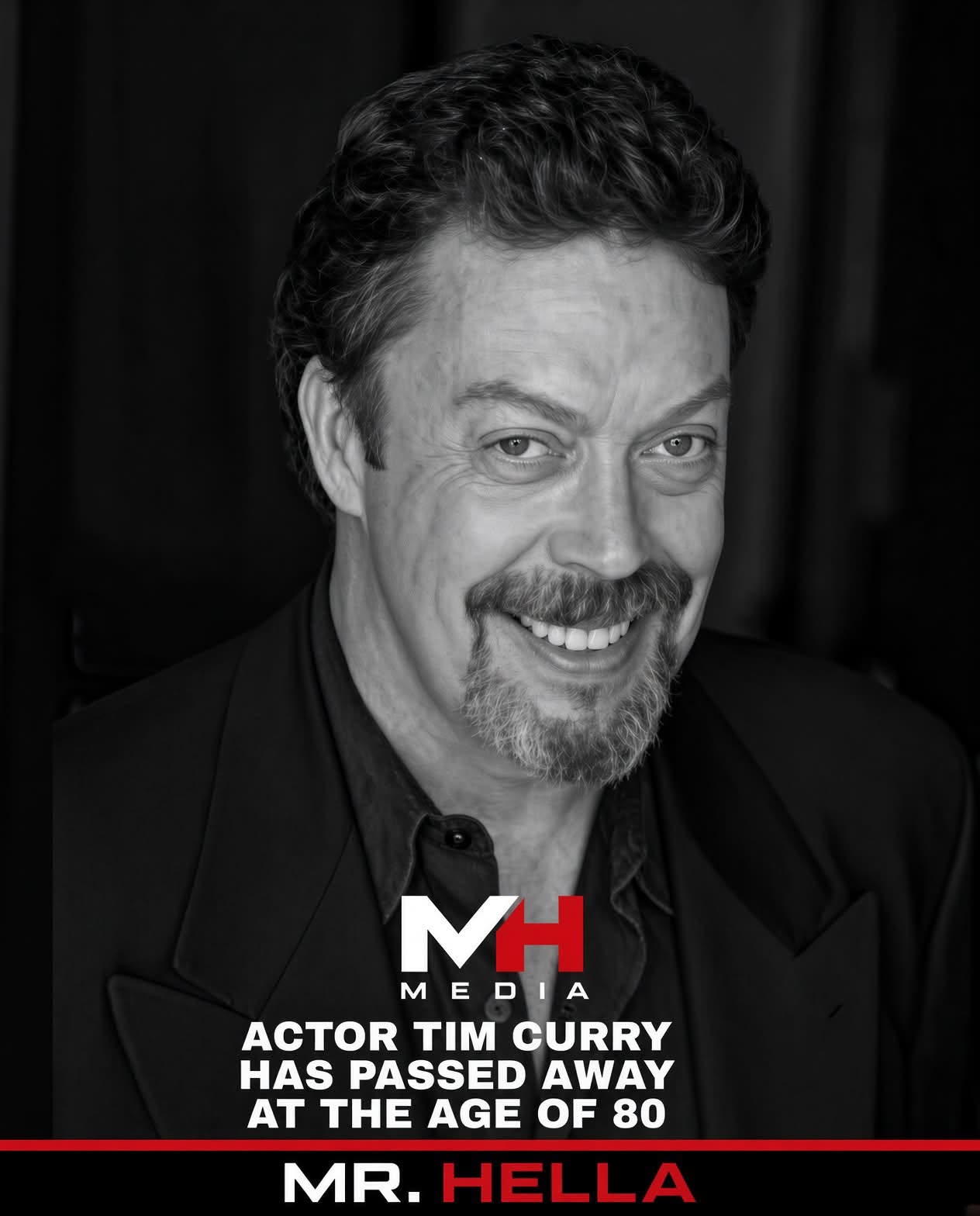
Tim Curry, the British actor whose unmistakable voice, theatrical presence and willingness to embrace eccentric characters made him a cult icon across film, television and the stage, died Tuesday, August 25, at his home in Los Angeles. He was 80.
Curry died peacefully at his home in Toluca Lake, according to his longtime manager and friend Marcia Hurwitz. His death brought to a close a career spanning more than five decades, during which he became permanently associated with the flamboyant Dr. Frank-N-Furter in The Rocky Horror Picture Show while building a body of work that ranged from Pennywise in Stephen King’s It to the frantic butler Wadsworth in Clue, the intimidating Lord of Darkness in Legend and the suspicious hotel concierge in Home Alone 2: Lost in New York.
Curry had lived with serious health problems for more than a decade after suffering a major stroke in 2012. The stroke left him partially paralyzed and dependent on a wheelchair, dramatically reducing the kind of physical acting work that had defined much of his career. It did not, however, completely remove him from entertainment. Curry continued working as a voice actor and occasionally returned for public appearances and projects connected to the roles that had made him famous.
When Curry's death was first announced, his representatives did not disclose a cause. Public-health records later identified coronary artery disease as the cause of death, while his history of stroke and kidney cancer were listed as other significant medical conditions. His representative subsequently confirmed the coronary artery disease finding.
A Role That Became Bigger Than the Movie
For all the characters Curry played, one followed him for the rest of his life.
Curry originated the role of Dr. Frank-N-Furter in Richard O'Brien's The Rocky Horror Show on the London stage in 1973, creating a performance that was provocative, funny, sexually uninhibited and almost impossible to categorize. When the production was adapted into the 1975 film The Rocky Horror Picture Show, Curry brought the character to the screen in fishnet stockings, a corset and heavy makeup, delivering songs including “Sweet Transvestite” with the confidence of a rock star.
The movie initially struggled commercially, but its afterlife became extraordinary. Midnight screenings turned Rocky Horror into an interactive cultural phenomenon, with audiences dressing as characters, shouting lines back at the screen and returning repeatedly. What began as an unconventional musical became one of the defining cult films of its era, and Curry's Frank-N-Furter became its most recognizable image.
The performance also carried a cultural significance that extended beyond the movie's box-office history. Frank-N-Furter's unapologetic rejection of conventional expectations surrounding sexuality, gender presentation and self-expression resonated with generations of viewers who encountered Rocky Horror long after its original release. Curry would remain closely connected to that audience for the rest of his life.
His association with the character was so durable that he returned to the Rocky Horror universe decades later. In Fox's 2016 television production The Rocky Horror Picture Show: Let's Do the Time Warp Again, Curry appeared as the criminologist and narrator while Laverne Cox took on Frank-N-Furter.
Curry Built a Career Out of Characters Other Actors Might Avoid
While Rocky Horror made Curry famous, it was his ability to disappear into unusual, sinister and often darkly funny characters that sustained his career.
In the 1985 murder mystery comedy Clue, Curry played Wadsworth, the butler at the center of an increasingly chaotic evening involving murder, blackmail and a mansion filled with suspects. The film, like Rocky Horror, developed a stronger reputation after its initial theatrical run and eventually became another cult favorite.
Five years later, Curry terrified a different generation as Pennywise in the 1990 television adaptation of Stephen King's It. His performance turned an ordinary clown into a source of childhood nightmares, long before Bill Skarsgård would reinterpret the character for a new generation. Curry's Pennywise could shift from playful to threatening almost instantly, demonstrating how effectively the actor could use humor as part of a villain rather than treating comedy and horror as separate modes.
Curry also played Darkness in Ridley Scott's Legend, Rooster Hannigan in Annie, Cardinal Richelieu in The Three Musketeers and Long John Silver in Muppet Treasure Island. In Home Alone 2: Lost in New York, he transformed the relatively small role of Plaza Hotel concierge Mr. Hector into one of the movie's most memorable supporting performances.
His characters were frequently villains, schemers or eccentrics, but Curry rarely played them quietly. His expressive face, deep voice and theatrical instincts allowed him to make even supporting roles feel larger than their screen time.
That was not accidental. Curry once explained that he was drawn to the more unusual corners of human behavior, an instinct that helps explain why so many of his performances remained memorable decades after the productions themselves were released.
His Career Began on the Stage
Before Hollywood made Curry recognizable around the world, he was a theater actor.
Born Timothy James Curry on April 19, 1946, in Cheshire, England, he studied drama and English at the University of Birmingham before joining the original London production of Hair in 1968. His theatrical background became central to the intensity and precision he later brought to film roles.
Curry eventually built a significant Broadway career alongside his screen work. He received three Tony Award nominations, including recognition for playing Mozart in Amadeus, his performance in My Favorite Year and his role as King Arthur in Monty Python's Spamalot. The latter reunited him creatively with Eric Idle and became another major stage success late in Curry's career.
His theatrical work helps explain why Curry could make exaggerated characters feel deliberate rather than uncontrolled. Even when he appeared to be chewing the scenery, there was usually a performer with extensive stage training controlling the rhythm underneath it.
Curry was also a singer and recording artist, releasing albums during a period when he pursued rock music alongside acting. His baritone voice ultimately became valuable in another field as well: animation.
Voice Acting Gave Curry Another Career
Long before celebrity voice casting became routine in major animated productions, Curry established himself as a prolific voice performer.
He voiced Captain Hook in Peter Pan and the Pirates, a performance that earned him a Daytime Emmy Award, and accumulated credits across animated television, movies and video games.
Voice acting proved particularly important after his stroke because it offered Curry a way to continue performing despite the physical limitations he faced. His voice had always been one of his most distinctive instruments, capable of sounding sophisticated, sinister, absurd or warmly comedic depending on the character.
After decades of relying on his entire physical presence as a performer, Curry could still create characters with sound alone.
A 2012 Stroke Changed His Life
Curry's life changed dramatically in 2012 when he suffered a major stroke.
The medical emergency affected the right side of his brain and left him paralyzed on the left side of his body. He temporarily lost his speech and underwent emergency brain surgery, followed by an extensive rehabilitation process involving physical and speech therapy. Curry eventually regained his ability to speak but remained unable to walk independently and used a wheelchair for the rest of his life.
News of the stroke was initially kept private and did not become widely public until the following year. For an actor whose performances had often depended on exaggerated physical movement, dancing and stage presence, the consequences were profound.
Curry nevertheless continued working.
He took occasional voice roles, participated in events and eventually discussed his health publicly with the same dry humor that had characterized his performances. In his 2025 memoir Vagabond, Curry reflected on the stroke and the long process of adapting to a body that no longer worked the way it once had.
Eric Idle, Curry's longtime friend and collaborator, later recalled that Curry handled the challenges following his stroke remarkably well. The two had worked together on Spamalot and remained friends away from the stage.
The stroke narrowed Curry's professional options, but it never erased him from popular culture. Fans continued meeting him at conventions and celebrating the performances that had become part of their childhoods, Halloween traditions and movie-night rituals.
Generations Knew Different Versions of Tim Curry
Part of Curry's unusual longevity came from the fact that different audiences discovered him through completely different roles.
For one generation, he would always be Frank-N-Furter.
For another, he was Pennywise.
Children who grew up during the 1990s might first remember him glaring suspiciously at Kevin McCallister from behind the front desk in Home Alone 2. Others knew him through Clue, Muppet Treasure Island, Legend, animated television or his stage performances.
Many eventually discovered that these wildly different characters had all been played by the same man.
That versatility gave Curry a type of cultural staying power that isn't easily measured through box-office numbers or awards. Several projects associated with him became more beloved with age than they had been upon release, allowing his performances to continually find new audiences.
The Rocky Horror Picture Show is the clearest example. Its theatrical release did not initially suggest that people would still be dressing as its characters half a century later. Yet Curry's Frank-N-Furter survived changes in fashion, music and popular culture to become one of cinema's most recognizable cult performances.
Clue followed a similar trajectory, developing a devoted audience through home video and television after an initially modest theatrical reception.
Curry seemed uniquely suited to movies that refused to disappear.
A Career Built on Taking Risks
Curry never fit neatly into the traditional mold of a Hollywood leading man, and that ultimately became one of his greatest strengths.
He could be frightening without losing his humor, ridiculous without losing his authority and theatrical without seeming unaware of the joke. Directors repeatedly cast him when they needed a character who could dominate a scene almost immediately, even when Curry wasn't the star of the film.
His stage career demonstrated the same range. From Hair and Rocky Horror to Amadeus and Spamalot, Curry moved between rock musicals, drama and comedy without becoming permanently confined to the role that made him famous.
The result was a career filled with performances that people remembered.
Curry never married and had no children. He kept much of his private life away from the public, allowing his characters to occupy far more space in popular culture than the details of his personal life.
When news of his death arrived, those characters became the language through which generations of fans remembered him: the corset, the clown, the butler, the concierge, the pirate, the demon and the unmistakable voice behind countless animated villains.
Tim Curry spent much of his career playing people who were strange, dangerous, extravagant or impossible to ignore. He had an unusual ability to turn those characters into something audiences wanted to see again, sometimes long after critics or box-office receipts had moved on.
He was 80 when he died at his Los Angeles home on August 25, more than 50 years after he first stepped into Frank-N-Furter's heels and created the performance that would follow him for the rest of his life.
For Curry, that role opened the door. What followed was a career proving he could walk through almost any other one.


Comments