

Ariana Grande has spent most of her adult life being analyzed by millions of strangers.
Her relationships have been dissected.
Her voice has been analyzed.
Her appearance has been compared from year to year.
Her body has repeatedly become the subject of headlines, viral posts and unsolicited commentary.
Now, on “Petal,” Grande appears ready to confront the machinery surrounding celebrity rather than quietly absorb it.
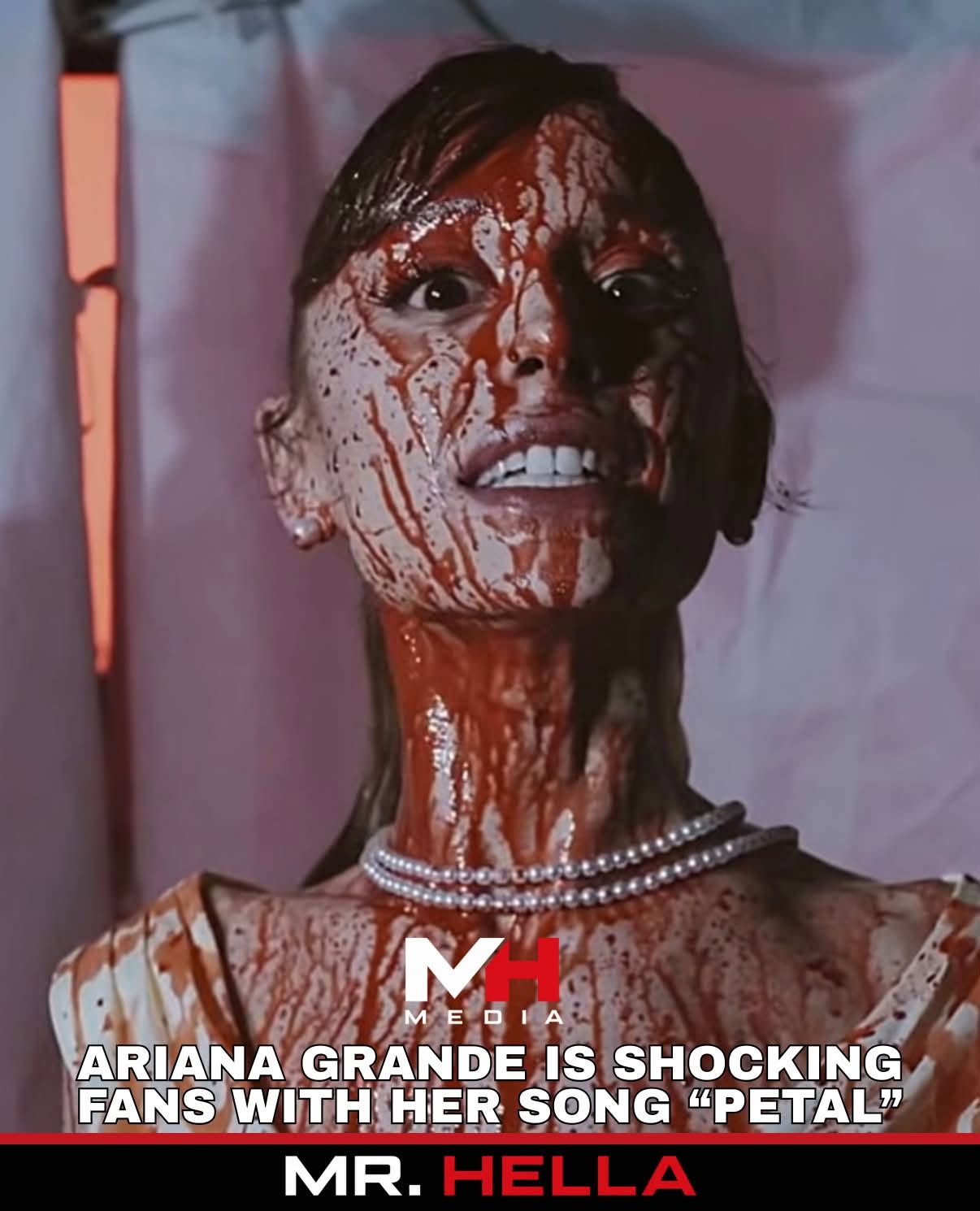
The 33-year-old superstar released her eighth studio album, Petal, on July 31, 2026, alongside a disturbing, horror-inspired music video for its title track that transforms the pressures of fame, rejection and impossible beauty standards into something considerably darker.
The song itself finds Grande questioning the relationship between her pain, her music and an industry that financially rewards artists for turning personal suffering into entertainment.
But the video takes the idea even further.
Grande plays an aspiring actress named Pepper who repeatedly auditions for executives at a fictional company called Fame Inc.
Again and again, she isn't good enough.
She changes.
She returns.
She's rejected again.
Eventually, the criticism becomes brutal.
And Pepper snaps.
What begins as a stylized story about auditioning ends in a blood-soaked horror sequence involving a chainsaw and the violent destruction of the people who had spent the video judging her.
It's deliberately extreme.
But underneath all the blood is a recognizable message about celebrity:
What happens when a woman spends years being told that everything about her is available for public evaluation?
‘Petal’ Is Ariana Grande’s Eighth Studio Album
Petal arrived July 31 through Babydoll Music and Republic Records.
It is Grande's eighth studio album and follows 2024's Eternal Sunshine.
Grande co-wrote and executive produced the project with longtime collaborator ILYA, while Max Martin also contributed as a writer and producer on three tracks.
The album contains songs including “kiss me,” “hate that i made you love me,” “petal,” “stay,” “oh well,” “big feelings,” “freak,” “like i do,” “never get over me” and “nowhere, nobody.”
Its lead single, “hate that i made you love me,” had already given Grande another massive commercial success before the album arrived, debuting at No. 1 on the Billboard Hot 100.
That became Grande's tenth career No. 1 on the chart.
But despite the commercial success surrounding the era, Petal isn't presented as a straightforward victory lap.
Grande has described the album as coming from a much angrier place.
She told Apple Music that she wrote from a place she doesn't normally access publicly: “an unfiltered rage.”
She also described herself as typically being too shy to fully tap into those emotions.
This time, she didn't filter them as much.
The Meaning Behind the Name ‘Petal’
The title itself establishes the album's central metaphor.
Grande has described Petal as representing something alive growing through the cracks of something cold, hard and challenging.
It's a delicate image.
A flower petal represents softness and vulnerability.
Pavement represents the opposite.
Cold.
Hard.
Unforgiving.
The title track repeatedly returns to the image of a petal against pavement, creating an obvious contrast between vulnerability and the environment attempting to crush it.
That metaphor can be read against Grande's relationship with fame.
She has achieved a level of success experienced by very few entertainers.
She's won Grammys.
She's accumulated No. 1 records.
She's starred in enormous films.
She's toured internationally.
She's spent years as one of the most recognizable celebrities on Earth.
But success doesn't eliminate scrutiny.
In some ways, it intensifies it.
The Song Questions Whether Pain Has Become Part of the Product
“Petal” doesn't simply attack the media.
It's more complicated than that.
Grande also turns the questions inward.
She asks who is responsible for the cycle—the audience or herself.
The song examines an uncomfortable reality of celebrity songwriting: personal suffering can become commercially valuable.
Heartbreak becomes an album.
An album becomes a tour.
The tour becomes headlines.
The headlines create more public interest.
And the cycle repeats.
Grande presents herself as aware of that contradiction.
She's enormously successful because millions of people care about her life.
But that same interest can become suffocating when the public believes access to her music also grants access to her body, relationships, mental state and private decisions.
The title track lives inside that contradiction.
Grande isn't presenting herself simply as powerless.
At one point, she explicitly rejects positioning herself as a victim and acknowledges the extraordinary privileges her career has given her.
That's what makes the song more complicated than a celebrity simply complaining about fame.
She appears to understand that fame has given her an extraordinary life.
She's questioning the cost attached to it.
Then the Music Video Turns Everything Into a Horror Movie
The official “Petal” video was directed by Christian Breslauer, who has worked with Grande on several previous visuals.
The approximately seven-minute production opens with a parental advisory warning.
Grande isn't simply playing herself.
She's Pepper.
Pepper is a hopeful actress attempting to impress executives at Fame Inc.
At first, the scenario feels familiar.
She auditions.
She's rejected.
So she changes herself.
Then she tries again.
Still not good enough.
The process repeats.
Pepper attempts different appearances and attitudes, apparently searching for whatever version of herself the executives might finally approve.
Pepper Can Never Become What They Want
That's where the video becomes particularly relevant to Grande's own celebrity experience.
Pepper isn't rejected because she refuses to change.
She changes repeatedly.
It doesn't matter.
There is always something else wrong.
Eventually, the executives' criticism becomes increasingly personal.
They characterize her as forgettable.
They criticize her attractiveness.
They question whether she's authentic.
One even asks whether she has a personality disorder.
The audition has stopped being an evaluation of her performance.
They're evaluating her entire existence.
That distinction appears central to the video.
For celebrities—especially women—the conversation frequently moves beyond their actual work.
An album becomes a conversation about someone's face.
A movie premiere becomes a discussion about someone's body.
An interview becomes an analysis of someone's voice.
A photograph becomes evidence for thousands of strangers debating whether someone looks healthy.
The performance becomes secondary.
The person becomes the product.
Then Pepper Snaps
Eventually, the executives push Pepper too far.
The polished aspiring actress disappears.
The video explodes into horror.
Pepper attacks the executives with a chainsaw.
She emerges from the room covered in blood.
Outside, the other women waiting to audition stand and applaud her.
It's intentionally absurd and grotesque.
It's also clearly fictional.
Grande isn't literally advocating violence against critics.
The sequence functions as an exaggerated horror metaphor for someone finally destroying the system that has spent the entire video attempting to reshape her.
The woman being evaluated becomes the person controlling the room.
The judges are no longer judging.
And Pepper is no longer auditioning.
The Video Arrives After Years of Commentary About Grande’s Body
The visual carries additional weight because Grande's physical appearance has been the subject of intense public discussion for years.
Her body became an especially frequent topic during the Wicked era.
Photographs and videos routinely generated viral discussions about her weight.
Some people framed their comments as concern.
Others openly criticized her appearance.
Still others compared current photographs of Grande with older images and speculated about her health.
Grande has previously pushed back against that type of commentary.
Her broader argument has been straightforward: people generally don't know what is happening privately in another person's life, and publicly evaluating someone's body can be harmful even when the commentary is presented as concern.
That context matters when interpreting Petal.
It doesn't mean every scene in the video should automatically be interpreted literally as a response to weight commentary.
Grande hasn't publicly provided a scene-by-scene explanation confirming that.
But the larger themes surrounding appearance, public judgment and constantly changing oneself to satisfy outside expectations are difficult to separate from the scrutiny Grande herself has experienced.
Critics reviewing the album have also connected its themes to years of tabloid and social-media commentary about her body and image.
‘Like I Do’ Appears to Push the Conversation Even Further
The title track isn't the only moment on Petal that critics have connected to Grande's relationship with public scrutiny.
Reviews have pointed toward “like i do” as another song apparently examining her strange codependence with the press and the public.
One particularly pointed line plays with the idea of having something to talk about keeping her “well fed”—wordplay that reviewers interpreted as a possible response to years of headlines presenting speculation about her weight as concern.
Again, Grande doesn't name individual publications or explicitly explain every target.
That's part of what makes the album effective.
Rather than turning Petal into a list of grievances against specific journalists or social-media accounts, she appears to be attacking the entire ecosystem.
Grande Has Been Famous Since She Was a Teenager
There is another layer to the frustration expressed throughout the project.
Grande didn't become famous at 30.
She has spent virtually her entire adult life in public.
She first reached a massive young audience playing Cat Valentine on Nickelodeon's Victorious before transitioning into music.
Her 2013 debut album Yours Truly immediately established her as a major pop vocalist.
From there came My Everything.
Dangerous Woman.
Sweetener.
Thank U, Next.
Positions.
Eternal Sunshine.
And now Petal.
Every era came with a different version of Ariana Grande.
Different styling.
Different relationships.
Different hairstyles.
Different sounds.
Different levels of public exposure.
And with each transformation came another wave of analysis.
Grande Has Also Experienced Extraordinary Trauma in Public
Her relationship with fame can't be separated from what has happened during it.
In May 2017, a suicide bomber attacked Manchester Arena following Grande's concert, killing 22 people and injuring hundreds.
Grande subsequently returned to Manchester for the One Love Manchester benefit concert.
The following year, her former boyfriend Mac Miller died at age 26.
Grande was simultaneously navigating enormous fame, public relationships, grief and constant media attention.
Years later, even changes in how she speaks became viral controversies.
When social-media users noticed Grande sometimes speaking in a higher vocal register, speculation spread about why.
Grande later explained that placing her voice higher can be a technique she uses to protect her vocal health when she has extensive speaking or singing ahead of her.
Even her speaking voice had become something the public believed required an explanation.
‘Petal’ Feels Like a Different Ariana Grande Era
Sonically, critics have also noticed the shift.
The project is darker than much of Grande's previous material.
There are still unmistakably Ariana Grande vocal arrangements and pop structures.
But Petal incorporates darker electronics, distorted textures and an atmosphere that several reviews have described as uneasy or haunted.
That sound matches the imagery.
The bright, polished pop-star presentation has been replaced by something stranger.
Grande isn't attempting to pretend everything is perfect.
The album allows resentment, frustration and contradiction to exist alongside gratitude.
That Makes the Chainsaw Scene More Than Shock Value
Without the larger context, the ending of the “Petal” video could simply be viewed as Grande experimenting with horror.
Ariana Grande picks up a chainsaw.
People die.
Grande walks out covered in blood.
Internet reacts.
But within the album's themes, the sequence has another meaning.
Pepper spends the entire video asking for approval.
She changes herself.
She tries again.
She's rejected.
She changes again.
Eventually, she stops asking.
The horror sequence represents an extreme reversal of power.
The people deciding whether Pepper is beautiful enough, authentic enough or interesting enough suddenly lose their authority entirely.
For an artist who has spent years having strangers debate whether she's too thin, too different, too fake, too polished, too private, too public or no longer the version of Ariana Grande they remember, the metaphor isn't particularly subtle.
But Her Appearance Shouldn't Become the Story All Over Again
There is an irony surrounding the reaction to “Petal.”
A video that appears deeply concerned with the destructive nature of constant judgment can easily generate another round of exactly that behavior.
Viewers can watch a visual about a woman being endlessly evaluated and immediately begin evaluating Grande's real body.
That risks recreating the very cycle the project appears to criticize.
There is no responsible basis for diagnosing Grande's health from a music video.
Nor does someone's appearance establish the cause of weight gain or weight loss.
Grande's physical appearance is visible.
Her private medical information isn't.
Those are two different things.
The Album Doesn't Pretend Grande Hates Fame
Perhaps the most interesting element of Petal is that Grande doesn't simply declare fame terrible and walk away.
She recognizes what it has given her.
Millions of fans.
Extraordinary wealth.
Creative freedom.
Chart records.
Film opportunities.
World tours.
A career few artists will ever experience.
That's why the conflict is compelling.
Grande appears to love creating.
She appears to love performing.
She clearly understands how fortunate her position is.
What she's questioning is whether success requires surrendering ownership over everything else.
Her body.
Her relationships.
Her grief.
Her appearance.
Her private life.
Her identity.
‘Petal’ Turns That Conflict Into the Centerpiece
The result is one of the more confrontational artistic statements of Grande's career.
Petal doesn't completely abandon the pop star audiences know.
Her vocals remain unmistakable.
Her melodic instincts remain intact.
Her theatrical background remains visible.
But there's substantially more anger underneath the surface.
Grande herself has acknowledged that.
She called the emotional place behind the album “unfiltered rage.”
The title track distills that feeling into a simple image:
Something delicate attempting to survive against something hard enough to crush it.
Then the video asks what happens when that delicate thing finally fights back.
Ariana Grande's answer is intentionally excessive.
Pepper doesn't politely leave the audition.
She doesn't give another speech.
She doesn't try one more makeover.
She picks up a chainsaw.
And after years of Ariana Grande being publicly examined from virtually every possible angle, it's difficult not to understand what the metaphor is trying to say.



Comments