

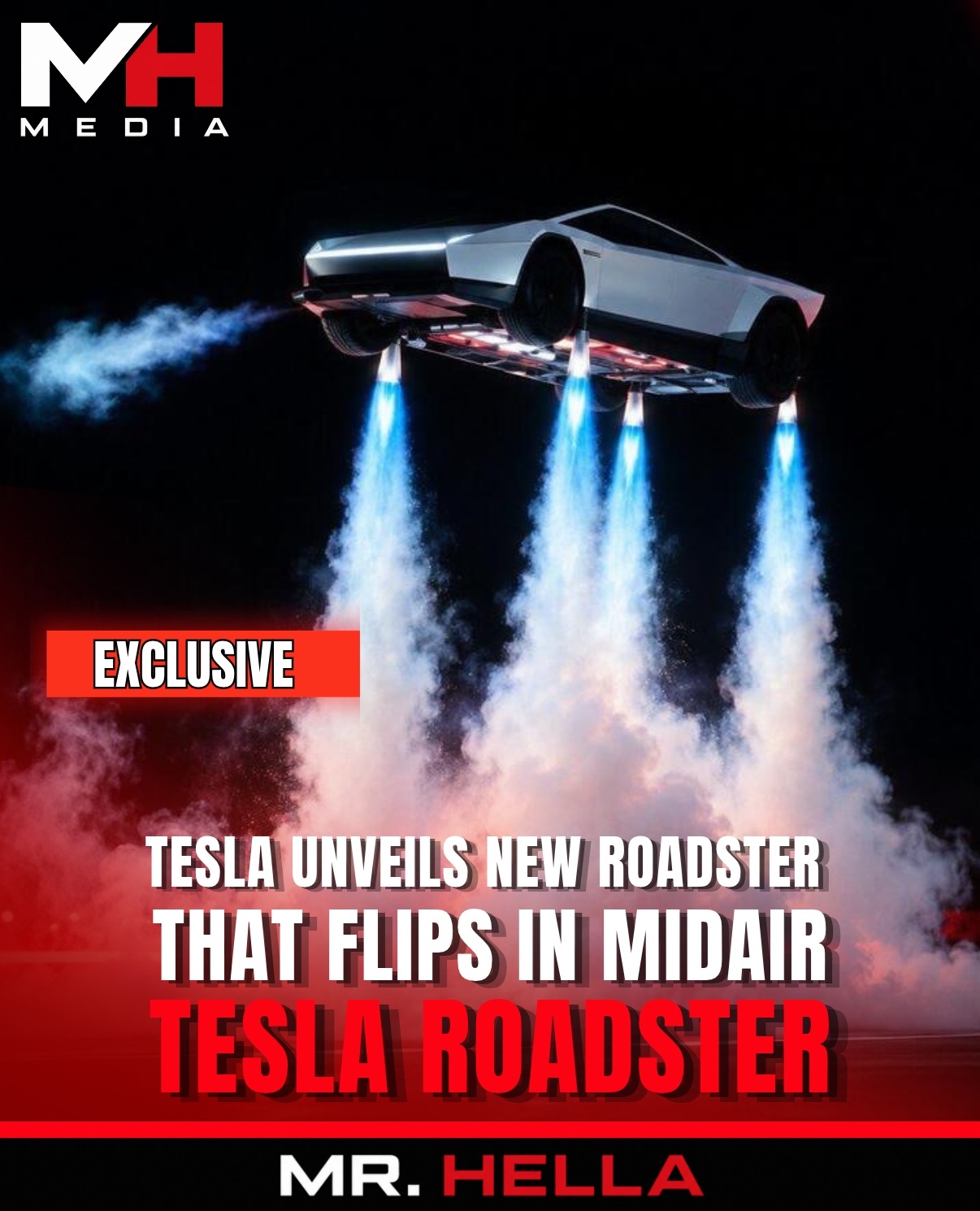
Tesla Unveils Flying Roadster That Flips in Midair, Hits 60 MPH in Under One Second — But the Price Could Shock Buyers
Tesla has finally unveiled its long-awaited next-generation Roadster, and Elon Musk delivered a demonstration unlike anything typically seen at an automotive launch. The electric supercar drove upside down, launched itself into the air, performed a midair flip and landed back on its wheels using technology developed in collaboration with SpaceX.
The dramatic presentation took place October 15, 2026, at SpaceX’s rocket-testing facility in McGregor, Texas, nearly nine years after Tesla first introduced plans for the second-generation Roadster.
During the livestreamed event, Tesla demonstrated a redesigned prototype equipped with high-powered suction fans and compressed-air thrusters capable of briefly lifting and maneuvering the vehicle off the ground. In another demonstration, the Roadster jumped over a lineup of five Tesla vehicles, including the Cybertruck and Cybercab.
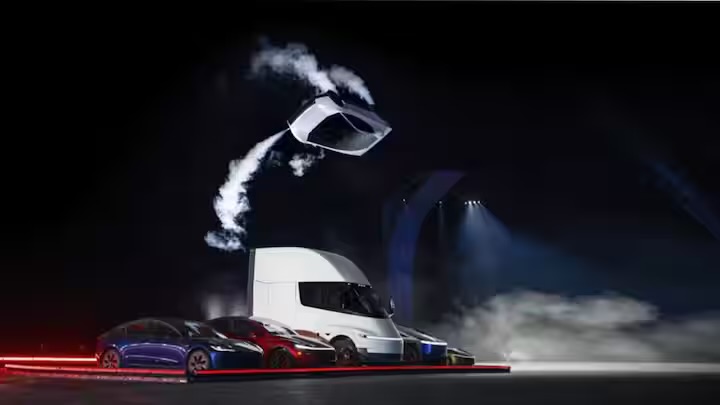
The company also showcased extraordinary acceleration, with the prototype reportedly reaching 60 mph from a standstill in just 0.81 seconds.
But the excitement comes with several important qualifications. Tesla has not announced a final purchase price, production is not expected until 2028, and the most extreme versions of the Roadster may not be legal to drive on public roads.
The unveiling nevertheless marks a significant development for a vehicle that has faced repeated delays since its original announcement in 2017.
Tesla Roadster Performs Midair Flip During Dramatic Reveal
The centerpiece of Tesla’s presentation was a demonstration that blurred the line between an electric sports car and an experimental aerospace vehicle.
A Roadster prototype approached a large curved ramp resembling an oversized Hot Wheels track. As the vehicle climbed the structure, a powerful fan system underneath the car generated suction, allowing it to remain attached to the surface even while traveling upside down.
The vehicle then left the ramp, rotated through the air and used its integrated thrusters to stabilize itself before landing upright.
Tesla’s engineers explained that the system combines aerodynamic downforce with high-pressure compressed air to accomplish maneuvers that conventional automobiles cannot perform.
In a separate stunt, the Roadster used its propulsion system to jump over five Tesla vehicles parked in a row.
The demonstrations were carried out with a prototype under controlled conditions. They should not be interpreted as proof that customers will be permitted to perform aerial maneuvers on public roads.
Tesla also has not demonstrated that the Roadster can sustain conventional flight over meaningful distances. The system shown is designed for brief jumps, airborne maneuvers and extreme performance rather than transportation through the sky like an airplane.
Still, the ability to lift a full-size automobile into the air and control its movement using integrated thrusters represents an unusual engineering achievement.
How the Flying Tesla Roadster Actually Works
Unlike traditional aircraft, the Roadster does not rely on wings or jet engines to achieve its brief airborne movements.
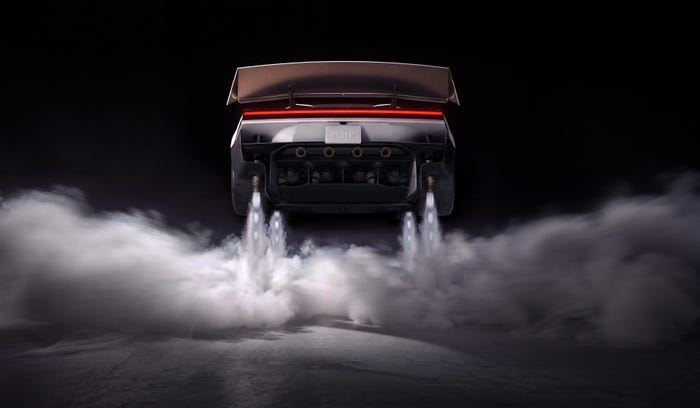
Instead, Tesla worked with engineers from SpaceX to incorporate a system of cold-gas thrusters that release compressed air at high pressure.
The technology generates thrust without combustion, using bursts of stored compressed gas to create forces capable of pushing or repositioning the vehicle.
Tesla engineering executive Lars Moravy explained that the experimental Roadster uses a network of 10 thrusters connected to approximately 600 liters of compressed-air storage.
The thrusters can help propel the vehicle forward, lift it temporarily or control its orientation during airborne maneuvers.
A separate suction system uses high-powered fans to pull air from beneath the car, creating substantial downward force that helps keep it attached to the driving surface.
Tesla claims the suction system can generate approximately two times the force of gravity, helping the Roadster maintain traction even under extreme conditions.
This technology is particularly important for acceleration because conventional tires have physical limitations on how much force they can transfer to the road.
By combining electric propulsion, aerodynamic downforce and rocket-inspired thrusters, Tesla hopes to achieve performance beyond the capabilities of traditional high-performance electric vehicles.
The company has not yet released complete technical documentation or independent test results establishing how the systems will perform under everyday operating conditions.
Tesla Roadster Claims 0–60 MPH in Just 0.81 Seconds
One of the most talked-about figures from the presentation was the Roadster’s acceleration.
Tesla demonstrated a prototype reaching 60 mph in approximately 0.81 seconds, a figure that would put the vehicle among the quickest-accelerating automobiles ever demonstrated.
The result is particularly extraordinary because most production supercars require considerably more time to reach that speed, even with advanced all-wheel-drive systems and powerful electric motors.
Tesla attributes the performance to its combination of electric propulsion and thrust assistance.
The company says the Roadster’s more advanced configurations can accelerate to 60 mph in less than one second, while the standard Performance model will offer exceptionally rapid acceleration without the full rocket system.
However, the 0.81-second result comes from Tesla’s own demonstration. It has not yet been independently verified through standardized third-party testing of a production vehicle.
The company also has not established whether such acceleration could be repeatedly achieved under ordinary driving conditions.
For now, the figure is best understood as a demonstrated prototype result rather than an independently certified production-car specification.
Tesla Roadster Specifications: Speed, Range and Performance
Tesla’s new Roadster differs substantially from the vehicle first unveiled in 2017. While the company has released several headline performance figures, complete production specifications remain unavailable.
Here is what Tesla has announced or demonstrated as of October 16, 2026.
Feature Latest details
0–60 mph As fast as 0.81 seconds in Tesla’s prototype demonstration
Top speed More than 230 mph claimed
Driving range More than 300 miles claimed
Powertrain Fully electric, with optional compressed-air propulsion
Seating One or two occupants, depending on version
Special technology Cold-gas thrusters, suction fans and active aerodynamics
Production target 2028
Final purchase price Not announced
Reservations $50,000 Performance; $250,000 Thrust
Rocket version Invitation only
The range estimate is especially notable because it is substantially lower than Tesla’s original promise. When the second-generation Roadster was introduced in 2017, Musk advertised approximately 620 miles of driving range, along with a top speed exceeding 250 mph and seating for four.
The redesigned vehicle now prioritizes extreme performance and experimental propulsion technology over some of those earlier specifications.
Tesla has not disclosed a final battery capacity, horsepower figure, charging time, curb weight or independently certified range.
How Much Will the New Tesla Roadster Cost?
One of the biggest unanswered questions concerns the price.
Tesla did not announce an official selling price during the October 15 unveiling. However, the company has reopened reservations, revealing the amount prospective buyers must pay to secure a place in line.
The distinction between a reservation deposit and the vehicle’s actual purchase price is important. A $50,000 deposit does not mean the Performance Roadster costs $50,000, just as the $250,000 reservation requirement does not establish the final price of the Thrust model.
When Tesla originally announced the Roadster in 2017, it suggested a starting price of approximately $200,000, with a limited Founders Series priced at $250,000. Those figures are historical references, not confirmed prices for the redesigned 2026 vehicle.
Given the substantial engineering changes and the introduction of specialized propulsion systems, the new Roadster could ultimately cost considerably more. However, any specific price estimate beyond Tesla’s published reservation requirements remains speculative.
Three Versions: Performance, Thrust and Rocket
Tesla plans to offer the Roadster in three configurations, each emphasizing a different level of performance.
The Performance model is intended to be the most conventional version. It seats two people and incorporates advanced aerodynamics and a suction system designed to improve grip during high-performance driving. Tesla describes this version as road-ready, although final regulatory approval and production specifications have not been established.
The Thrust model adds rear-mounted cold-gas thrusters intended to deliver extraordinary straight-line acceleration. Tesla describes the configuration as race-ready, with performance claims that extend beyond conventional electric supercars.
The Rocket model is the most extreme version. It has only one seat and uses 10 thrusters positioned around the vehicle to enable airborne movement and controlled rotation. Tesla describes it as air-ready, but the vehicle has not been approved for ordinary road use.
This distinction is critical for prospective buyers. The Roadster shown performing flips and jumps is not necessarily representative of the version most customers would purchase.
Why the Roadster Has Taken Nearly Nine Years to Arrive
Tesla originally revealed the second-generation Roadster in November 2017, promising a revolutionary electric supercar capable of challenging the world’s fastest production vehicles.
At the time, Musk projected that production would begin in 2020.
That deadline passed without deliveries. The company subsequently shifted attention toward expanding production of its mainstream vehicles, including the Model 3 and Model Y, while also developing the Cybertruck, Tesla Semi and autonomous-driving technology.
The Roadster continued to appear in company presentations and public statements, but its production schedule repeatedly moved further into the future.
Tesla’s priorities have also evolved considerably since 2017. The company now devotes substantial attention to artificial intelligence, robotics and autonomous transportation, including its Optimus humanoid robot and Cybercab.
The October 2026 unveiling represents the most substantial public demonstration of the redesigned Roadster to date, but it is not the same as beginning mass production.
Musk now says production is expected to start in 2028, meaning customers may still have a considerable wait before receiving their vehicles.
Will the Flying Tesla Roadster Be Street Legal?
The Roadster’s most spectacular capabilities also raise significant regulatory and safety questions.
Ordinary passenger vehicles are required to comply with federal motor-vehicle safety standards before they can be sold for use on public roads in the United States.
A car equipped with systems capable of launching it into the air introduces additional questions about vehicle control, occupant protection, surrounding traffic and the safe operation of high-pressure propulsion equipment.
The experimental Roadster’s unusual design, including its specialized thrusters and certain exterior features, may complicate the approval process.
Tesla has not established that the airborne capabilities demonstrated in Texas will be legal for customers to use on public streets.
The company may ultimately need to restrict some functions to closed courses, specialized environments or versions not approved for road use.
For that reason, the Roadster should not yet be described as a commercially available flying car. Tesla has demonstrated a prototype capable of brief controlled airborne maneuvers, not a certified aircraft or a vehicle capable of routine point-to-point flight.
Tesla’s Biggest Roadster Reveal Still Leaves Major Questions
Tesla has succeeded in making the Roadster one of the most talked-about automotive unveilings of the year.
The image of a white electric supercar driving upside down, rotating through the air and landing using rocket-inspired technology is an extraordinary promotional moment, even by Musk’s standards.
The acceleration demonstration is similarly impressive, with Tesla claiming performance that would challenge the limits of conventional automotive engineering.
Yet the company still faces the difficult task of turning the prototype into a reliable, manufacturable vehicle that customers can actually purchase.
Final pricing remains unknown. Independent performance testing has not been completed, and the most extreme propulsion features face unresolved regulatory questions. Production is not scheduled to begin until 2028, more than a decade after the Roadster was first announced.
For now, Tesla has delivered something it has been promising for years: a Roadster capable of leaving the ground.
Whether it can deliver that technology to customers at a practical price, with the performance and safety standards expected of a production automobile, remains the bigger challenge.
The new Roadster can flip through the air. The question now is how much buyers will have to pay—and how long they will have to wait—to own one.



Comments