

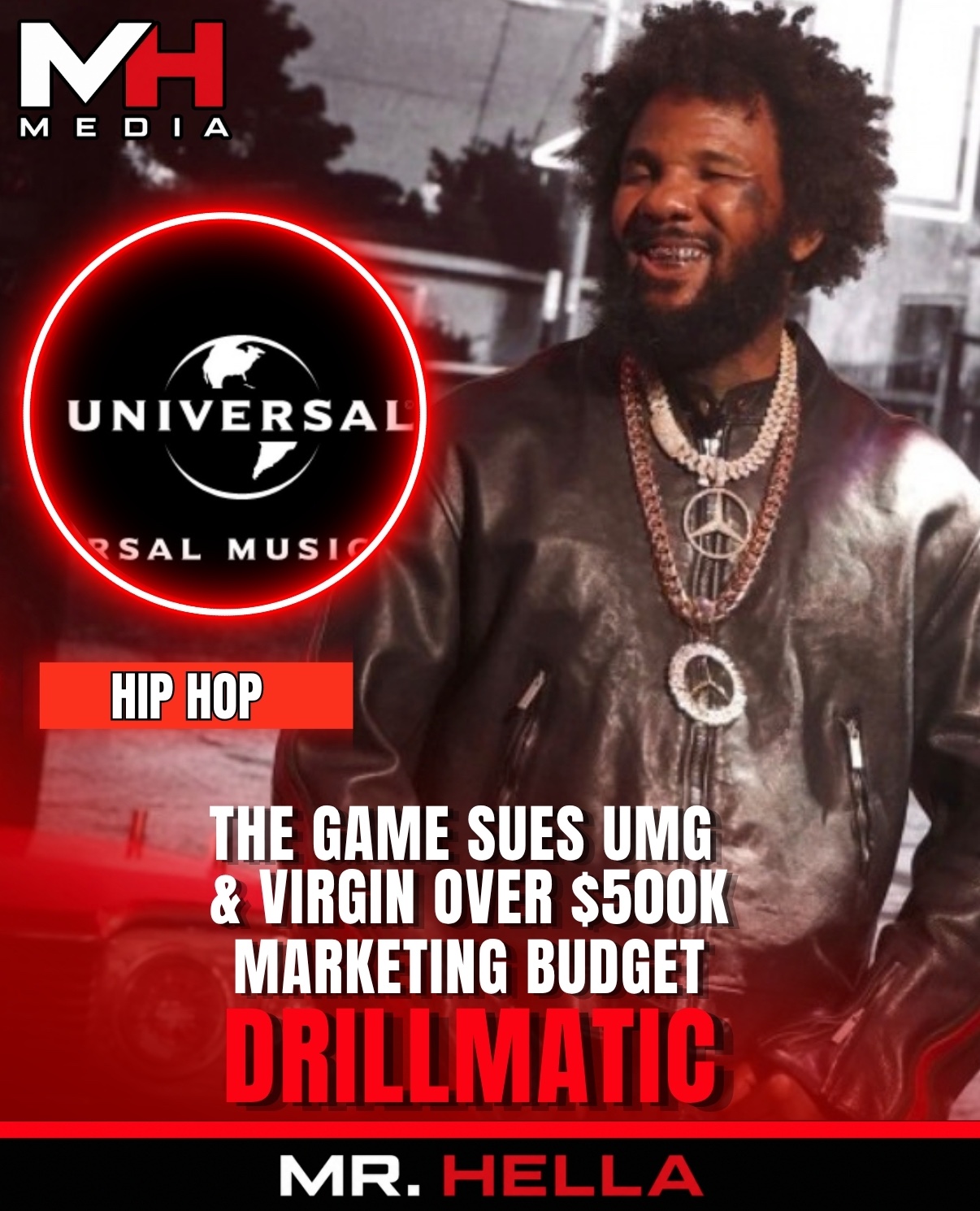
The Game’s independent record company is taking Universal Music Group and Virgin Music Group to court, claiming the companies failed to spend hundreds of thousands of dollars that had allegedly been committed to promoting his sprawling 2022 album, Drillmatic — Heart vs. Mind.
100 Entertainment Inc., the independent label operated by The Game, whose legal name is Jayceon Taylor, filed a breach-of-contract lawsuit Wednesday, September 30, in California Superior Court. The complaint centers on an alleged $500,000 marketing and promotion fund connected to Drillmatic, an album that arrived with 30 songs, nearly two hours of music and a guest list packed with some of hip-hop’s biggest names. (Billboard)
According to the lawsuit, 100 Entertainment had an exclusive distribution arrangement with UMG’s Virgin Music Group for the album, and the parties approved a detailed promotional budget shortly before its August 2022 release. The Game’s company claims that despite the $500,000 budget, only $179,274.79 was ultimately spent — leaving more than $320,000 of the alleged commitment unused during what the lawsuit describes as the album’s crucial release period. (TMZ)
The biggest alleged gap involved radio.
The budget reportedly allocated $125,000 specifically for radio promotion.
According to 100 Entertainment, not a single dollar of that $125,000 was spent. (TMZ)
The Game’s company argues that the shortfall wasn’t merely an accounting dispute. It claims the missing promotional support damaged Drillmatic’s commercial performance, costing the company money from streaming, sales and royalties that it believes the album could have generated with the full campaign behind it. (Billboard)
UMG and Virgin have denied breaching the agreement in previous legal communications, according to the complaint. The allegations have not been proven in court. (Music Times)
The $500,000 Marketing Plan
At the center of the lawsuit is a question that can have enormous consequences in the record business: What happens when an artist and distributor agree on a marketing budget, but the artist’s company claims most of that money never gets deployed?
According to the complaint, the planned $500,000 campaign wasn’t simply a vague promise that the label would “promote” the album.
The money was allegedly divided across specific promotional categories, including music videos, digital advertising, international promotion, out-of-home advertising and radio. (TMZ)
100 Entertainment alleges that the final spending fell dramatically short.
Complex, citing the complaint, reports that $179,274.79 was spent in total. Of that amount, $87,947.58 went toward videos despite an alleged $170,000 video allocation. Other expenditures were spread across digital, international and outdoor promotion. (Complex)
Radio allegedly received nothing.
That is particularly important because radio remained one of the larger individual categories in the promotional plan, with $125,000 allegedly set aside for it.
The lawsuit argues that the parties had already signed off on the broader marketing plan before the album arrived, making the alleged failure to execute that plan a breach of the distribution arrangement rather than simply a disagreement over strategy. (Complex)
The Game Says Nearly Two-Thirds Went Unspent
The numbers form the backbone of 100 Entertainment’s case.
Promised marketing and promotion fund: $500,000.
Alleged actual spending: approximately $179,275.
Alleged amount left unused: more than $320,000.
That means 100 Entertainment claims Virgin and UMG deployed only about 36% of the agreed marketing budget.
The company argues that the missing money mattered because album campaigns are heavily dependent on timing. Promotion months or years after an album’s release doesn’t necessarily have the same value as promotion during the days and weeks when a project is first reaching listeners, playlists, radio programmers and the media.
The complaint says that without nearly two-thirds of the promotional support it expected, Drillmatic suffered “diminished commercial performance.” (Billboard)
The lawsuit’s theory is therefore bigger than simply asking where $320,000 went.
100 Entertainment is claiming the alleged underspending caused downstream financial damage.
The Game’s Company Says It Had to Spend Its Own Money
The lawsuit also alleges that 100 Entertainment was forced to cover expenses that it expected the distribution arrangement to support.
One example involves “Stupid,” The Game’s collaboration with Big Sean.
According to the complaint, 100 Entertainment paid a “substantial portion” of the production costs for the song’s music video to keep the rollout moving and says those expenses still haven’t been reimbursed. (Complex)
That claim gives the dispute another dimension.
100 Entertainment isn’t simply arguing that UMG and Virgin should have spent more money in an abstract sense. It alleges that The Game’s own company had to put additional money into the campaign when the expected promotional funds weren’t deployed.
The album’s official credits confirm that “Stupid” featuring Big Sean was among the tracks supported with a music video. (Apple Music - Web Player)
The Lawsuit Also Takes Issue With Recoupment
Another potentially significant allegation concerns the money that was spent.
TMZ reports that 100 Entertainment claims the promotional money ultimately deployed was recouped from The Game’s royalties. (TMZ)
Recoupable marketing funds aren’t unusual in recording and distribution agreements. Depending on the contract, money advanced for recording, marketing or other expenses can be recovered from an artist’s share of revenue before the artist begins receiving certain royalty payments.
But the lawsuit’s argument is that the full $500,000 promotional fund was supposed to benefit the album campaign.
If only approximately $179,000 was spent while that amount was still recouped from The Game’s side, 100 Entertainment contends it was left without the full promotional campaign it bargained for while still bearing the economic effect of the money that was actually deployed. (TMZ)
The precise contractual language will be important as the case progresses.
‘Drillmatic’ Was Built Like a Major Event
The dispute is particularly striking considering the scale of Drillmatic — Heart vs. Mind.
Released August 12, 2022, the album contained 30 songs and ran for nearly two hours. Apple Music lists the project under 100 Entertainment Inc. and Numinati Inc. (Apple Music - Web Player)
Its guest list was enormous.
The project included appearances from Ye, Lil Wayne, Big Sean, Pusha T, Roddy Ricch, Tory Lanez, Meek Mill, A$AP Rocky, Cam’ron, Rick Ross, Chris Brown, Fivio Foreign, Ty Dolla $ign and French Montana, among others. (Music Times)
For an album carrying that many recognizable names, 100 Entertainment’s lawsuit argues that the missing promotional spending prevented the project from reaching the commercial level it otherwise could have achieved.
That claim will ultimately require more than pointing to the album’s chart position.
The company would have to establish its contractual rights and, to recover damages tied to lost performance, support its contention that the alleged promotional shortfall actually caused measurable financial losses.
‘Drillmatic’ Debuted at No. 12
Commercially, Drillmatic didn’t become the blockbuster its enormous track list and roster of collaborators might have suggested.
The album debuted at No. 12 on the Billboard 200 in August 2022 and spent two weeks on the chart. (Billboard)
TMZ reports the album moved approximately 25,000 equivalent album units during its first week. (TMZ)
The Game’s company now argues those results don’t represent what the project could have achieved with the complete promotional campaign allegedly promised under the distribution agreement.
That is an important distinction.
The lawsuit isn’t claiming marketing guarantees a hit.
It is claiming 100 Entertainment purchased or negotiated for a specific level of promotional support and didn’t receive it — and that the shortfall caused financial damage.
Whether a court accepts the second part of that argument could become one of the most contested issues in the case.
Why the Radio Money Matters
The alleged $125,000 radio allocation stands out because it is both substantial and easy to understand.
100 Entertainment claims zero dollars from that category were used.
Radio promotion in hip-hop can involve a complicated network of legitimate expenditures, including independent promotion, servicing records, coordinating with stations and supporting campaigns designed to increase airplay.
For a project with multiple commercially recognizable collaborators, radio could theoretically have been an important part of extending the album beyond The Game’s established fan base.
But the lawsuit will still have to deal with the difference between opportunity and certainty.
Spending $125,000 on radio wouldn’t guarantee spins.
Spins wouldn’t guarantee streams.
And streams wouldn’t guarantee that Drillmatic would have climbed substantially higher on the Billboard 200.
The Game’s company nevertheless argues that it was deprived of the opportunity it had contracted for.
The Dispute Had Apparently Been Brewing Before the Lawsuit
The September 30 filing doesn’t appear to be the first time the two sides have disagreed over the issue.
According to reporting on the complaint, UMG and Virgin had already denied that they breached the agreement in earlier legal communications with 100 Entertainment. (Music Times)
That suggests the parties attempted to address the dispute before it became a public lawsuit.
Now the disagreement has moved into court, where the precise wording of the distribution agreement, marketing provisions, spending records and communications between the companies could become central evidence.
A UMG representative did not immediately respond to Billboard’s request for comment on the new lawsuit. (Music Times)
The Game Wants at Least $500,000
100 Entertainment is seeking damages of at least $500,000, along with attorneys’ fees and court costs. (Complex)
The company also claims it lost royalties, streaming revenue and album-sales income because of the allegedly underfunded campaign.
Those additional losses are to be established at trial, according to the complaint. (Hip Hop Hero)
The lawsuit therefore doesn’t simply ask for the roughly $320,000 that 100 Entertainment says went unspent.
Its theory is that the alleged breach created broader financial damage that extended beyond the original promotional budget.
That could make the case considerably more complicated if it proceeds into discovery and ultimately reaches trial.
The Case Could Put the Business Behind Album Promotion Under a Microscope
For fans, album marketing can look relatively straightforward from the outside.
An artist announces a project.
Singles arrive.
Videos appear.
Interviews happen.
Advertisements show up.
The album drops.
Behind that public rollout, however, budgets can determine how aggressively a release is promoted and who ultimately pays for that promotion.
The Game’s lawsuit offers an unusually specific look at that process because the dispute isn’t simply over whether a label “supported” an album.
There is an alleged number: $500,000.
There are alleged spending categories.
There is an alleged actual expenditure: $179,274.79.
And there is an alleged radio budget: $125,000, which 100 Entertainment says went completely unused. (TMZ)
Those figures could make the case easier for the public to follow than many music-industry contract disputes.
The more difficult question will be what the contract actually required Virgin and UMG to do with the money.
The Game Has Since Moved Into His Next Album Era
The lawsuit arrives more than four years after Drillmatic was released and only weeks after The Game returned with another major project.
In August 2026, he released The Documentary III, continuing the album series that began with his landmark 2005 debut The Documentary. The newer project debuted at No. 68 on the Billboard 200 after being announced just one day before its release. (Hip Hop Hero)
That means The Game is fighting over the economics of an older album while simultaneously moving forward with the next stage of his career.
But Drillmatic remains significant because of how ambitious the project was.
Thirty tracks.
A long list of major collaborators.
A planned half-million-dollar promotional fund.
And now, four years later, a lawsuit over whether most of that marketing campaign ever happened.
UMG and Virgin Haven’t Been Found Liable
For now, the allegations belong to 100 Entertainment.
Filing a lawsuit doesn’t establish that UMG or Virgin breached their agreement, nor does Drillmatic’s commercial performance prove that insufficient marketing caused its results.
UMG and Virgin have reportedly denied breaching the contract in prior communications. (Music Times)
The case will depend on documents.
The distribution agreement will matter.
The approved marketing plan will matter.
Invoices and promotional spending records will matter.
Emails and other communications between the parties could matter.
And if 100 Entertainment wants compensation for lost sales and streams, it may eventually need to demonstrate how the alleged marketing shortfall translated into actual financial damages.
What is clear is that The Game’s company has now turned a years-old disagreement over the Drillmatic rollout into a formal legal battle.
100 Entertainment says $500,000 was supposed to support the album.
It alleges only about $179,000 was spent.
It claims none of the $125,000 designated for radio was used.
And it says the consequences were felt where artists and labels ultimately measure a release: sales, streams and royalties. (TMZ)
Now The Game’s company wants UMG and Virgin to pay for what it alleges the album lost when hundreds of thousands of dollars in promised promotion never arrived.

Comments