


YNW Melly is heading back to court next month as one of the biggest unresolved issues surrounding his long-delayed double-murder retrial moves toward another critical hearing.
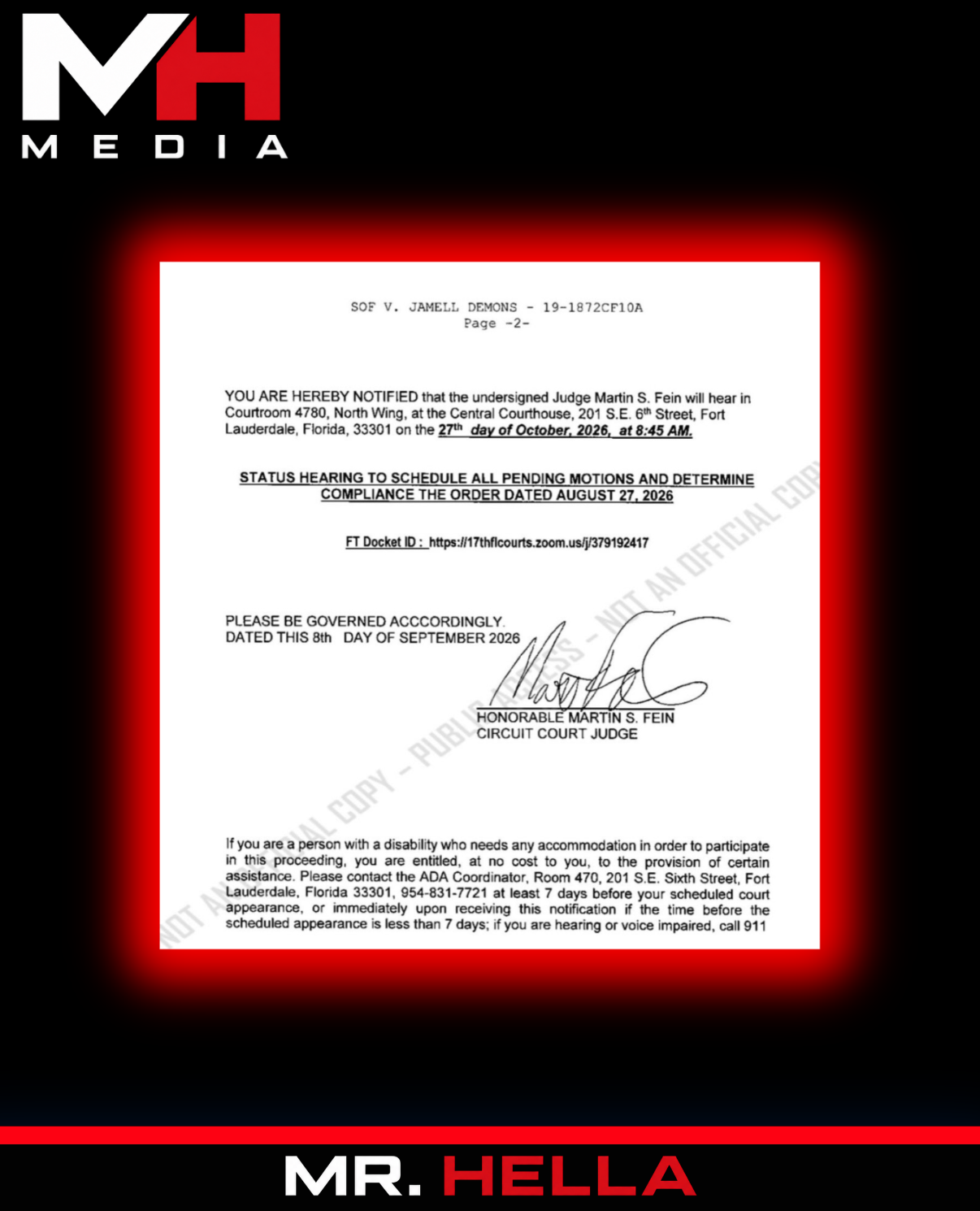
A status hearing for the Florida rapper, whose legal name is Jamell Demons, is scheduled for October 27, 2026, before Broward Circuit Judge Martin S. Fein.
The hearing comes as the court attempts to determine exactly what evidence prosecutors will be permitted to use — and what evidence remains suppressed — when Melly is retried on two counts of first-degree murder in January 2027.
Before the October hearing, both the prosecution and defense have been ordered to identify the evidence affected by previous suppression rulings in the case.
The deadline for those submissions is October 20.
That makes the upcoming hearing much more than a routine scheduling appearance. After years of appeals, suppression litigation, delays and changes surrounding the prosecution, Judge Fein is attempting to establish a clearer evidentiary record before another jury is selected.
Melly’s retrial is currently scheduled to begin January 6, 2027.
Judge Fein Wants Both Sides to Identify the Evidence
The October hearing stems from an August 27 order addressing a problem that has followed the case for years.
Certain evidence was suppressed after the court concluded that law enforcement used overly broad warrants to obtain digital information connected to Melly, including material involving email and social-media accounts.
Those rulings subsequently generated appeals and contributed to the extraordinary delays surrounding the retrial.
Judge Fein’s August order now requires both sides to get specific.
Rather than continuing to argue about suppression in broad terms, prosecutors and defense attorneys must identify the individual evidence they believe is affected.
That means establishing what prosecutors still intend to introduce, what the defense believes the court has already excluded and where disagreements remain.
According to legal analysis of the order, the judge noted that the parties had not fully complied with the original suppression ruling for hundreds of days.
The October 20 deadline is designed to force that issue toward resolution before the retrial begins.
The Digital-Evidence Fight Has Already Changed the Case
The suppression dispute is particularly important because digital evidence played a significant role during Melly’s first trial.
Prosecutors have accused Melly of fatally shooting Christopher “YNW Juvy” Thomas Jr. and Anthony “YNW Sakchaser” Williams inside a vehicle in October 2018 following a recording session in Fort Lauderdale.
The state alleges the shooting was subsequently staged to resemble a drive-by attack.
Melly has pleaded not guilty.
His defense has disputed the state’s theory and maintained that prosecutors cannot prove he was responsible for the killings.
During the first trial, prosecutors relied in part on electronic and digital evidence while attempting to reconstruct Melly’s movements and communications surrounding the night of the shootings.
But subsequent litigation over the warrants used to obtain some of that information produced a major victory for the defense.
An appellate court upheld a suppression ruling involving records obtained through overly broad searches, preventing prosecutors from simply presenting all of the same digital material used during the first trial.
That does not mean all digital evidence in the case has automatically been excluded.
And it does not mean the murder charges have been dismissed.
Instead, the dispute has created a complicated evidence-by-evidence question about exactly what remains legally admissible.
That is what Judge Fein is now trying to clarify.
First Trial Ended Without a Verdict
Melly has been incarcerated since February 2019.
His first double-murder trial finally reached a jury in 2023, but jurors were unable to unanimously determine whether he was guilty.
The judge declared a mistrial after the panel deadlocked.
Because there was no conviction or acquittal, prosecutors retained the ability to try Melly again.
That retrial has repeatedly been delayed as attorneys litigated evidentiary issues and other legal disputes.
The delays have become particularly significant because Melly has remained jailed throughout the process.
By the time his January 2027 retrial begins, assuming the current date holds, he will have spent nearly eight years in custody without having been convicted in the murder case.
The Retrial Has Been Pushed All the Way to 2027
Judge Fein scheduled the retrial for January 6, 2027 after earlier trial dates became impossible amid the ongoing evidence disputes.
The extraordinary delay means the second jury will hear the case more than eight years after Thomas and Williams were killed.
It will also hear a case that could look substantially different from the prosecution presented in 2023.
The biggest reason is the evidence fight.
If material prosecutors relied upon during the first trial remains suppressed, the state will have to construct its second prosecution without portions of that evidence.
The defense, meanwhile, is expected to aggressively challenge any attempt to introduce evidence it believes falls within the previous suppression orders.
That makes the October 27 hearing an important checkpoint.
The judge needs to know what the two sides actually disagree about before those disagreements can be resolved.
Melly Was Denied Bond Again
While waiting for trial, Melly has repeatedly attempted to secure his release from jail.
His attorneys returned to court earlier this year seeking bond, emphasizing the extraordinary length of his pretrial detention and arguing that the prosecution’s case had changed because of the suppression of evidence.
The defense proposed strict release conditions, including extensive monitoring.
Prosecutors opposed the request.
Judge Fein ultimately denied bond, finding that the state’s evidence remained legally sufficient under the standard governing pretrial detention in the capital case.
Melly therefore remains incarcerated while preparing for the January retrial.
The bond ruling should not be confused with a determination of guilt.
Melly continues to be presumed innocent unless prosecutors prove the charges beyond a reasonable doubt at trial.
Witness-Tampering Case Is No Longer Hanging Over Him
Another major change heading into the retrial is that a separate witness-tampering prosecution against Melly was dropped earlier this year.
Florida prosecutors abandoned that case in January.
The dropped charges included allegations involving witness tampering and other related conduct, while prosecutors made clear they were continuing with the original homicide prosecution.
That narrowed the immediate legal fight surrounding Melly.
Instead of simultaneously preparing for separate prosecutions, attention has returned to the case that originally put him behind bars: the deaths of Thomas and Williams.
Bortlen’s Case Has Also Changed
Melly’s former co-defendant Cortlen “YNW Bortlen” Henry is no longer awaiting the same murder trial.
Henry ultimately resolved his case through a plea agreement.
The development further separates the upcoming retrial from the case jurors saw in 2023 and raises additional questions about what evidence and testimony prosecutors may seek to introduce when Melly stands trial again.
Melly, however, continues to contest the murder charges.
His case remains headed toward a new jury.
Why October 27 Matters
Status hearings can sometimes be largely administrative.
This one could have greater significance.
The court is approaching the final months before a January trial in a case that has already been delayed repeatedly.
Judge Fein’s August 27 order indicates that the court wants the prosecution and defense to stop treating the suppression dispute abstractly and identify exactly which pieces of evidence remain contested.
Both sides have until October 20 to comply.
Seven days later, they return to court.
The October 27 hearing is expected to address compliance with the evidence order while also giving Judge Fein an opportunity to review unresolved motions and determine what still needs to be decided before trial.
That could provide the clearest picture yet of what the second Melly trial will actually look like.
The State Still Has to Prove Its Case Again
The prosecution has spent years alleging that Melly killed Thomas and Williams and participated in an effort to make the deaths appear to have resulted from a drive-by shooting.
Melly has spent those same years denying the charges.
The first jury couldn’t reach a unanimous verdict.
The second jury will not simply resume where the first one stopped.
Prosecutors must present the case again, witnesses must testify again, the defense can challenge the state’s evidence again, and a new jury will determine whether the state has proved each charge beyond a reasonable doubt.
This time, however, prosecutors may enter the courtroom with a different evidentiary arsenal.
The suppression litigation has already removed or restricted material that previously formed part of the case.
The question Judge Fein is now demanding both sides answer is straightforward:
Exactly what evidence is left?
By October 20, prosecutors and defense attorneys are expected to put their positions on paper.
On October 27, they return to Judge Fein’s courtroom.
And barring another delay, on January 6, 2027, YNW Melly’s second double-murder trial is finally scheduled to begin.


Comments