

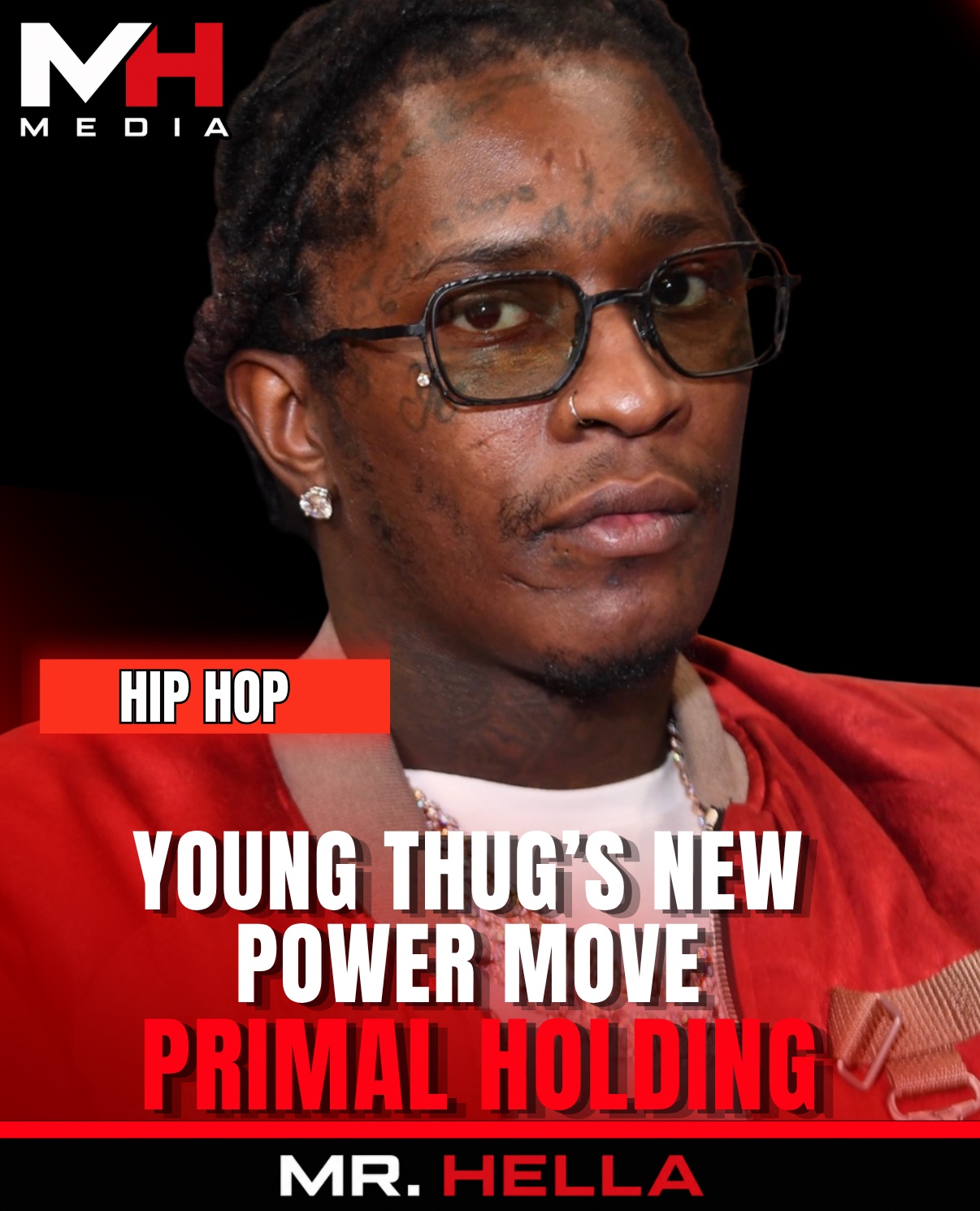
Young Thug is expanding his business ambitions far beyond music with the launch of Primal, a new creative holding company designed to help artists, athletes and creators become owners of the businesses their influence helps build.
The Atlanta rapper formally announced Primal on September 22, describing the company as an alternative to the traditional celebrity endorsement model. Instead of simply paying a famous person to promote a product, Primal intends to create, acquire, invest in and scale businesses alongside talent — giving participating creators an opportunity to hold equity and share in the long-term value.
“I’m bringing up a new generation of founders,” Young Thug said in announcing the company. “I want talent to build, own, and keep the upside. Ownership over endorsements.”
That phrase — ownership over endorsements — is essentially Primal’s entire pitch.
Young Thug isn’t simply launching another management company or celebrity marketing agency. Primal says it will combine capital, intellectual property, creative development, operating infrastructure, partnerships and distribution to build actual standalone companies with artists, athletes and creators positioned as stakeholders rather than hired promoters.
From Celebrity Endorsements to Celebrity Ownership
For decades, one of the most common ways celebrities monetized their fame outside their primary careers was through endorsement deals.
An athlete might appear in a commercial.
A rapper might promote a beverage.
An actor might become the face of a fashion campaign.
The celebrity gets paid, the company gets access to the celebrity’s audience, and the underlying business generally remains somebody else’s asset.
Primal is being built around a different proposition.
Young Thug wants talent to participate in the company itself.
That could mean helping create intellectual property from scratch, investing in an existing operation, acquiring a business or using Primal’s resources to scale something that already has traction.
The financial distinction can be substantial. An endorsement typically produces negotiated compensation for a campaign or relationship. Equity can give a person a continuing economic interest in a company if its value grows, although ownership also carries business risk and does not guarantee a profitable outcome.
Primal’s argument is that culturally influential people are frequently responsible for creating enormous commercial value but don’t necessarily retain enough ownership in what their influence helped create.
“At the highest level, talent has always created value,” Young Thug said. “Primal is about creating the structure for the talent to own more of that value.”
Primal Isn’t Supposed to Be a Traditional Talent Agency
The structure is an important part of the announcement.
Primal isn’t presenting itself as another record label, management company or agency.
It describes itself as a creative holding company.
That means the company intends to participate directly in businesses and intellectual property rather than simply arranging deals between talent and outside brands.
Primal says it can create new IP, acquire existing businesses, deploy investment capital and provide the operational resources needed to turn concepts into functioning companies.
The strategy could put Young Thug and Primal on both sides of the celebrity-business equation.
Instead of finding an artist an endorsement deal with someone else’s company, Primal could potentially help that artist build or own the company being promoted.
The company plans to work selectively with artists, athletes, creators, operators, investors and strategic brands.
Young Thug Had Already Been Teasing the Idea
The formal launch didn’t come completely out of nowhere.
Days before Primal was announced, Young Thug began publicly laying out the philosophy behind the company.
“Marketing is dead,” he wrote in a September 15 post. “That means talent now holds all the power.”
He said he wanted artists, athletes and creators to think beyond “quick bags” and turn their influence into businesses built around ownership and intellectual property.
“Ownership and IP,” he wrote. “That’s PR5MAL.”
At the time, it wasn’t entirely clear what PR5MAL would become.
The September 22 announcement provided the answer.
It wasn’t merely a marketing campaign or another Young Thug brand. Primal was being positioned as the infrastructure through which he wants to develop and invest in creator-led businesses.
SP5DER Provides the Blueprint
Young Thug doesn’t have to look far for an example of the type of creator-led business Primal wants to build.
His own fashion venture, SP5DER, is being presented as proof of concept.
Founded in Atlanta, SP5DER grew from a rapper-associated streetwear label into an internationally recognized fashion and lifestyle brand.
The company expanded well beyond basic artist merchandise, developing its own visual identity and customer base.
In 2026, that expansion reached another level when SP5DER launched a global collaboration with adidas Originals, including a football-inspired collection promoted through a campaign featuring Spanish soccer star Lamine Yamal.
Primal specifically points to SP5DER as evidence that talent can do more than attach a famous name to somebody else’s product.
The creator can build the brand itself.
Primal Wants to Operate Across Multiple Industries
Young Thug isn’t limiting the concept to fashion or music.
Primal says it expects to pursue opportunities across consumer products, sports, entertainment, media, fashion, technology, hospitality and licensing, along with emerging categories that intersect with culture.
That gives the company an unusually broad mandate.
A Primal investment doesn’t necessarily have to involve another rapper or a music-related product.
An athlete with a consumer-product idea could potentially fit.
So could a creator building a media company.
An existing fashion business could potentially be acquired or expanded.
A piece of intellectual property could be developed into a larger enterprise.
The connecting principle isn’t the industry. It’s the ownership structure and the ability of culturally influential talent to help create and retain value.
Fewer Businesses, Bigger Bets
Primal also says it doesn’t intend to become a high-volume celebrity incubator pumping out dozens of products simply because famous people are attached to them.
The company says its portfolio will be intentionally curated.
The strategy is to pursue fewer, larger opportunities where Primal believes its capital, creative resources, partnerships and distribution capabilities can meaningfully accelerate a business.
That approach would distinguish the operation from the long history of celebrity licensing, where a recognizable name is attached to everything from clothing and fragrances to beverages and consumer products without necessarily giving the celebrity meaningful involvement in the underlying company.
Primal’s announced model calls for deeper involvement.
The talent helps create the value.
The talent receives ownership.
Primal provides infrastructure to help turn that influence into a sustainable business.
The First Portfolio Will Be the Real Test
The concept is ambitious, but much of Primal’s track record still has to be built.
The company is newly launched, and it has not yet revealed a large portfolio of ventures demonstrating how its ownership model will work across different industries.
Primal is expected to announce its initial slate of ventures in the coming months.
Those announcements will answer some of the biggest questions surrounding the launch.
Which artists and athletes will participate?
How much equity will talent actually receive?
Will Primal primarily create businesses from scratch, acquire existing companies or invest in growing ones?
How much capital will it deploy?
And how will ownership be divided among Primal, talent, outside investors and operators?
The launch announcement establishes the philosophy, but detailed financial terms for future ventures will depend on the individual deals.
That distinction matters.
Saying Primal is focused on “real equity” does not mean every participant will receive the same ownership percentage or control. Those arrangements will ultimately be determined by the structure of each investment or company.
Young Thug Is Positioning Himself as a Business Builder
The move also represents another expansion of Young Thug’s identity beyond recording artist.
His influence on modern hip-hop is already well established, and he has previously used his position to develop artists through YSL Records.
Primal takes the entrepreneurial side of that strategy into a much broader arena.
Instead of focusing primarily on recording careers, the new company could allow Young Thug to participate in businesses created by people whose influence comes from music, sports, social media and other corners of culture.
The timing is notable because artists and athletes have increasingly looked for ways to turn fame into ownership rather than relying exclusively on salaries, record deals, sponsorship checks and appearance fees.
Primal is explicitly positioning itself around that transition.
The company isn’t arguing that endorsements are disappearing entirely.
It’s arguing that talent should think bigger.
‘Ownership Over Endorsements’
That may ultimately be the most important part of Young Thug’s announcement.
For years, celebrity success outside entertainment was often measured by the size of an endorsement deal.
Primal wants to change the question.
Instead of asking how much an artist was paid to promote the company, Young Thug wants creators asking how much of the company they own.
Instead of taking only a campaign fee, the idea is to participate in whatever long-term value the business creates.
Instead of simply licensing influence, build intellectual property.
And instead of treating artists and athletes exclusively as marketing tools, turn them into founders and equity holders.
“I want talent to build, own, and keep the upside,” Young Thug said.
Now Primal has to prove that model can work beyond the announcement.
Its first slate of businesses is expected in the coming months, and those ventures will provide the clearest indication yet of how Young Thug intends to turn a simple phrase — ownership over endorsements — into an actual portfolio of talent-owned companies.
Comments