

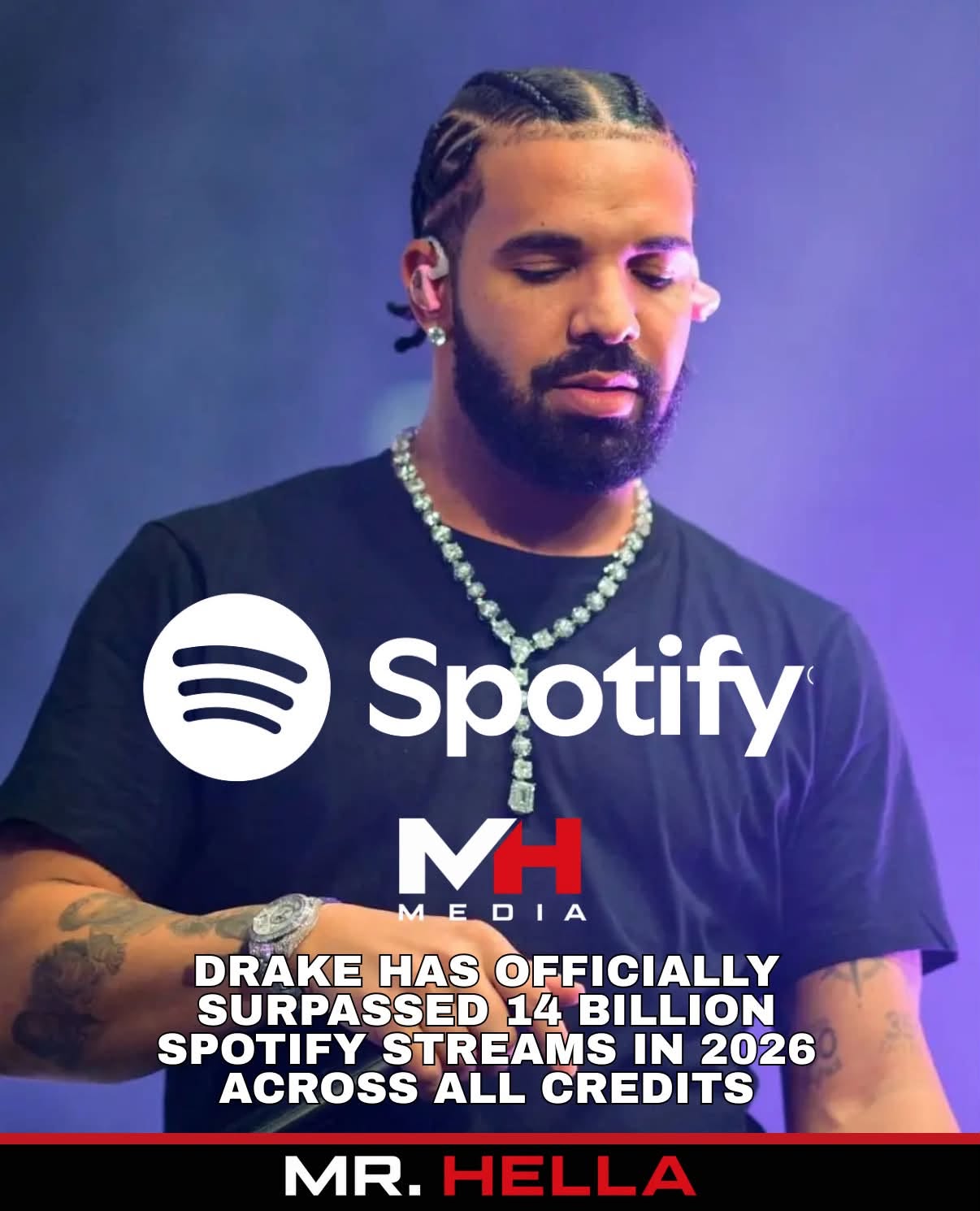
Drake has surpassed 14 billion Spotify streams in 2026 alone, putting the Toronto rapper in position to finish the year with one of the largest annual streaming totals ever recorded by a hip-hop artist and adding another staggering number to a career increasingly defined by its scale on streaming platforms.
By the end of August, Drake had accumulated roughly 14.5 billion Spotify streams across his credited catalog since the beginning of the year, according to streaming data circulated by hip-hop chart trackers. His monthly totals included approximately 1.6 billion streams in January, 1.5 billion in February, 1.6 billion in March, 1.6 billion in April, 2.7 billion in May, 2 billion in June, 1.8 billion in July and roughly 1.75 billion in August. Those figures placed him at the top among rappers during every month of 2026 through August.
The milestone becomes even more remarkable when placed alongside Drake’s career numbers. Around the same period, data compiled by Kworb showed Drake crossing 140 billion Spotify streams across all songs on which he is credited, including his own releases and featured appearances. That made him the first artist in the database to reach the 140-billion threshold and illustrated how his enormous 2026 performance is being powered not only by new releases but by a catalog stretching back more than a decade.
Drake Has Been Spotify’s Most-Streamed Rapper Every Month This Year
The consistency may be more significant than any individual monthly number. Through August, Drake had finished as Spotify’s most-streamed rapper every month of 2026, according to streaming figures circulated by industry and hip-hop tracking accounts. August alone generated approximately 1.75 billion streams across all credits and extended his run as the platform’s most-streamed rapper to 18 consecutive months.
Streaming totals naturally fluctuate depending on new releases, viral songs and major album cycles, but Drake has managed to maintain an unusually large baseline even between major release moments. His catalog contains hundreds of tracks spread across studio albums, mixtapes, collaborative projects, singles and guest appearances, meaning listeners entering through one current song can quickly move into years of older material.
That catalog depth helps explain why comparing Drake's streaming performance with another rapper based solely on one current album can be misleading. A new release may temporarily generate an enormous spike for another artist, while Drake continues collecting streams simultaneously from records released in the 2010s, recent albums and a huge collection of collaborations.
His August numbers arrived after an especially strong May, when Drake generated approximately 2.7 billion Spotify streams during the month. That remains his biggest monthly total of the year so far and helped push his 2026 total dramatically higher.
A Massive Release Cycle Supercharged an Already Enormous Catalog
The biggest acceleration came during Drake's major 2026 release cycle. His new material generated hundreds of millions of streams immediately while simultaneously drawing listeners back toward older portions of his catalog.
ICEMAN became a major component of that surge. The project generated approximately 140.2 million Spotify streams globally during its first 24 hours, according to reported streaming figures, while Drake's accompanying releases pushed his combined opening-day activity substantially higher. ICEMAN went on to surpass one billion Spotify streams within approximately three weeks.
That kind of release has a multiplier effect for an artist with Drake's catalog. Listeners do not necessarily stop after playing the newest album. New music can push older albums back into rotation, send individual songs climbing through playlists and introduce newer listeners to records they may have missed when they were originally released.
For Drake, that means a major release is layered on top of an already unusually high level of daily listening.
Songs such as “One Dance,” “God's Plan,” “Passionfruit” and “Hotline Bling” continue accumulating substantial numbers years after their original releases. By September, “One Dance” alone had surpassed 4.4 billion Spotify streams, while “God's Plan” had exceeded 3.1 billion and “Passionfruit” had moved beyond 2.3 billion.
Those songs are effectively operating alongside Drake's current releases rather than being replaced by them.
His Daily Numbers Show the Size of the Catalog
Around the time Drake crossed the 140-billion career threshold, his catalog was generating approximately 58 million Spotify streams on strong days, according to streaming trackers. Daily totals fluctuate, and they should not be treated as a permanent fixed number, but the scale illustrates how much listening activity Drake can generate even without limiting the calculation to one album or song.
The distinction between lead streams and credited streams is also important when discussing Drake's numbers. His career total includes music released under his own name as well as songs on which he appears as a featured artist. By mid-September, Kworb tracked approximately 141 billion Spotify streams across all Drake credits, with more than 97 billion coming from tracks on which he was the lead artist.
That leaves an enormous portion generated through collaborations—another consequence of Drake's unusually extensive presence across mainstream music.
Over the course of his career, he has appeared alongside artists spanning hip-hop, R&B, pop, dancehall, Afrobeats and Latin music. Those collaborations continue producing streams even when listeners are not specifically searching for a Drake album.
It creates a catalog whose reach extends far beyond his own discography.
The 140 Billion Career Milestone Puts the 2026 Run Into Perspective
Drake's annual total becomes even more striking when compared with the size of his career catalog.
At approximately 14.5 billion streams through August, his 2026 activity represented more than 10% of a 140-billion-plus career total being generated during just eight months of one calendar year. That does not mean all of those listeners were consuming new music. Much of the activity came from older records continuing to be played alongside his newest releases.
The career milestone itself also requires some context. Spotify's own 20th-anniversary data, reflecting streams through April 2026, ranked Taylor Swift as the platform's most-streamed artist historically, followed by Bad Bunny and Drake. The later 140-billion figure circulating around Drake uses Kworb's methodology counting streams across all credited appearances, including features, so the two rankings should not be treated as contradictory measurements without considering how the totals are calculated.
Under the all-credits methodology used by Kworb, Drake had moved beyond 140 billion by late August and continued climbing afterward.
That distinction matters because streaming records frequently circulate online without explaining whether they measure lead-artist streams, solo recordings, featured appearances or every song carrying an artist credit.
Whichever measurement is used, however, Drake's scale remains exceptional.
Older Drake Records Continue Producing Like Current Music
Perhaps the most important component of Drake's streaming dominance is catalog longevity.
“One Dance” was released in 2016. “God's Plan” arrived in 2018. “Passionfruit” dates to 2017. Yet years later, each remains responsible for hundreds of thousands—or in some cases more than a million—Spotify plays on individual days.
That gives Drake something increasingly valuable in the streaming era: a catalog that behaves less like an archive and more like an active collection of current music.
When a new Drake project arrives, it does not have to generate his entire streaming total on its own. It is added to a library containing numerous albums and singles already receiving substantial daily traffic.
The result is cumulative.
A listener might arrive through a new ICEMAN track before playing For All the Dogs, Her Loss, Certified Lover Boy, Scorpion, Views, Nothing Was the Same or Take Care. Each additional play contributes to the same artist-level total even though those records span dramatically different periods of Drake's career.
That helps explain how an artist can generate more than a billion streams in a month without having one individual song responsible for anything close to that number.
Drake's streaming business is no longer dependent on a single hit. It is dependent on the combined activity of an enormous catalog.
2026 Is Becoming One of Drake’s Biggest Streaming Years
The numbers through August leave Drake with four full months remaining in the calendar year after already generating approximately 14.5 billion Spotify streams.
Simply maintaining the pace of his first eight months would push the final number substantially higher, although streaming totals can rise or fall dramatically depending on release schedules and listener behavior. For that reason, any precise year-end projection should be treated as an estimate rather than a guaranteed record.
What is already established does not require a projection.
Drake generated more than 14 billion Spotify streams during the first eight months of 2026. He led rappers on the platform each month during that period. His May total reached approximately 2.7 billion streams, while August still produced around 1.75 billion.
At approximately the same time, his catalog crossed 140 billion Spotify streams across all credited appearances under Kworb's tracking methodology.
Those two numbers tell different parts of the same story.
The 140 billion illustrates how enormous Drake's catalog has become over the course of his career.
The 14 billion illustrates that listeners are still consuming that catalog at an extraordinary rate right now.
More than 15 years after Drake became a mainstream star, his biggest advantage on streaming platforms may no longer be simply his ability to produce another hit. It is that every new hit is being added to one of the deepest and most heavily streamed catalogs in modern music—and in 2026, listeners are continuing to run through virtually every era of it.
Comments