

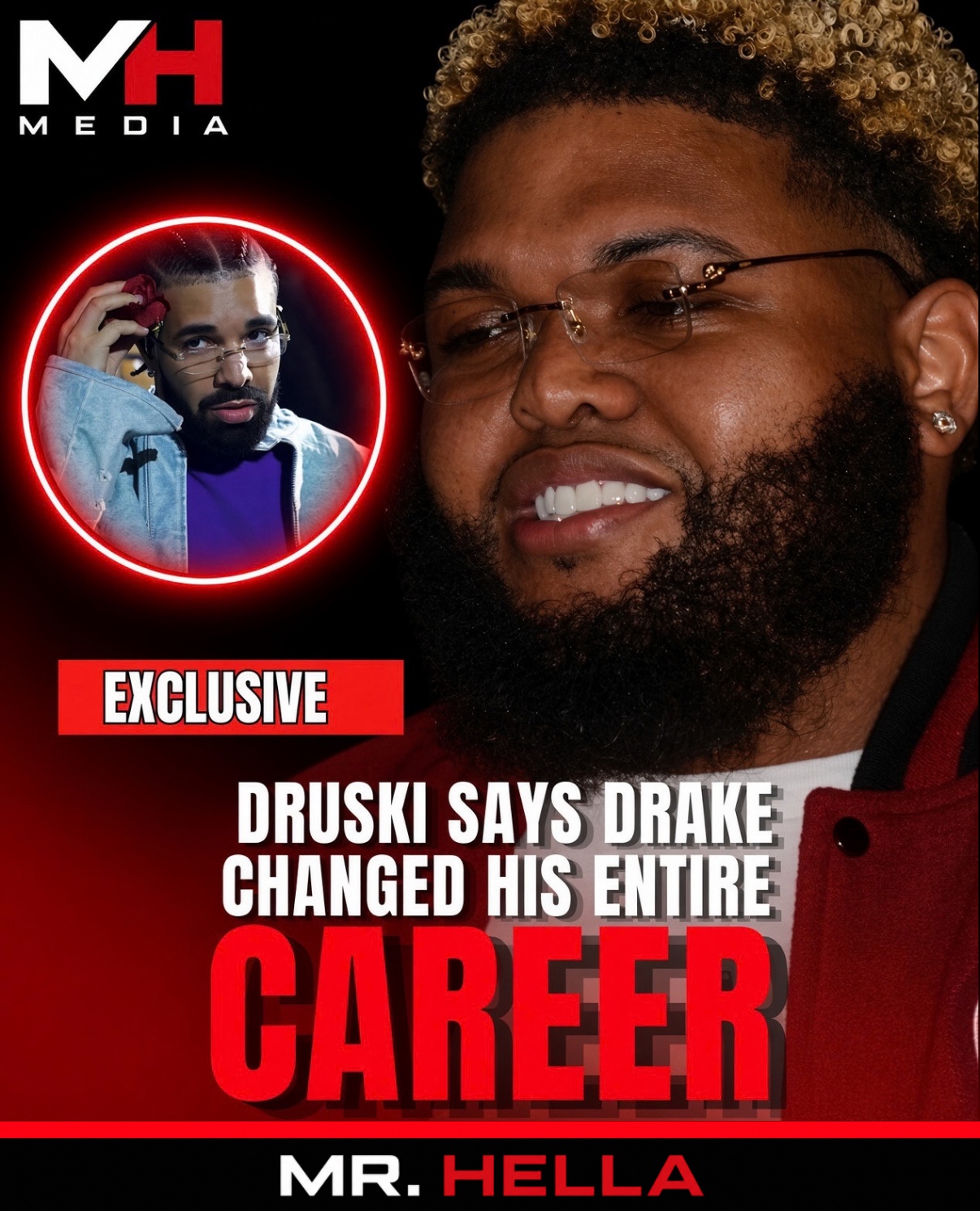
Long before Druski was hosting award shows, selling tickets to arena-sized comedy events and becoming one of the most recognizable personalities on the internet, he was already going viral.
But according to Druski, going viral wasn’t the same thing as making it.
The comedian says the moment that truly changed his career came in 2020, when Drake called and gave him a role in the star-studded music video for “Laugh Now Cry Later.”
“The thing that changed my life at the time was Drake calling for the ‘Laugh Now Cry Later’ music video,” Druski said during a new interview with Steven Bartlett on The Diary of a CEO. “Everything shifted after that because brands started to take me seriously.”
For Druski, the Drake appearance wasn’t simply another viral moment.
It changed how the entertainment business viewed him.
Before the video, Druski said companies were largely offering him the typical perks given to rising internet personalities: free merchandise, invitations and complimentary access to events.
After appearing alongside Drake, Lil Durk and some of the biggest athletes in professional sports, Druski says those conversations became financial.
“Now it’s transactional with everything,” he explained. (PodScripts)
Druski Was Already Building Something
Druski didn’t suddenly become funny because Drake put him in a music video.
By 2020, he had already spent years developing the characters and observational sketches that would eventually become his signature.
His social-media audience was growing, and his videos were circulating far beyond his original following.
But there was still a gap between internet popularity and mainstream entertainment-industry recognition.
That distinction was especially pronounced during the era when Druski emerged.
Social media had created an entirely new class of comedians who could accumulate millions of views without television shows, movie roles or traditional Hollywood representation.
The audience could recognize you before the industry fully understood what to do with you.
Druski was living inside that transition.
He had attention.
What he didn’t yet have was the commercial infrastructure that usually accompanies a conventional celebrity.
Then Drake called.
“Laugh Now Cry Later” Put Him in a Different Room
Released in August 2020, “Laugh Now Cry Later” was one of the biggest records of the year.
The song paired Drake with Lil Durk and eventually peaked at No. 2 on the Billboard Hot 100. It also earned two Grammy nominations. (Radio 88.8 - Demo)
Its video was designed as a celebrity event.
Filmed at Nike’s headquarters in Oregon, the visual featured an extraordinary collection of recognizable names from sports and entertainment.
Kevin Durant appeared.
Odell Beckham Jr. appeared.
Marshawn Lynch appeared.
Lil Durk was there.
And so was Druski.
Druski’s job was essentially to be Druski.
He provided the comedic relief inside a video packed with people who were already household names.
Looking back six years later, he says the company he was suddenly keeping mattered enormously.
“Once I was seen on a higher level” alongside Drake, Durk, Lynch, Durant and Beckham, Druski said, the perception surrounding him changed.
Being the comedian in that particular room communicated something to brands and entertainment executives that millions of social-media impressions apparently had not.
“This meant a lot more than just another music video,” Druski explained. (PodScripts)
Drake Was Already Watching His Content
The opportunity wasn’t random.
According to Druski, Drake had already become a fan of the comedy videos he was posting online.
That detail helps explain why the appearance mattered so much.
Drake wasn’t simply selecting an established television comedian for a cameo.
He was identifying someone who was still emerging primarily through social media and putting him inside one of the biggest music videos in the world.
Druski said he still has difficulty processing that Drake took the chance.
At that stage of his career, the comedian said there wasn’t much real money coming in.
He had momentum, but he hadn’t yet figured out how to turn all of that attention into the kind of income associated with a mainstream entertainer.
The Drake cosign helped solve that problem.
Brands began looking at him differently.
His price increased.
Instead of seeing Druski as one of many comedians making viral videos online, he says companies began viewing him as an actual star.
The shift, according to Druski, happened “almost immediately.” (Complex)
Before Drake, It Was Free Clothes
Druski’s description of his life immediately before the video makes the transformation even clearer.
He recalled living with his mother while his growing internet popularity resulted in companies constantly sending him merchandise.
There were so many clothes arriving that they began piling up in the dining area.
The free products were evidence that brands knew who he was.
But free clothes don’t necessarily create a career.
Druski said he had begun earning enough money to consider getting his own apartment, but the commercial breakthrough hadn’t happened yet.
Companies might send merchandise.
They might invite him to an event.
They might let him inside for free in exchange for an appearance.
What they weren’t necessarily doing was writing serious checks.
After “Laugh Now Cry Later,” Druski says that changed.
The conversation became transactional.
He wasn’t simply an influencer receiving perks anymore.
He was talent.
And talent gets paid. (PodScripts)
The Drake Effect Became a Career Accelerator
The significance of a Drake cosign during that period is difficult to separate from Drake’s position in music.
By 2020, Drake had already spent years as one of the world’s most commercially dominant artists.
His music videos generated enormous audiences.
His collaborations could introduce emerging artists to millions of listeners.
His cultural reach also extended beyond music into sports, fashion, nightlife and internet culture.
For an emerging comedian, appearing organically inside that ecosystem offered something traditional advertising couldn’t easily reproduce.
It was validation.
Druski wasn’t standing beside Drake because a company had purchased an advertisement featuring both of them.
Drake wanted him there.
That distinction gave the cameo cultural credibility.
And brands apparently noticed.
Druski Didn’t Waste the Opportunity
The more important part of the story is what happened after the cosign.
A celebrity appearance can introduce someone to a larger audience.
It can’t guarantee a career.
Druski turned the increased visibility into a much larger entertainment operation.
His characters continued growing online, particularly the fictional Coulda Been Records universe, where Druski plays an outrageous record executive auditioning aspiring artists.
The concept eventually expanded beyond individual social-media sketches.
Coulda Been Records became a recognizable comedy property of its own.
Druski also became increasingly embedded in hip-hop culture, developing relationships with artists while maintaining enough distance to parody the industry’s personalities, executives and aspiring stars.
That positioning helped distinguish him from a conventional stand-up comedian.
Druski wasn’t simply telling jokes about hip-hop.
He became part of hip-hop’s entertainment ecosystem.
From Instagram Sketches to Arenas
The scale eventually became difficult to ignore.
Druski moved into live touring and expanded Coulda Been Records into events capable of drawing significant crowds.
Coulda Fest pushed that concept even further, blending comedy, music and the chaotic fictional universe he had created online.
By 2026, the person Drake had placed in a music-video cameo was operating on an entirely different level.
Druski hosted the 2026 BET Awards.
He received a Webby Special Achievement Award.
He became the first comedian featured on Billboard’s No. 1s issue.
He toured arenas through Coulda Fest.
And his influence spread far enough beyond traditional comedy that he appeared on Justin Bieber’s SWAG album in 2025. (Radio 88.8 - Demo)
That résumé makes his reflection on 2020 particularly striking.
Druski isn’t saying Drake created his talent.
He’s identifying the moment when the business caught up with the audience.
The Difference Between Viral and Famous
Druski’s story also captures something increasingly common in modern entertainment.
Social media can make someone recognizable incredibly quickly.
But recognition and industry power aren’t always the same thing.
A creator can have millions of followers and still struggle to convince traditional companies that their audience has value.
The right mainstream cosign can collapse that gap.
For Druski, Drake apparently did exactly that.
Before “Laugh Now Cry Later,” brands saw an internet comedian worth sending clothes to.
After the video, according to Druski, they saw a star worth paying.
That shift changed his economics.
And once the economics changed, the scale of what he could build changed with them.
Drake Saw Something Early
There’s another side of the story that Druski appears to appreciate more in hindsight.
Drake made the call before Druski became the version of Druski everyone recognizes today.
He wasn’t hosting the BET Awards.
He wasn’t filling arenas.
He hadn’t built Coulda Been Records into the cultural property it later became.
He was a rising comedian making videos online.
Drake was watching.
Druski recalled being stunned that someone he viewed as a megastar had enough confidence in his work to place him inside such a major project.
That early recognition remains meaningful to him six years later.
“I can’t believe he took a chance on me,” Druski said while reflecting on the opportunity. (HOT 97)
Everything Shifted
There are usually several different answers to the question of when somebody became successful.
There is the first viral video.
The first check.
The first celebrity follower.
The first time someone recognizes them in public.
The first sold-out show.
For Druski, however, there appears to be a very clear dividing line.
Before “Laugh Now Cry Later,” he was a fast-rising social-media comedian trying to turn internet attention into a sustainable career.
After it, brands started treating him like a business.
The checks got bigger.
The opportunities changed.
The perception changed.
And the audience expanded.
Six years later, Druski is no longer simply the funny guy who appeared in a Drake video.
He’s one of the biggest comedy personalities to emerge from the social-media generation.
But when asked to identify the moment that changed everything, he still traces it back to the same phone call.
Drake wanted him in “Laugh Now Cry Later.”
And, as Druski remembers it:
“Everything shifted after that.”

Comments