

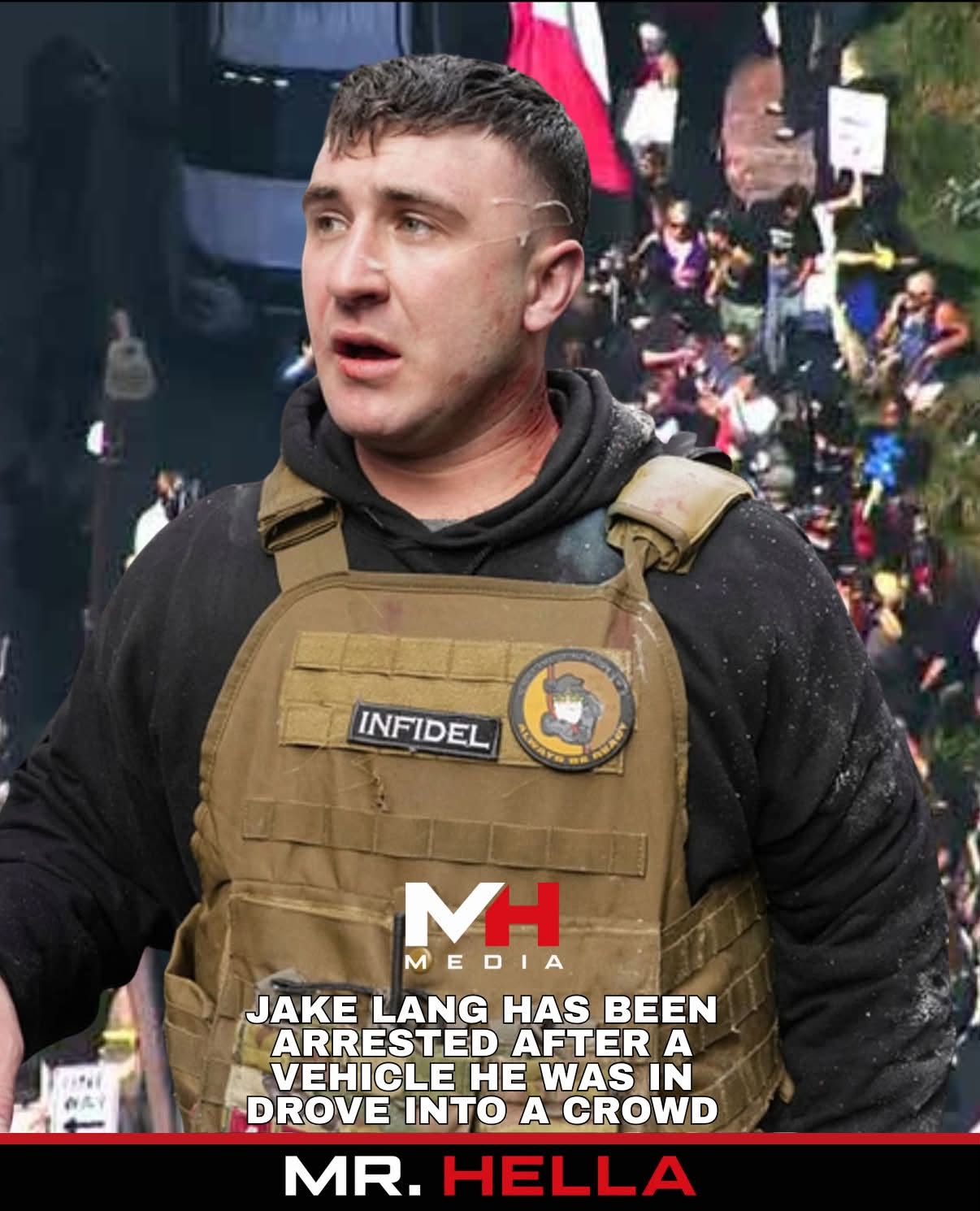
Far-right activist Jake Lang was among 11 people arrested after a planned demonstration outside Minneapolis City Hall descended into chaos, with opposing groups clashing, chemical irritants being deployed and two vehicles driving onto a sidewalk toward a crowd.
The confrontation unfolded shortly before noon on Saturday, August 22, 2026, after Lang arrived near City Hall with six other people traveling in two vehicles.
According to the Minneapolis Police Department, both vehicles illegally drove onto the sidewalk adjacent to City Hall and traveled eastbound at what police described as a “very slow speed” toward people gathered there.
A confrontation erupted almost immediately.
People associated with the vehicles and members of the opposing crowd clashed as officers attempted to separate the groups and move the vehicles away from the sidewalk.
Chemical irritants believed to be mace were deployed during the confrontation, potentially by people on both sides, according to police.
Objects were also thrown.
Three Minneapolis police officers suffered apparent non-life-threatening injuries.
By the end of the incident, police had arrested 11 people, including Lang and all six other occupants of the two vehicles.
But while Lang and the others traveling with him were initially arrested on probable cause of riot, prosecutors later declined to pursue felony charges stemming from the City Hall incident.
Lang Arrived at City Hall Shortly Before Noon
Minneapolis police had known about the planned demonstration for several weeks.
Because authorities anticipated opposing groups gathering in the same area, police developed an incident plan ahead of the event.
That included bringing additional officers on duty, coordinating with other public-safety agencies and installing barriers around City Hall intended to separate demonstrators from vehicle traffic.
At approximately 11:50 a.m., Lang arrived near South 4th Street and 3rd Avenue with six other people.
The group was traveling in two vehicles.
According to MPD's preliminary account, both vehicles then drove illegally onto the sidewalk adjacent to City Hall and proceeded slowly toward the crowd.
That movement triggered an almost immediate confrontation.
Police Say the Vehicles Were Moving at a ‘Very Slow Speed’
The exact description of what the vehicles did is important.
Initial headlines understandably focused on vehicles driving onto a sidewalk toward a crowd.
Minneapolis police confirmed that happened.
But MPD's more detailed statement also specified that the vehicles were traveling at a “very slow speed.”
That doesn't make driving onto a pedestrian sidewalk lawful or eliminate the public-safety concerns created by the situation.
It does, however, provide important context when describing the incident accurately.
Police officers quickly moved in, surrounded the vehicles and attempted to move them away from the sidewalk and crowd.
Video from the scene showed an increasingly chaotic environment surrounding the vehicles.
Counter-protesters crowded around them.
People yelled at one another.
Physical confrontations broke out.
Objects and liquids were thrown.
And chemical irritants eventually filled parts of the area.
Chemical Irritants Were Used by Both Sides
According to Minneapolis police, chemical irritants believed to be mace were deployed during the confrontation.
Investigators initially believed people associated with opposing groups may have used the irritants.
Police said there was no evidence that Minneapolis officers deployed chemical irritants at the scene.
That distinction became important because videos showed people reacting to irritants while officers attempted to regain control.
Interim Minneapolis Police Chief Bill Peterson said the situation developed extremely quickly.
Rather than attempting to arrest Lang and his associates while their vehicles were surrounded by a large and hostile crowd, officers allowed the vehicles to leave the immediate area.
Police described that decision as a de-escalation measure.
Officers then coordinated with other agencies to locate the vehicles away from the crowd.
Both Vehicles Were Tracked After Leaving City Hall
The two vehicles didn't simply disappear.
Law enforcement communicated their direction of travel to other agencies.
Minnesota State Patrol eventually stopped one vehicle near Washington Avenue and southbound Interstate 35W.
Three occupants were arrested.
The second vehicle was stopped by Bloomington police near Lindau Lane and IKEA Way in Bloomington.
Lang and three other occupants were arrested there.
That meant all seven people who had arrived in the two vehicles were ultimately taken into custody.
Both vehicles were impounded.
Police initially arrested the seven occupants on probable cause of riot.
Lang Was Taken to the Hospital Before Jail
Lang was transported to a hospital following his arrest because of an apparent injury.
Police said the injury wasn't caused by his arrest.
After being medically cleared, Lang was booked into the Hennepin County Jail.
The arrest added another chapter to Lang's long history of highly confrontational political activism.
But the legal meaning of the arrest was important from the beginning.
Being arrested on probable cause isn't the same thing as being formally charged or convicted.
Prosecutors still needed to review the evidence and determine whether criminal charges could be proved in court.
That review ultimately produced a major development several days later.
Prosecutors Declined Felony Charges
On August 25, the Hennepin County Attorney's Office announced it would not file felony charges related to the City Hall incident involving Lang.
The reason wasn't that prosecutors approved of his conduct.
Instead, the county attorney's office said its decision resulted from evidence showing communication and logistical coordination between Minneapolis police and Lang's security detail before the event.
After reviewing that evidence, prosecutors concluded there wasn't a viable path to proving felony charges beyond a reasonable doubt.
Hennepin County Attorney Mary Moriarty sharply criticized Lang's conduct while simultaneously explaining that prosecutors were obligated to make a legal determination based on the evidence.
She said declining felony charges did not amount to condoning what occurred.
The office said it couldn't establish the necessary intent required for the potential felony offenses being reviewed.
An Officer Was Struck During the Chaos
The prosecutor's explanation revealed another important detail.
During the incident, a community member fell in front of one of the trucks.
A Minneapolis police officer attempted to assist that person.
The officer feared the driver might not see the person on the ground because of the surrounding crowd and chaos.
During that effort, the officer was struck by the vehicle.
The officer was taken to a hospital and later released.
However, according to the county attorney's office, the officer himself reported that he didn't believe the driver had seen what was happening.
That became legally significant.
A felony assault charge would require prosecutors to establish the necessary intent.
Based on the available evidence—including the officer's own account—prosecutors concluded they couldn't prove that intent beyond a reasonable doubt.
Three Officers Were Injured
In total, Minneapolis police reported that three officers suffered apparent non-life-threatening injuries during the confrontation.
One was transported to a hospital for evaluation and later released.
Officers were also struck by thrown objects while attempting to move the vehicles away from the sidewalk.
Police additionally took a report from a man who said he had been assaulted outside City Hall.
Investigators continued reviewing video and other evidence after the crowd dispersed.
MPD said additional arrests or charges remained possible as the investigation continued.
Four More People Were Arrested Around City Hall
The seven occupants of Lang's two vehicles weren't the only people arrested.
Police made four additional arrests in connection with the confrontation around City Hall.
Those arrests involved allegations ranging from disorderly conduct to assault.
That is an important part of the story because the violence wasn't described by police as coming exclusively from one group.
Authorities reported confrontations involving opposing sides.
Chemical irritants were potentially deployed by people associated with both sides.
Objects were thrown at officers.
And physical confrontations occurred around the vehicles.
By approximately 2 p.m., police said the remaining crowds had dispersed and the area had cleared.
Why Lang Was in Minneapolis
Lang's demonstration didn't emerge randomly.
He had promoted his return to Minneapolis in advance.
According to local reporting, Lang said he was coming to advocate for Shiloh Hendrix, a Rochester woman whose confrontation with a Black autistic child had generated national controversy after she was recorded using a racial slur.
Hendrix was later convicted on one misdemeanor disorderly-conduct count connected to an interaction with the person recording the incident, while being acquitted on another count.
Lang had publicly promoted the Minneapolis demonstration as a free-speech rally.
Counter-protesters organized in response.
By the time he arrived, hundreds of people were reportedly gathered in the area.
The demonstration therefore began with substantial tension already surrounding it.
Lang Displayed an Explicit Racial Slur
Local reporting from the scene documented Lang displaying a large sign containing the N-word while riding in or on one of the vehicles.
That intensified an already hostile atmosphere between Lang's group and counter-protesters.
The Minnesota Star Tribune reported that Lang raised the sign as the vehicle moved onto the City Hall sidewalk.
The racial messaging was part of why city officials had strongly condemned the planned demonstration before it happened.
Minneapolis Mayor Jacob Frey had publicly urged residents not to give the event additional attention.
Frey argued that ignoring the rally would deny Lang the confrontation and publicity he appeared to be seeking.
The strategy didn't work out that way.
Large numbers of counter-protesters showed up, and the situation ultimately became a significant police incident.
Mayor Jacob Frey Condemned Lang
After the confrontation, Frey issued a statement describing Lang as a far-right extremist and racist.
The mayor emphasized that Minneapolis would protect people's constitutional right to peacefully express offensive or hateful views while also requiring demonstrators to obey the law and respect public safety.
Frey thanked Minneapolis police and assisting law-enforcement agencies for responding to the confrontation and making arrests.
He later said that people who drove onto sidewalks, endangered public safety or incited violence should expect police intervention.
Those comments reflected the city's position immediately after the incident.
The subsequent charging decision, however, illustrates the distinction between an arrest based on probable cause at a chaotic scene and prosecutors later determining what charges can actually be proved beyond a reasonable doubt.
Lang Was Pardoned for His January 6 Case
Lang was already nationally known because of his involvement in the January 6, 2021 attack on the U.S. Capitol.
Federal prosecutors accused him of participating in violence against police during the riot.
He spent approximately four years incarcerated while his federal case was pending.
That prosecution ultimately changed dramatically after Donald Trump returned to the presidency in January 2025.
Trump issued sweeping clemency for people charged or convicted in connection with January 6.
Lang received a pardon and was released.
The pardon ended his federal January 6 prosecution, but it did not prevent him from being arrested or prosecuted for alleged conduct occurring afterward.
Lang subsequently became increasingly visible through rallies and political activism around the country.
This Wasn't Lang’s First Recent Minnesota Arrest
Lang had already encountered Minnesota law enforcement earlier in 2026.
In March, he was arrested after destroying an ice sculpture outside the Minnesota State Capitol.
The sculpture displayed a political message criticizing Immigration and Customs Enforcement.
Lang faced charges related to that incident.
He had also previously attempted to organize another controversial Minnesota demonstration.
His repeated appearances in the state have frequently generated much larger counter-protests than the groups accompanying him.
That pattern continued outside Minneapolis City Hall.
The Minneapolis Rally Became Exactly the Confrontation Officials Feared
Before the event, Minneapolis officials understood that Lang's appearance could draw a substantial counter-protest.
Police prepared barriers.
Extra personnel were assigned.
Other agencies were placed on standby.
Yet the confrontation still developed rapidly once the vehicles arrived.
The decision to drive onto the sidewalk brought Lang's group directly into close proximity with the crowd.
Counter-protesters surrounded the vehicles.
Chemical irritants were deployed.
Objects were thrown.
People fought.
Officers were injured.
And the situation became sufficiently unstable that police decided making immediate arrests inside the crowd would create additional danger.
Instead, they moved the vehicles out and arrested the occupants elsewhere.
From a public-safety perspective, the strategy ended the immediate confrontation.
From a legal perspective, however, the events became much more complicated once prosecutors reviewed what happened before the vehicles arrived.
Prior Police Coordination Became Crucial
The Hennepin County Attorney's decision reveals why early descriptions of criminal incidents can change as more evidence becomes available.
On August 22, police had probable cause to arrest Lang and the other occupants for riot.
Three days later, prosecutors had access to more evidence.
That included communications and logistical coordination between MPD and Lang's security detail.
Prosecutors concluded that evidence prevented them from proving the intent necessary for felony prosecution beyond a reasonable doubt.
Those two conclusions aren't necessarily contradictory.
Police make arrest decisions based on the information and circumstances available at the time.
Prosecutors later apply a different standard when deciding whether they can successfully prove a criminal charge in court.
In Lang's case, the prosecutor ultimately concluded the felony standard couldn't be met.
That Doesn't Necessarily End the Case
Declining felony charges doesn't automatically mean no criminal case can result from the incident.
The Hennepin County Attorney specifically noted that its decision doesn't prevent the Minneapolis City Attorney from considering applicable misdemeanor or gross-misdemeanor charges.
That means Lang's August 22 arrest and the events surrounding it could still produce lower-level criminal allegations depending on the city attorney's review.
But it would be inaccurate to report today that Lang currently faces felony riot charges from the City Hall confrontation.
He was arrested on probable cause of riot.
The county prosecutor subsequently declined felony prosecution.
Those are two distinct legal events.
The Incident Shows How Quickly Political Demonstrations Can Escalate
The Minneapolis confrontation lasted only a relatively short period.
Yet within that window, two vehicles entered a pedestrian area.
Counter-protesters surrounded them.
Chemical irritants were deployed.
Objects were thrown.
People physically confronted one another.
Police officers were injured.
Eleven people were arrested.
And multiple law-enforcement agencies became involved.
The episode also demonstrated how political demonstrations increasingly play out simultaneously in two environments.
One is physical.
The other is online.
Videos from Minneapolis began spreading almost immediately, with different clips being used by opposing political communities to argue dramatically different versions of what happened.
The police investigation required something more methodical: reviewing video, witness statements, officer reports and communications that occurred before the confrontation.
That evidence ultimately affected the charging decision.
The Arrest Made Headlines, but the Charging Decision Matters Just as Much
The images from August 22 were dramatic.
Jake Lang arrived at Minneapolis City Hall.
His group encountered a large crowd of counter-protesters.
Two vehicles drove onto the sidewalk.
People surrounded them.
Mace was deployed.
Objects flew.
Police rushed in.
And Lang was later arrested.
Those facts generated immediate national attention.
But the story didn't end with the arrest.
After reviewing the evidence, the Hennepin County Attorney's Office declined to file felony charges connected to the incident, saying prosecutors couldn't prove the necessary intent beyond a reasonable doubt because of prior communication and logistical coordination between police and Lang's security detail.
Lower-level charges remained legally possible.
That distinction is critical.
Lang was arrested.
The confrontation was real.
Eleven people were taken into custody.
Three officers were injured.
But an arrest is not a conviction—and in this case, the prosecutor responsible for felony charging ultimately determined that the evidence didn't support taking those felony allegations forward.
Comments