

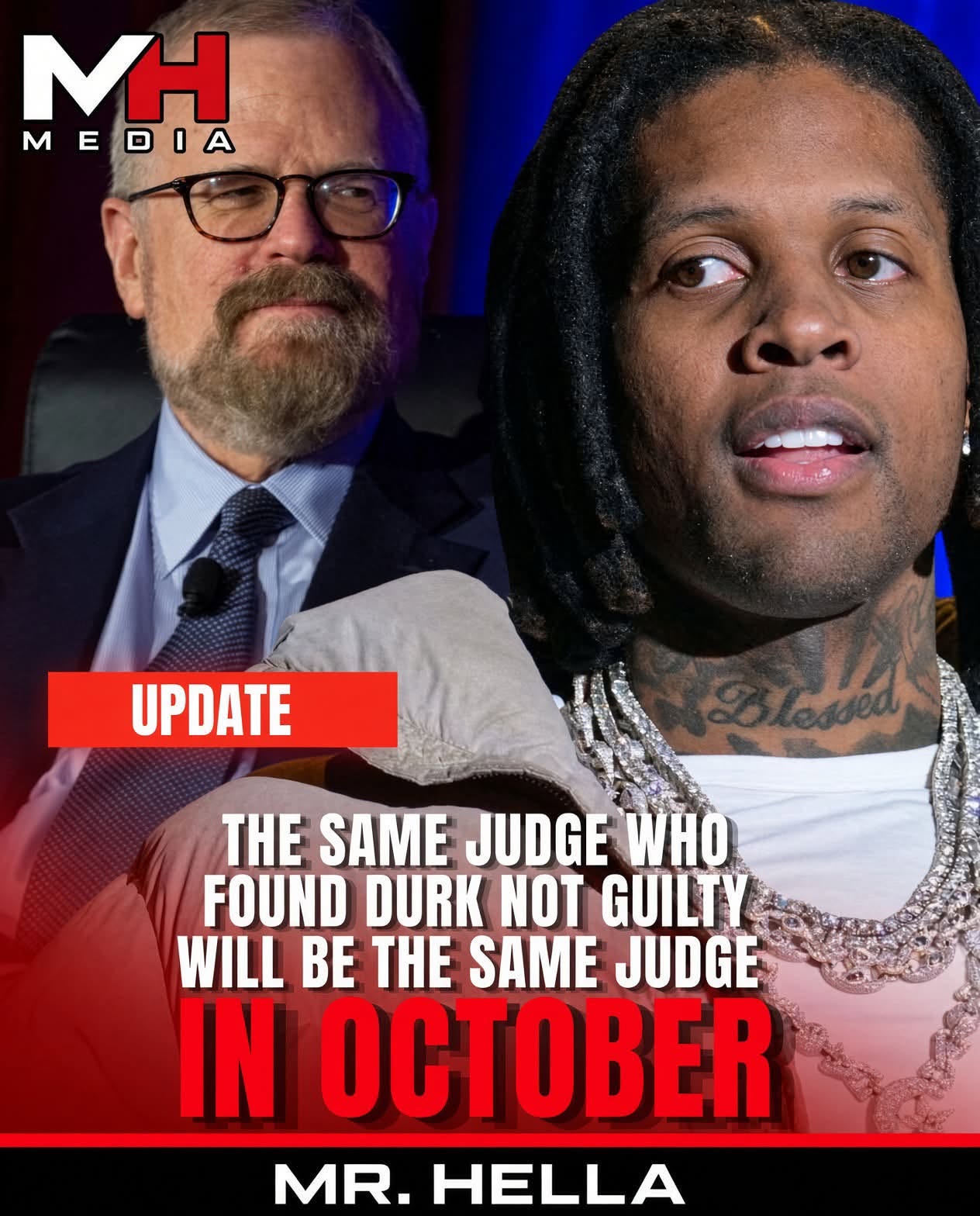
Lil Durk will see a familiar face on the bench when he returns to federal court for his next major criminal trial.
U.S. District Judge Michael W. Fitzgerald, the same judge who presided over Durk’s recently completed murder-for-hire trial in Los Angeles, is set to oversee the rapper’s separate federal case involving murder-related racketeering and firearms allegations.
The assignment means Durk will return before a judge who has already spent weeks overseeing testimony, evidence and legal arguments involving the rapper, his Only the Family organization and several of the people prosecutors have accused of participating in violent crimes connected to OTF.
Fitzgerald presided over Durk’s first trial, which ended Sept. 11 when a federal jury acquitted the Grammy-winning rapper on all five counts against him.
Durk, whose legal name is Durk Banks, was cleared of conspiracy to commit stalking, stalking with a dangerous weapon, stalking resulting in death and two murder-for-hire-related counts stemming from the August 2022 shooting that killed Saviay’a “Lul Pab” Robinson while allegedly targeting rapper Quando Rondo.
That verdict ended one federal prosecution.
It did not end Durk’s legal battle.
Fitzgerald Will Be Back on the Bench
Durk remains in federal custody because he faces a separate case involving murder-related racketeering and firearms charges. The second trial is currently listed for Oct. 5, although subsequent reporting indicates that date was tentatively set immediately following the acquittal and could still change.
Fitzgerald is set to preside over that proceeding as well.
The judge’s continued involvement is notable because he is already deeply familiar with the government's broader prosecution of Durk and OTF.
Earlier in the litigation, Fitzgerald scrutinized prosecutors' effort to bring allegations involving a separate Chicago killing into the Los Angeles prosecution. When the government pursued an additional indictment, Fitzgerald openly questioned whether prosecutors were attempting to strengthen the Los Angeles case by tying the two matters together.
Fitzgerald said he was concerned about fairness and emphasized that his responsibility was to make sure both the government and defendants received a fair trial.
The cases ultimately remained separate.
That decision became considerably more significant after Durk was acquitted in the first trial.
First Jury Cleared Durk on Every Count
Prosecutors had accused Durk of orchestrating and financing a plot to kill Quando Rondo in retaliation for the 2020 killing of Durk’s close friend and fellow Chicago rapper King Von.
The August 2022 attack near the Beverly Center in Los Angeles missed Rondo but killed his cousin, Robinson.
Durk denied ordering the shooting.
His attorneys argued that a murder plot existed but maintained that Durk had no knowledge of it and blamed former associate Kavon Grant for organizing the attack without the rapper's involvement.
After hearing weeks of testimony, jurors deliberated for three days before finding Durk not guilty on every charge he faced.
Two co-defendants, Deandre Wilson and David Lindsey, were also acquitted of the murder-for-hire allegations but were convicted on stalking-related counts.
Fitzgerald warned the packed courtroom to maintain order before the verdict was announced. Durk began wiping away tears as the not-guilty verdicts were read.
Despite the complete acquittal, Durk did not leave the courthouse a free man.
Second Case Focuses on Different Allegations
The upcoming prosecution is separate from the failed attempt to kill Quando Rondo.
Prosecutors are pursuing murder-related racketeering and weapons allegations tied to their broader theory surrounding OTF. Durk has pleaded not guilty and remains presumed innocent of the pending charges.
The government has alleged that OTF was not merely a legitimate music organization but also functioned as a criminal enterprise involved in violence and other crimes.
Those allegations remain just that—allegations. Durk’s acquittal in the Los Angeles murder-for-hire case did not decide the pending racketeering-related charges, and prosecutors will have to prove the separate case beyond a reasonable doubt.
The government will also be returning to a courtroom overseen by a judge already intimately familiar with its investigation.
Fitzgerald Previously Challenged Prosecutors
Fitzgerald’s earlier comments about the government's charging strategy could receive renewed attention as the second trial approaches.
When prosecutors sought to introduce the additional allegations, Fitzgerald questioned why they had not more aggressively pursued admission of evidence involving the Chicago incident during the original Los Angeles case.
He characterized the superseding indictment as an attempt to have the Chicago allegations influence the Los Angeles prosecution and expressed concern that combining the matters could become unfair.
Those comments did not amount to a ruling on whether Durk committed any of the alleged crimes. They concerned how the government structured its prosecution and what evidence could fairly be presented to a jury.
Now Fitzgerald is positioned to oversee the separate case itself.
That gives the next proceeding an unusual degree of continuity: the same federal judge, some overlapping defendants and a broader prosecution involving many of the same alleged OTF connections—but a different set of criminal allegations for jurors to decide.
Bond Hearing Also Set Before Fitzgerald
Durk’s attorneys are simultaneously trying to secure his release from federal custody.
On Sept. 18, Fitzgerald ordered a bond-review hearing for Nov. 4 and directed U.S. Probation and Pretrial Services to provide an updated bail report.
The timing creates some uncertainty because the second trial is presently listed for Oct. 5, roughly a month before that bond hearing.
The October trial date therefore remains something to watch rather than a date that should be treated as immovable.
What is clear is that Durk’s acquittal ended only the first chapter of his federal prosecution.
The rapper beat every charge placed before the jury in the murder-for-hire case, but he remains in custody while preparing to defend himself against a separate set of allegations.
And when that case reaches the courtroom, Judge Michael W. Fitzgerald—the judge who watched Durk’s first federal jury clear him on every count—is set to be behind the bench again.

Comments