

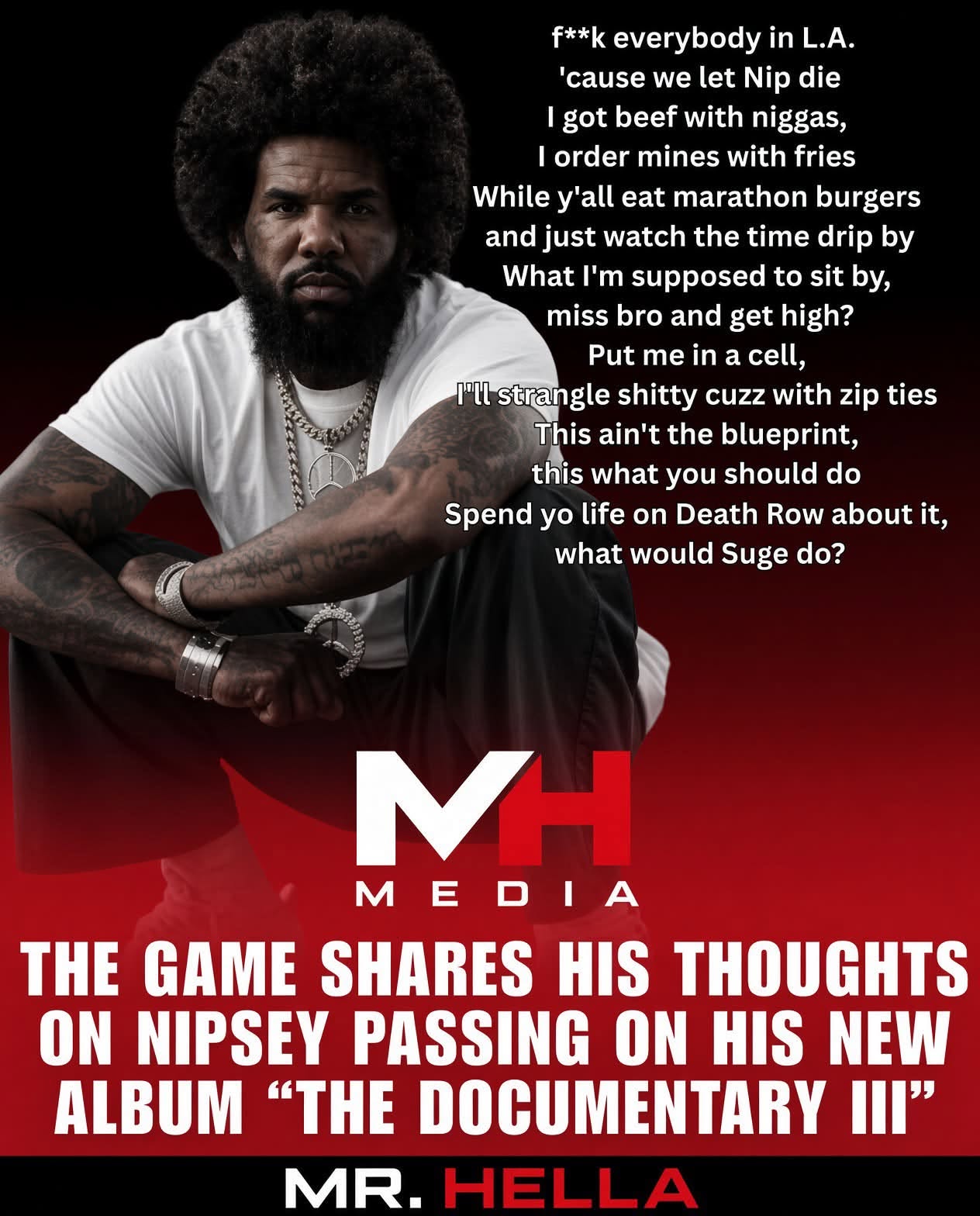
Behind the superstar collaborations, West Coast anthems and nearly 90-minute runtime of The Game's new album The Documentary III sits one of the project's darkest and most personal records.
“Nothing 2 Hide,” the album's 18th track, strips away much of the bravado normally associated with The Game and replaces it with something considerably heavier.
Depression.
Death.
Family.
Regret.
Financial pressure.
Fame.
And thoughts about whether continuing to live is even worth it.
Across the record, the Compton rapper opens up about the emotional weight accumulated throughout more than two decades in hip-hop, offering listeners a much different version of the man behind The Documentary.
While some listeners have connected the song's themes of death and grief with The Game's well-documented heartbreak following Nipsey Hussle's 2019 murder, “Nothing 2 Hide” is broader than a single loss.
Instead, it sounds like an inventory of everything The Game has been carrying.
The Game Opens Up About Depression
The emotional center of “Nothing 2 Hide” is The Game discussing his mental health with unusual directness.
Rather than presenting depression as something abstract, he describes the experience as something capable of following him despite his fame, money and accomplishments.
That contrast is significant.
From the outside, The Game has lived the kind of life many aspiring rappers dream about.
Platinum records.
Grammy nominations.
Worldwide tours.
Celebrity friendships.
Luxury cars.
Massive homes.
More than two decades of relevance in one of music's most competitive genres.
But “Nothing 2 Hide” repeatedly undermines the assumption that those accomplishments automatically create happiness.
The record presents someone who has achieved enormous professional success while still dealing with emotional pain that material success cannot necessarily resolve.
The Song Goes Into Extremely Dark Territory
The most striking portions of “Nothing 2 Hide” involve The Game addressing thoughts surrounding death and suicide.
Those moments make the song considerably heavier than a typical introspective rap record.
The Game isn't simply saying he had a bad day or went through a difficult period.
He describes reaching points where the pressure surrounding his life became psychologically overwhelming.
That vulnerability stands in sharp contrast with the aggressive persona listeners have associated with him throughout much of his career.
For an artist who built his reputation through confrontational records, street narratives and rap battles, openly acknowledging emotional vulnerability creates an entirely different kind of intensity.
There is no opponent to defeat.
The battle is internal.
More Than 20 Years of Loss Sit Behind the Record
The Game has experienced an extraordinary amount of death throughout his life and career.
Long before becoming famous, he grew up around gang violence in Compton.
As his career expanded, he continued losing people connected to his personal and professional life.
Some were childhood friends.
Some were fellow artists.
Some were people he considered family.
And one of the most publicly devastating losses was Nipsey Hussle.
Nipsey was murdered outside his Marathon Clothing store in South Los Angeles on March 31, 2019.
He was 33 years old.
The killing sent shockwaves throughout hip-hop, but The Game's response was particularly emotional.
The two rappers shared more than geography.
They represented different generations of Los Angeles hip-hop and had developed a close personal relationship.
Nipsey Hussle's Death Hit The Game Extremely Hard
Following Nipsey's murder, The Game repeatedly expressed his grief publicly.
He posted emotional messages.
He spoke about Nipsey's impact.
He visited areas associated with the late rapper.
And during the weeks immediately following the killing, The Game documented himself driving through Los Angeles in the middle of the night while struggling to process what had happened.
At one point, he described waking up around 4 a.m. and driving down Slauson Avenue because he couldn't sleep.
The behavior became part of what he described as his attempt to cope with the loss.
His grief wasn't limited to a single tribute post immediately after Nipsey died.
The Game continued talking about him months and years later.
That is why listeners hearing The Game discuss death, depression and losing people on a song like “Nothing 2 Hide” may naturally connect some of those emotions with Nipsey.
But it is important to distinguish that broader emotional context from saying the song itself is specifically about Nipsey Hussle.
The Game and Nipsey Shared a Long History
Their relationship stretched back years before Nipsey became a Grammy-winning household name.
The Game was already an established Los Angeles rap superstar when Nipsey was emerging from the city's independent mixtape scene.
Rather than treating the younger rapper purely as competition, The Game embraced him.
They collaborated musically.
Nipsey appeared on “They Roll,” from The Game's 2008 album LAX.
Years later, they reunited on “Welcome Home,” a record appearing on The Game's 2019 album Born 2 Rap.
That song became particularly emotional because it arrived after Nipsey's death.
The two represented different sides of Los Angeles but shared a broader commitment to West Coast hip-hop.
Nipsey Represented Something Bigger Than Music
Part of what made Nipsey's death especially difficult for many of his peers was what he had become outside rap.
By the time of his death, Nipsey had increasingly focused on entrepreneurship, ownership and investment within his community.
His Marathon Clothing store wasn't simply merchandise attached to a rapper's brand.
It became symbolic of his larger philosophy surrounding economic ownership and reinvestment.
Nipsey frequently discussed buying property, building businesses and creating opportunities in neighborhoods that had historically experienced disinvestment.
That message resonated deeply throughout hip-hop.
For The Game, losing someone pursuing that mission created another type of grief.
It wasn't simply losing another rapper.
It was losing someone attempting to demonstrate what a successful rapper could eventually become for his community.
‘Nothing 2 Hide’ Is Bigger Than One Tragedy
Still, reducing “Nothing 2 Hide” entirely to Nipsey would overlook much of what makes the song significant.
The Game uses the record to examine multiple pressures simultaneously.
His family relationships.
His career.
His emotional health.
His finances.
His public image.
His past.
The people he has lost.
And the reality of growing older while carrying memories from a life that has included extraordinary highs and devastating lows.
The title itself fits that approach.
After spending decades as a public figure, The Game presents himself as someone reaching a point where there is little reason to continue hiding what is happening internally.
The Tough-Guy Image Disappears
Hip-hop has historically had a complicated relationship with discussions surrounding mental health.
Particularly within gangsta rap, vulnerability was once considerably less common than it is today.
Artists were expected to project strength.
Fear was weakness.
Depression wasn't necessarily something discussed openly.
Therapy rarely appeared in rap conversations.
The Game emerged directly from that era.
His breakthrough image was built around Compton street credibility, gang affiliations, confrontational lyrics and an aggressive West Coast identity.
That history makes “Nothing 2 Hide” especially striking.
The same artist who once entered hip-hop through records filled with threats and street stories is now openly examining what decades of that lifestyle, fame and loss have done emotionally.
Success Didn't Erase the Pain
One of the recurring contradictions throughout The Game's career is the distance between external success and internal peace.
His 2005 debut The Documentary became a blockbuster.
He worked with Dr. Dre.
He recorded with 50 Cent.
He collaborated with Kanye West.
He became one of the biggest rappers to emerge from Los Angeles during the 2000s.
Twenty-one years later, The Documentary III features Drake, Kanye West, Lil Wayne, Snoop Dogg, PARTYNEXTDOOR, YG, Black Thought, E-40 and numerous others.
From a career perspective, that is remarkable longevity.
But “Nothing 2 Hide” asks listeners to look behind those accomplishments.
Awards don't prevent depression.
Famous friends don't eliminate loneliness.
Money doesn't resurrect dead loved ones.
And success cannot automatically resolve trauma accumulated before the success ever arrived.
The Record Fits a More Reflective Version of The Game
At 46, The Game is approaching The Documentary III from a completely different stage of life than when he recorded the original album.
He was in his mid-20s when The Documentary arrived in 2005.
At that point, much of his music centered around establishing himself.
Proving he belonged.
Representing Compton.
Competing with other rappers.
Surviving the industry.
Two decades later, the questions are different.
What did all of it cost?
Who survived with you?
Who didn't?
What happens when the excitement of becoming famous disappears and fame simply becomes your normal life?
And what happens when someone who spent decades presenting himself as nearly indestructible realizes he isn't?
Those are the questions sitting underneath records like “Nothing 2 Hide.”
Nipsey's Death Remains Part of The Game's Story
Even if “Nothing 2 Hide” isn't explicitly a Nipsey Hussle tribute, Nipsey's death remains impossible to completely separate from The Game's larger conversations surrounding grief.
The Game has demonstrated repeatedly that the loss affected him deeply.
Years after the murder, he continued honoring Nipsey and discussing his legacy.
That grief exists alongside other losses and pressures that accumulated throughout The Game's life.
In that sense, Nipsey isn't necessarily the sole subject of “Nothing 2 Hide.”
He is part of the emotional history behind the person performing it.
And that distinction actually makes the record more powerful.
The song isn't about one terrible day.
It's about what happens when terrible days accumulate over decades.
A Different Kind of Record on ‘The Documentary III’
The Documentary III is loaded with moments designed to generate headlines.
Drake appears on “No Brakes.”
Kanye West appears on “40 Nights.”
Lil Wayne joins “Steppers.”
Snoop Dogg appears on “Love It or Hate It.”
Black Thought, PARTYNEXTDOOR, YG, Tyga, E-40, Larry June and numerous other artists appear throughout the 24-track project.
Those collaborations naturally attract attention.
But “Nothing 2 Hide” doesn't need a superstar feature.
The attraction is hearing The Game himself.
Not The Game competing with another rapper.
Not The Game attempting to create a radio record.
Not The Game defending his place in Los Angeles rap history.
Just Jayceon Taylor confronting what exists underneath The Game.
The Song Shows What Longevity Can Really Look Like
Hip-hop frequently celebrates longevity as an accomplishment.
An artist surviving 20 years in the industry is considered a victory.
And professionally, it is.
But “Nothing 2 Hide” explores another side of longevity.
Living longer also means carrying more.
More memories.
More relationships.
More mistakes.
More responsibilities.
And, inevitably, more people you've lost.
For The Game, the distance between The Documentary and The Documentary III isn't simply 21 years of music.
It's 21 years of life.
Nipsey Hussle's murder happened during those years.
So did countless personal battles, public controversies, family changes, financial pressures and losses that listeners may never fully know about.
“Nothing 2 Hide” sounds like an artist finally allowing some of that accumulated weight to surface.
The Game Has Nothing Left to Prove by Pretending Everything Is Fine
Perhaps that is ultimately what makes “Nothing 2 Hide” one of the more revealing songs on The Documentary III.
The Game has spent more than two decades proving he can make aggressive records.
He has proven he can battle.
He has proven he can survive controversy.
He has proven he can work with hip-hop's biggest stars.
And he has proven he can remain relevant long after many artists from his generation disappeared from mainstream conversation.
At this stage, vulnerability may require more courage than another diss record.
“Nothing 2 Hide” allows The Game to acknowledge that surviving everything doesn't mean everything leaves you untouched.
The deaths still hurt.
The pressure still exists.
Depression doesn't care about platinum albums.
And some nights, the memories of people who aren't here anymore can become heavier than the success surrounding you.
Nipsey Hussle remains one of the most significant losses The Game has publicly mourned.
But “Nothing 2 Hide” appears to reach beyond any single person.
It is The Game looking at decades of accumulated pain and allowing listeners to hear what happens when the cameras, collaborations and celebrity disappear.
More than 20 years after The Documentary introduced the world to The Game, “Nothing 2 Hide” offers something considerably different:
A glimpse of the human being who had to live through everything that happened afterward.



Comments