


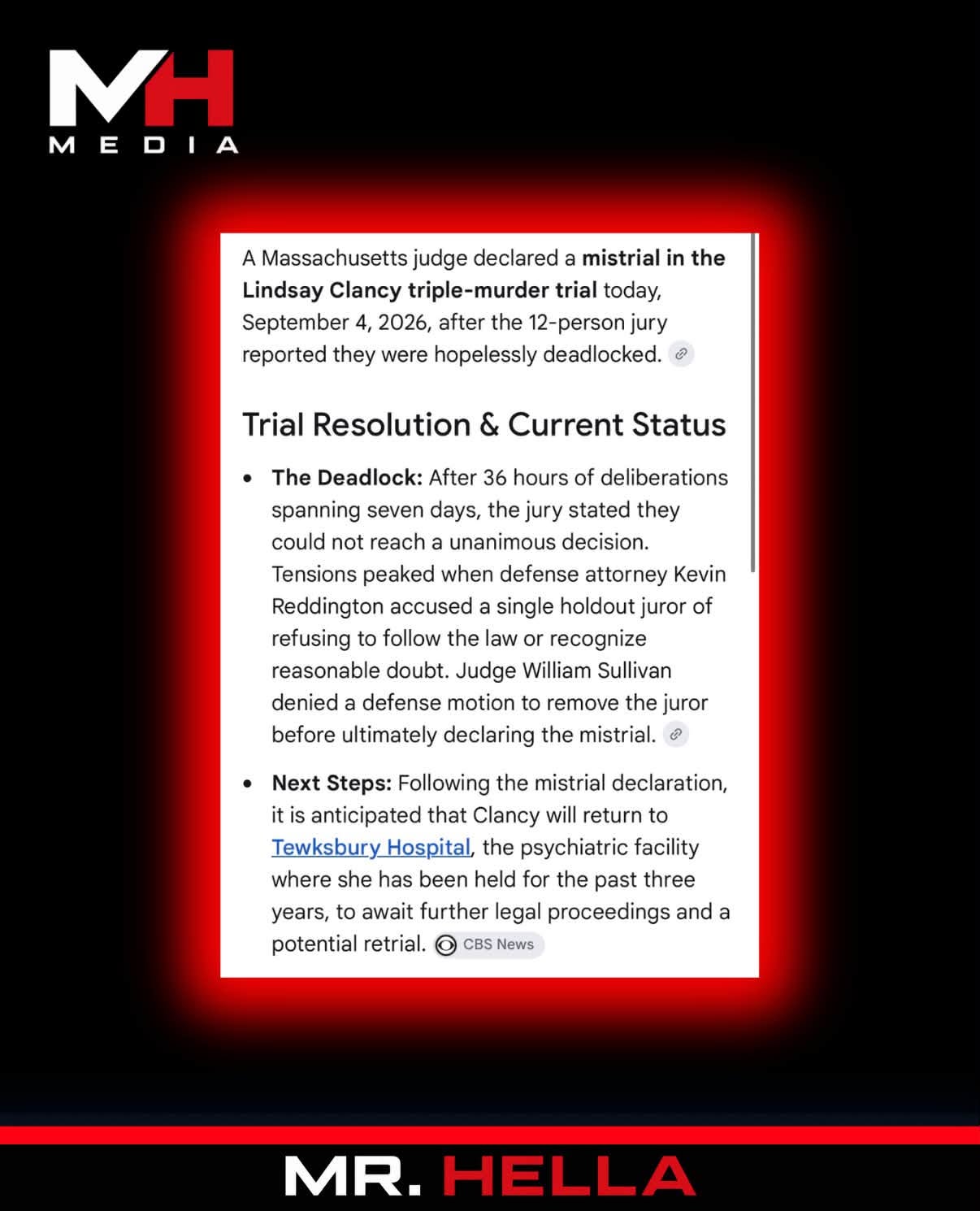
A Massachusetts judge declared a mistrial Friday in the closely watched murder case against Lindsay Clancy after jurors said they remained hopelessly deadlocked over whether the mother should be held criminally responsible for killing her three young children.
Plymouth Superior Court Judge William F. Sullivan formally ended the trial on Sept. 4 after the 12-person jury reported for the third time that it could not reach a unanimous decision. Jurors had spent seven days and nearly 40 hours deliberating following more than five weeks of testimony.
“It is with a heavy heart that we report we are unable to come to a unanimous decision and will not be able to,” the jury wrote in its final note to the court.
Sullivan ultimately concluded that further deliberations were unlikely to produce a verdict.
“I'm going to declare the jury is deadlocked, and I'm going to declare a mistrial,” Sullivan said.
Defense Made Last-Minute Attempt to Stop Mistrial
The mistrial did not become official immediately.
After Sullivan initially announced his intention to end the case, Clancy's lead attorney, Kevin Reddington, asked for time to seek emergency intervention from the Massachusetts Supreme Judicial Court.
The defense argued that the judge should investigate concerns surrounding a holdout juror rather than discharge the entire panel. According to the emergency filing, Clancy's attorneys believed the juror was unwilling to properly apply the court's instructions concerning reasonable doubt.
A single justice of Massachusetts' highest court declined to grant the emergency stay. Sullivan subsequently reconvened court and formally declared the mistrial.
The mistrial means there is no verdict in the case. Clancy has not been acquitted or convicted, and the charges against her remain unresolved.
Case Centered on Clancy’s Mental State
Clancy, 36, is charged with three counts of murder in the January 2023 deaths of her children, Cora, 5, Dawson, 3, and Callan, who was 8 months old.
There was no dispute at trial over whether Clancy killed the children. The central question placed before jurors was whether she was criminally responsible for her actions at the time.
Her defense argued that Clancy was experiencing severe postpartum mental illness, including postpartum psychosis, and therefore lacked criminal responsibility when she killed the children inside the family's Duxbury home.
Prosecutors challenged that defense, arguing that evidence surrounding Clancy's actions demonstrated that she understood what she was doing and knew that it was wrong.
The competing interpretations of Clancy's mental state dominated weeks of testimony from medical experts, family members, investigators and other witnesses.
Ultimately, the jury could not unanimously resolve that question.
What Happens Next Remains Undecided
The mistrial does not automatically end the prosecution.
Because the case concluded without a verdict, prosecutors can seek to try Clancy again. Plymouth County District Attorney Timothy Cruz did not immediately announce whether his office would pursue a second trial following Friday's decision.
The court scheduled another hearing for Sept. 29, when the parties are expected to address the next steps in the case.
That leaves one of Massachusetts' most closely watched criminal cases without a resolution after weeks of testimony and seven days of jury deliberations.
For now, the proceedings end where jurors repeatedly said they had arrived: deadlocked, with neither a guilty verdict nor a finding that Clancy was not criminally responsible for the deaths of her three children.



Comments